


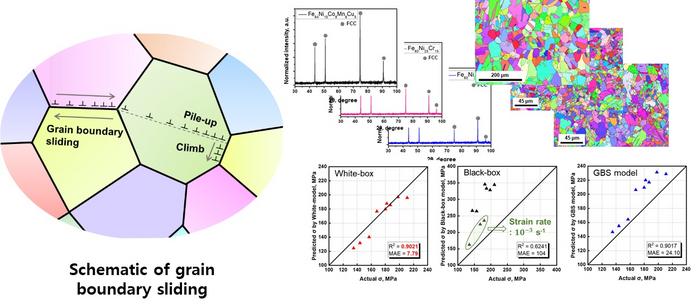
A research team led by Professor Hyoung Seop Kim from the Graduate Institute of Ferrous & Eco Materials Technology and the Department of Materials Science and Engineering and Jeong Ah Lee, a PhD candidate, from the Department of Materials Science and Engineering, in recent collaboration with Professor Figueiredo from Universidade Federal de Minas Gerais’s Department of Metallurgical and Materials Engineering in Brazil, has developed an optimal artificial intelligence model to predict the yield strength of various metals, effectively addressing traditional cost and time limitations. This research has been published in the online edition of Acta Materialia, an international journal for metals and materials engineering.

Credit: POSTECH
A research team led by Professor Hyoung Seop Kim from the Graduate Institute of Ferrous & Eco Materials Technology and the Department of Materials Science and Engineering and Jeong Ah Lee, a PhD candidate, from the Department of Materials Science and Engineering, in recent collaboration with Professor Figueiredo from Universidade Federal de Minas Gerais’s Department of Metallurgical and Materials Engineering in Brazil, has developed an optimal artificial intelligence model to predict the yield strength of various metals, effectively addressing traditional cost and time limitations. This research has been published in the online edition of Acta Materialia, an international journal for metals and materials engineering.
Yield strength is the point at which a material, such as a metal, begins to deform under external stress. In materials engineering, accurately predicting yield strength is crucial for developing high-performance materials and enhancing structural stability. However, predicting this property involves considering numerous variables such as grain size and types of impurities in the material and typically requires extensive experimentation over prolonged periods to gather data.
To address this, the Hall-Petch equation which establishes the relationship between a material’s yield strength and its grain size, is commonly used. However, it has limitations in accurately predicting the yield strength of new materials, considering their specific characteristics and various environmental conditions such as temperature and strain rate.
In this study, the team combined physical theory with artificial intelligence (AI) techniques to enhance accuracy while reducing the cost and time needed to predict yield strength. They developed a machine learning model that applies the mechanism of “grain boundary sliding,” which describes how particles within a material move against each other, along with a machine learning algorithm to predict yield strength.
First, the team employed a black-box model to analyze the impact of various material properties on yield strength. They then developed a white-box model with clear inputs and outputs to enhance the precision of yield strength predictions.
The team validated their model using a variety of iron-based alloys that were not part of the training data for the yield strength prediction model. The results demonstrated that the model was highly accurate with an average absolute error of 7.79 MPa compared to the actual yield strength even when predicting on untrained data.
Professor Hyoung Seop Kim of POSTECH expressed his aspirations, saying, “We have developed a general-purpose AI model that can accurately predict the yield strength of different types of metals and under various experimental conditions.” He added, “We will continue to actively utilize AI technology to make significant advances in materials engineering research.”
The research was conducted with support from the Nano & Material Technology Development Program through the National Research Foundation of Korea (NRF) funded by Ministry of Science and ICT.
Journal
Acta Materialia
Article Title
Unveiling yield strength of metallic materials using physics-enhanced machine learning under diverse experimental conditions
Article Publication Date
1-Jun-2024
Cite Scienmag News
Blake Davidson. (June 28, 2024). The future of metals research with artificial intelligence. Scienmag. https://scienmag.com/the-future-of-metals-research-with-artificial-intelligence/
Blake Davidson. "The future of metals research with artificial intelligence." Scienmag, 28 June 2024, https://scienmag.com/the-future-of-metals-research-with-artificial-intelligence/. Accessed 4 September 2026.
Blake Davidson. "The future of metals research with artificial intelligence." Scienmag. June 28, 2024. https://scienmag.com/the-future-of-metals-research-with-artificial-intelligence/

