


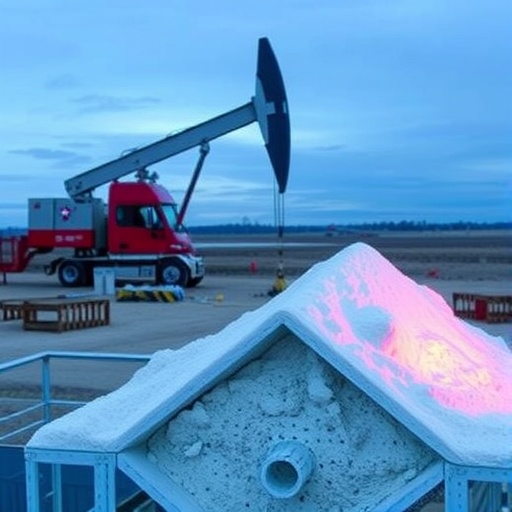
In an age where the intersection of technology and sustainability is increasingly prioritized, innovative solutions in the oil and gas industry are more important than ever. Recent research spearheaded by da Silva and colleagues has focused on the formulation of geopolymers for oil well cementing, particularly utilizing combinations of metakaolin, fly ash, and granulated blast furnace slag. This groundbreaking study holds the potential to reshape conventional practices, greatly impacting both the efficiency of oil extraction processes and environmental sustainability.
Geopolymers are solid materials formed from the polymerization of inorganic aluminosilicate compounds, which makes them suitable for high-performance engineering applications. The authors meticulously explored the properties of various combinations of metakaolin, fly ash, and granulated blast furnace slag in order to enhance the physical and mechanical properties of cement for oil well applications. These materials not only possess substantial mechanical strength but also exhibit robustness in demanding environments, a necessity for any substance used in oil drilling operations.
One of the primary motivations behind this research is the need for more environmentally friendly cement alternatives. Traditional cement production is notorious for its carbon footprint, which has led many researchers to seek alternative solutions. By utilizing industrial by-products like fly ash and granulated blast furnace slag, this approach not only reduces waste but also mitigates the overall environmental concerns associated with cement production. The findings from this study point towards a future where resource efficiency and sustainability can coexist within the oil and gas sector.
The combination of metakaolin and other industrial by-products promises not only to provide a strong binding matrix but also to reduce the energy consumption typically associated with cement production. Metakaolin, derived from kaolin clay, is significantly activated via thermal processes, resulting in a highly reactive pozzolanic material. This activation augments the performance of the blend, leading to enhanced setting times and mechanical properties, which are critical in the often harsh environments of oil drilling operations.
Additionally, the study delves into variabilities in formulation that can directly influence the performance of these geopolymers. By varying the ratios of metakaolin, fly ash, and slag, the authors were able to optimize properties such as compressive strength, setting time, and resistance to harsh chemicals often encountered in oil wells. Their results suggest that diligent manipulation of these variables could lead to the development of tailor-made solutions for specific operational challenges faced in oil extraction.
Crucially, the research emphasizes the role that water-to-binder ratios play in the performance of geopolymer formulations. Too much water can lead to reduced mechanical strength, while too little can hamper workability. The authors conducted rigorous experimental studies to determine optimal ratios, ensuring that their formulations would not only perform well initially but would also maintain their integrity over time under pressure and varying temperatures.
Moreover, the aesthetics of geopolymer binders should not be overlooked. Unlike traditional cements, which are often characterized by a greyish hue, geopolymers can be formulated to present various colors, offering potential advantages for applications where visual appeal is requisite. Though often overshadowed by functional attributes, visual characteristics can play a significant role in customer perceptions and the marketability of products that utilize these innovative materials.
The implications of these findings extend beyond just improving oil well cementing practices. The versatility of geopolymers suggests they could be applied across various sectors, including construction, infrastructure, and even artistic creations. This adaptability points towards a larger trend focused on the globalization of sustainable materials, encouraging the widespread adoption of geopolymers in multiple industries seeking responsible alternatives.
Furthermore, the experimentations in formulation also reveal significant cost implications for the oil and gas industry. Utilizing widely available industrial by-products alleviates the financial burden often associated with purchasing high-quality traditional cement. This financial perspective is particularly appealing to small and medium-sized enterprises operating within the oil sector, who can leverage geopolymers to enhance performance without incurring extensive costs.
In conclusion, as the oil and gas industry grapples with increasing scrutiny regarding its environmental impact, advances such as those presented in this study will be crucial. The careful formulation and utilization of geopolymers derived from metakaolin, fly ash, and granulated blast furnace slag create a unique opportunity to operate sustainably while enhancing performance. As researchers like da Silva continue to pioneer these paths toward a greener future, the ramifications resonate throughout not only the energy sector but the broader conversation regarding sustainability across various industries.
This research sets a foundational precedent for further exploration into geopolymers in other applications, reaffirming the critical role that scientific innovation plays in addressing global challenges. As we progress through 2025 and beyond, such studies may become a benchmark for the convergence of operational excellence and ecological responsibility within the oil and gas industry, catalyzing a profound transformation in engineering practices worldwide.
da Silva, S.M.S., Taborda-Barraza, M., de Andrade Silva, F. et al. Preliminary formulations of geopolymers for oil well cementing application using metakaolin, fly ash and granulated blast furnace slag combinations.
Discov Sustain (2025). https://doi.org/10.1007/s43621-025-02525-7
Cite Scienmag News
Violet Maxwell. (December 31, 2025). Innovative Geopolymers for Oil Well Cementing Applications. Scienmag. https://scienmag.com/innovative-geopolymers-for-oil-well-cementing-applications/
Violet Maxwell. "Innovative Geopolymers for Oil Well Cementing Applications." Scienmag, 31 December 2025, https://scienmag.com/innovative-geopolymers-for-oil-well-cementing-applications/. Accessed 4 September 2026.
Violet Maxwell. "Innovative Geopolymers for Oil Well Cementing Applications." Scienmag. December 31, 2025. https://scienmag.com/innovative-geopolymers-for-oil-well-cementing-applications/


