

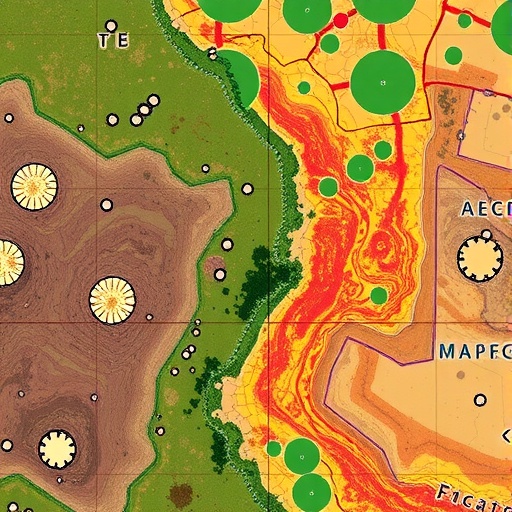
In the realm of environmental science and geospatial analysis, understanding soil characteristics is pivotal. Recent advancements in remote sensing technologies have paved the way for high-resolution monitoring of soil properties. The intricate interplay between soil texture and infiltration rate has garnered significant attention, particularly as it influences agricultural productivity and land management strategies. A groundbreaking study undertaken by Moorthi, Ramalingam, and Sellaperumal et al. proposes a novel approach to digital soil mapping by leveraging spectral covariates derived from an array of satellites, specifically Sentinel 1A, Sentinel 2A, Landsat 8, and PRISMA.
Digital soil mapping emphasizes the importance of accurately characterizing soil properties, which are essential for a multitude of applications ranging from agriculture to environmental monitoring. This study meticulously investigates the efficacy of various satellite-based spectral data to predict the infiltration rate and textural classes of soil. The integration of these diverse data sources offers a comprehensive framework that enhances the accuracy and reliability of soil assessments, which is critical for effective land use planning.
Sentinel satellites, operated by the European Space Agency, are significant contributors to Earth observation capabilities. Sentinel 1A, equipped with synthetic aperture radar, provides vital data regarding soil moisture and surface characteristics. On the other hand, Sentinel 2A, with its multispectral capabilities, enables researchers to capture detailed images of vegetation cover and soil properties. By employing these satellites, researchers can obtain a wealth of information that is integral for understanding the various aspects of the soil environment.
In comparison, Landsat 8 has long been a foundational asset in remote sensing, offering both optical and thermal information essential for ecological and agricultural assessments. Its historical data archive allows scientists to track changes over time effectively. The inclusion of PRISMA, a satellite renowned for its hyperspectral imaging capabilities, adds another layer of precision to the analysis. Hyperspectral imaging facilitates the examination of soil at a molecular level, uncovering subtleties that other imaging techniques might overlook.
The research demonstrates a robust framework for comparing the spectral covariates available from these distinct platforms. The results indicate that by synergizing data from multiple sources, the prediction accuracy of soil infiltration rates and textural classifications can significantly improve. This multi-satellite approach not only enhances the understanding of soil dynamics but also encourages the adoption of more sustainable agricultural practices by providing targeted information to farmers.
Furthermore, the study underscores the importance of incorporating modern technological methodologies into traditional soil science. Conventional soil mapping often relies on limited ground samples and outdated techniques, which may not accurately reflect the heterogeneity present in soils. By innovatively applying remote sensing technology, this research serves as a catalyst for the transformation of soil mapping approaches and reinforces the necessity of embracing advanced techniques for environmental analytics.
Soil infiltration, a crucial factor in hydrology, plays a significant role in determining how water interacts with the land. The capacity of soil to absorb and filter water has direct implications for water quality, runoff potential, and the overall health of ecosystems. Understanding the infiltration characteristics of various soil types is paramount for mitigating issues such as erosion and nutrient leaching, making this research invaluable for environmental stewardship.
In addition to its ecological relevance, the findings of this study hold crucial implications for agricultural productivity. As the global population continues to rise, the demand for efficient and sustainable agricultural practices becomes increasingly critical. By providing farmers with accurate data on soil conditions, they can implement tailored practices that enhance crop yield while minimizing resource waste. The integration of remote sensing data into agricultural decision-making reflects a significant paradigm shift towards data-driven strategies in farming.
The comprehensive assessment presented in this work allows for the creation of detailed soil maps that can be utilized for various land management applications. These maps not only provide crucial insights for local farmers but also aid policymakers and environmental agencies in planning sustainable land use strategies. The accessibility and richness of the data make it easier to address environmental challenges and promote sustainable practices at a broader scale.
One of the most remarkable aspects of the study is its emphasis on collaboration across various scientific disciplines. The multi-faceted approach taken by the researchers, which combines remote sensing technology with soil science, exemplifies the power of interdisciplinary research. Such collaboration can lead to groundbreaking findings and innovative solutions to real-world problems, showcasing how different fields can converge to tackle pressing global issues.
In conclusion, the research conducted by Moorthi, Ramalingam, and Sellaperumal et al. lays the groundwork for further advancements in the field of digital soil mapping. By harnessing the collective strengths of multiple satellite platforms, this study not only enhances the understanding of soil properties but also sets a precedent for future research endeavors. As remote sensing technology continues to evolve, it holds promise for unveiling deeper insights into our planet’s dynamic systems, ultimately paving the way for more sustainable and informed environmental practices.
Through their findings, the authors advocate for the application of advanced remote sensing methods in routine soil assessments, promoting the notion that technology is an ally in pursuing sustainable development goals. As we move into an era dominated by data and technology, the integration of innovative practices in soil mapping will be essential in answering the challenges presented by climate change and population growth.
This groundbreaking study not only aligns with contemporary scientific discourse but also fuels curiosity and engagement within the academic community and beyond. As more researchers explore the intersection of remote sensing and soil science, the potential for discoveries that can revolutionize environmental management strategies is immense.
In our pursuit of knowledge and progress, such research highlights that the tools we have at our disposal can profoundly impact how we understand and interact with the world around us. This study stands not only as a scholarly pursuit but also as a beacon for future endeavors that challenge us to think critically about the natural environment and our role within it.
Moorthi, N., Ramalingam, K., Sellaperumal, P. et al. Comparative assessment of spectral covariates from Sentinel 1 A, Sentinel 2 A, Landsat 8, and PRISMA for digital soil mapping of infiltration rate and textural classes.
Environ Monit Assess 198, 69 (2026). https://doi.org/10.1007/s10661-025-14921-7
Cite Scienmag News
SCIENMAG. (December 26, 2025). Evaluating Satellite Data for Soil Mapping Insights. https://scienmag.com/evaluating-satellite-data-for-soil-mapping-insights/
SCIENMAG. "Evaluating Satellite Data for Soil Mapping Insights." Scienmag, 26 December 2025, https://scienmag.com/evaluating-satellite-data-for-soil-mapping-insights/. Accessed 28 August 2026.
SCIENMAG. "Evaluating Satellite Data for Soil Mapping Insights." Scienmag. December 26, 2025. https://scienmag.com/evaluating-satellite-data-for-soil-mapping-insights/


