


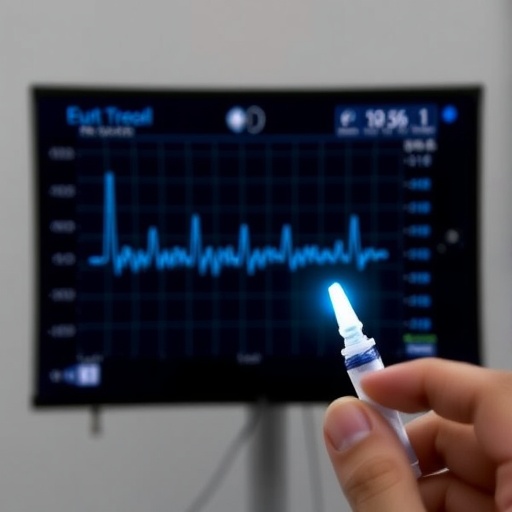
In a groundbreaking advancement poised to revolutionize neurological monitoring, a team of researchers led by Wang, Y., Wang, Z., and Yi, J. has introduced an innovative injectable eutectogel designed to significantly enhance the quality of scalp electroencephalogram (EEG) recordings. This development, detailed in their recent publication in npj Flexible Electronics, promises to overcome longstanding challenges in EEG technology by merging materials science with neuroengineering. The novel injectable gel not only provides superior signal fidelity but also offers a comfortable, minimally invasive alternative to traditional EEG electrodes, potentially transforming both clinical practice and brain research worldwide.
Electroencephalography, a critical tool in diagnosing and studying neurological disorders such as epilepsy and sleep abnormalities, relies heavily on the quality of signal acquisition from the scalp. Conventional electrodes have historically faced hurdles including poor contact quality, interference from the scalp’s natural electrical resistance, and discomfort during prolonged monitoring sessions. These limitations have often resulted in noisy signals and reduced data accuracy, complicating diagnosis and research outcomes. The injectable eutectogel introduced by Wang and colleagues cleverly addresses these issues through the use of a unique phase-change material that transitions from liquid to gel at body temperature.
The formulation of this eutectogel is ingeniously engineered to be injectable in its liquid state, allowing it to permeate the scalp’s surface irregularities and provide intimate contact with the skin’s microtopography. Upon injection, the gel solidifies, maintaining a stable interface with minimal impedance. This phase transition is pivotal in ensuring consistent and high-fidelity EEG signal capture, a striking improvement over existing hydrogel or paste-based electrodes which tend to dry out or shift position during extended use. By maintaining stable electrical properties, the eutectogel facilitates clearer brain wave recordings, enabling finer detection of subtle neural oscillations.
Importantly, the physical and chemical properties of this eutectogel are tailored to be biocompatible and mechanically flexible. Its softness mirrors that of human skin, significantly reducing the sensation of discomfort and irritation common with rigid electrodes. This attribute is especially beneficial for continuous or ambulatory EEG monitoring, allowing patients—whether in a hospital or at home—to maintain natural daily activities without cumbersome hardware. The injectability factor also simplifies electrode application, reducing setup time and obviating the need for extensive hair shaving or skin preparation.
Characterization studies conducted by the research team reveal that the electrical impedance of the eutectogel interface is remarkably low and stable across a wide range of frequencies relevant to EEG data acquisition. This stability ensures minimal signal distortion caused by electrode-skin impedance fluctuations, a chronic problem in standard EEG methodologies. Furthermore, the gel’s self-healing property—its ability to re-solidify after mechanical disruption—allows it to maintain continuous electrical connectivity even when there is slight scalp movement or deformation.
Another groundbreaking aspect of this study is the eutectogel’s multitasking capacity, extending beyond simple signal capture. The gel is imbued with conductive nanoparticles and ionic liquids that enhance signal transduction efficiency and resist dehydration, contributing to prolonged operational time without performance degradation. Such materials innovation pushes the boundary of wearable electronics into realms of sustainable, long-term brain monitoring, empowering new neurodiagnostic and neurofeedback applications.
The clinical implications of this injectable eutectogel cannot be overstated. For patients with epilepsy, traumatic brain injuries, or neurodegenerative diseases, more precise EEG readings can lead to earlier detection of abnormal brain activity and personalized therapeutic interventions. The superior signal quality paired with enhanced patient comfort could also expand EEG use cases in outpatient settings, telemedicine, and even neuroenhancement technologies aimed at brain-computer interfacing.
Beyond clinical applications, this technology offers exciting possibilities for cognitive neuroscience research. Accurate, artifact-free brainwave data facilitates deeper investigations into brain function, neural dynamics, and cognition in natural environments. By removing substantial technical barriers, researchers can now conduct longer, more naturalistic studies, generating higher-resolution data pools that unravel the complexities of human thought, attention, and emotion.
The production and deployment process for this injectable eutectogel is streamlined, leveraging scalable chemical synthesis and injection protocols compatible with existing clinical infrastructure. Its injectable nature offers a distinct logistical advantage compared to bulky or adhesive patches, potentially reducing costs and improving access to advanced neuro-monitoring technologies around the world. The research team also emphasizes the method’s adaptability, anticipating future refinement for integration with other sensing modalities such as functional near-infrared spectroscopy (fNIRS) or electromyography (EMG).
However, as with any new technology, certain challenges remain to be addressed before widespread commercialization. Long-term biostability, potential immune responses, and repeatability in diverse patient populations require further validation through extensive clinical trials. Nonetheless, preliminary safety and efficacy data presented by Wang et al. are promising, suggesting that the injectable eutectogel could soon set new standards in both routine EEG and specialized neural interfaces.
This pioneering study exemplifies an intersection of materials science, bioengineering, and neuroscience, demonstrating how innovative thinking can break barriers in health technology. The research not only highlights the importance of material properties in biomedical device performance but also establishes a new paradigm for non-invasive brain monitoring that minimizes patient burden without compromising data integrity.
Looking forward, the research team envisions the eutectogel’s application extending into personalized medicine, where customized formulations might target specific scalp conditions or patient requirements. Moreover, its potential integration with wireless telemetry and machine learning-driven signal analysis could herald a new era of continuous, real-time brain monitoring that is both ultra-precise and user-friendly.
In conclusion, the injectable eutectogel presented by Wang, Y., Wang, Z., Yi, J., and collaborators marks a transformative leap in EEG technology. By overcoming the technical limitations of traditional scalp electrodes with an intelligently designed phase-change material, this innovation promises improved diagnostic accuracy, enhanced patient comfort, and broadened applicability in both healthcare and neuroscience research. As this technology progresses through the research pipeline, it holds the exciting potential to fundamentally reshape how we interface with the brain, unlocking new possibilities in understanding and treating neurological conditions on a global scale.
Cite Scienmag News
Denise Maddox. (December 22, 2025). Injectable Eutectogel Enables Superior Scalp EEG Monitoring. Scienmag. https://scienmag.com/injectable-eutectogel-enables-superior-scalp-eeg-monitoring/
Denise Maddox. "Injectable Eutectogel Enables Superior Scalp EEG Monitoring." Scienmag, 22 December 2025, https://scienmag.com/injectable-eutectogel-enables-superior-scalp-eeg-monitoring/. Accessed 31 August 2026.
Denise Maddox. "Injectable Eutectogel Enables Superior Scalp EEG Monitoring." Scienmag. December 22, 2025. https://scienmag.com/injectable-eutectogel-enables-superior-scalp-eeg-monitoring/


