


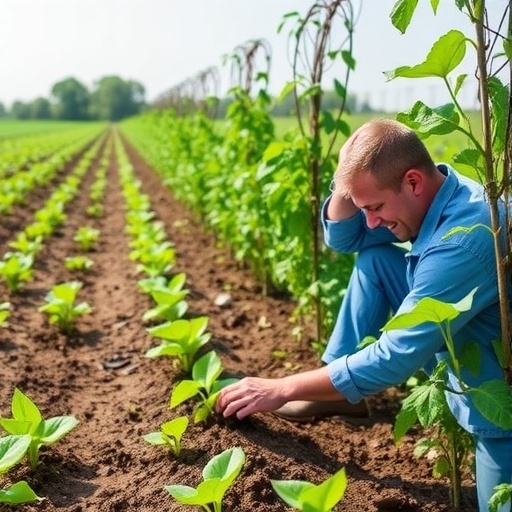
In the face of escalating global temperatures and the growing urgency to secure food production for a burgeoning population, the agricultural sector is under unprecedented pressure to adapt and innovate. A groundbreaking study recently published in Nature Communications unveils how conservation agriculture can significantly boost crop nitrogen acquisition by enhancing the symbiotic interactions between plants and soil microbes, particularly under conditions of climate warming. This discovery opens new avenues for sustainable farming practices designed to maintain soil health and crop productivity in a warming world.
Nitrogen is a fundamental nutrient for plant growth, directly influencing crop yield and quality. However, its availability in soil is often a limiting factor, especially under stressed environmental conditions such as elevated temperatures. Traditional agricultural practices frequently rely on synthetic nitrogen fertilizers, which are energy-intensive to produce and can cause environmental degradation through runoff and greenhouse gas emissions. The study conducted by Hao, Dungait, Shang, and colleagues explores how conservation agriculture—a practice that emphasizes minimal soil disturbance, crop rotation, and cover cropping—can create a more favorable microenvironment that enhances the plant’s ability to acquire nitrogen naturally through plant-microbe interactions.
Central to the researchers’ findings is the concept of plant-microbe synergy. Plants exude a variety of organic compounds through their roots that recruit beneficial microorganisms in the soil. These microbes, including nitrogen-fixing bacteria and mycorrhizal fungi, facilitate the conversion of atmospheric nitrogen or organic nitrogen compounds into forms that plants can absorb and utilize effectively. Under warming scenarios simulated in controlled experimental plots, conservation agriculture was shown to amplify this natural partnership, resulting in increased nitrogen uptake by crops compared to conventional tillage systems.
The experimental design integrated advanced molecular techniques with soil biochemical analyses to dissect the complex interactions occurring at the root-soil interface. High-throughput sequencing allowed the identification of key microbial taxa whose populations surged under conservation agriculture coupled with warming. Notably, the abundance of nitrogen-fixing bacteria like Rhizobium and Azospirillum increased substantially, correlating with elevated plant nitrogen content. These findings underscore the potential for targeted agricultural management to harness and optimize beneficial microbial communities as a climate-adaptive strategy.
Further, the research highlights the role of soil organic matter and its management in sustaining microbial activity. Conservation agriculture practices tend to preserve higher levels of organic residues on the soil surface, which serve as both habitat and nutrient sources for microbes. This protective mantle not only mitigates temperature fluctuations at the soil surface but also maintains moisture levels crucial for microbial metabolism, thus enhancing the microbial-mediated nutrient cycling under warming conditions. The cumulative effect is a positive feedback loop where improved soil microbial health translates directly into crop nutritional benefits.
Addressing the challenges posed by rising temperatures on crop nitrogen dynamics, the study offers compelling evidence that conservation agriculture equips agroecosystems with resilience. The traditional view that warming invariably exacerbates soil nitrogen losses is nuanced here; through fostering plant-microbe synergy, conservation practices mitigate these detrimental effects and can even enhance nitrogen use efficiency. This is particularly significant given the predicted increase in global food demand and the imperative to reduce dependency on synthetic fertilizers for environmental sustainability.
A further dimension of the study involves the examination of root architecture modifications under conservation agriculture. Enhanced root proliferation and deeper root systems were observed, which facilitate greater soil exploration and access to nitrogen pools otherwise unavailable to shallow-rooted crops. These root system adaptations appear to be stimulated by the improved microbial environment, indicating a tightly coupled system where physical, biological, and chemical soil properties interact to optimize nutrient acquisition.
Moreover, the study’s integrated approach sheds light on the molecular signaling pathways that underpin plant-microbe communication. Specific gene expression profiles associated with nitrogen uptake and microbial colonization were upregulated under conservation agriculture in warmed soils. These molecular insights provide a mechanistic understanding that can guide future biotechnological interventions aimed at breeding crops better suited for a warming world with reduced fertilizer inputs.
The implications of this research extend beyond nitrogen dynamics alone. By promoting a healthy soil microbiome, conservation agriculture also contributes to improved carbon sequestration, soil structure, and water retention, all of which are vital for the sustainability of agricultural landscapes amidst climate change. Thus, the multifaceted benefits underscore conservation agriculture’s role as a cornerstone strategy for climate-smart agriculture and sustainable food systems.
Implementing these findings on a global scale could transform agricultural practices, particularly in regions most vulnerable to climate change impacts. Policymakers and agricultural stakeholders are encouraged to integrate conservation agriculture principles with local knowledge and technological innovation to optimize nitrogen management and enhance crop resilience. Education and technical support systems will be essential to facilitate this transition and to maximize the potential benefits documented in this study.
In conclusion, Hao and colleagues’ research marks a significant advancement in our understanding of how agroecosystem management can leverage biological processes to combat the challenges posed by a warming climate. By amplifying plant-microbe synergy through conservation agriculture, crop nitrogen acquisition is not only preserved but enhanced, thereby securing crop productivity and environmental integrity. This development exemplifies a promising pathway toward sustainable intensification in agriculture, harmonizing productivity goals with ecological stewardship.
As climate change continues to reshape global agricultural landscapes, studies like this become indispensable guides. They not only elucidate complex ecological interactions but also provide actionable insights to redefine food production paradigms. Conservation agriculture emerges not just as a practice but as a vital strategy to safeguard the future of world food security in the face of unprecedented environmental change.
The synergy between plants and microbes illuminated in this study calls for a broader recognition of below-ground biodiversity as a critical component of sustainable agriculture. Future research directions hinted by the authors involve exploring the scalability of these findings across different crop species and agroecological zones, as well as the long-term impacts on soil health and ecosystem services.
Ultimately, this paradigm shift towards integrating biological insights with agronomic practices could pave the way for revolutionary advancements in agricultural resilience. By championing the role of microbial communities in nutrient cycling, conservation agriculture holds the potential to reconcile the often conflicting demands of high yield and environmental conservation, forging a sustainable path forward in a warming world.
Cite Scienmag News
Alan Morgan. (December 11, 2025). Conservation Agriculture Boosts Crop Nitrogen via Microbes. Scienmag. https://scienmag.com/conservation-agriculture-boosts-crop-nitrogen-via-microbes/
Alan Morgan. "Conservation Agriculture Boosts Crop Nitrogen via Microbes." Scienmag, 11 December 2025, https://scienmag.com/conservation-agriculture-boosts-crop-nitrogen-via-microbes/. Accessed 3 September 2026.
Alan Morgan. "Conservation Agriculture Boosts Crop Nitrogen via Microbes." Scienmag. December 11, 2025. https://scienmag.com/conservation-agriculture-boosts-crop-nitrogen-via-microbes/


