


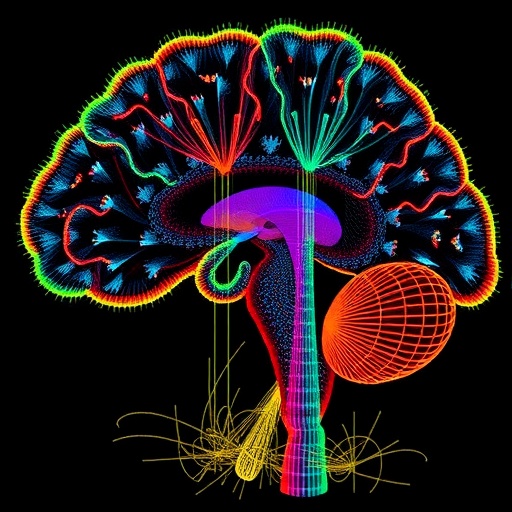
In a groundbreaking study published in Nature Neuroscience in 2025, researchers have unveiled an unprecedented level of detail in understanding the developmental intricacies of the prefrontal cortex in humans and macaques. The team, led by Zhang, Li, and Wang, employed cutting-edge single-cell spatiotemporal transcriptomic and chromatin accessibility profiling to explore how gene regulation unfolds over time and space during postnatal brain development. This meticulous work sheds new light on the molecular underpinnings governing the maturation of one of the most complex and evolutionarily significant regions of the brain.
The prefrontal cortex, known for its integral role in executive functions such as decision making, social behavior, and cognitive flexibility, has long fascinated neuroscientists. Despite its critical importance, the precise temporal and spatial dynamics of molecular changes leading to its mature state have remained elusive. This study moves the field forward by harnessing multi-omic single-cell technologies to capture the nuances of both transcriptomic and chromatin landscapes as development progresses.
At the heart of this investigation lies the innovative integration of spatial transcriptomics with chromatin accessibility assays performed at the single-cell level. By doing so, the researchers have been able to correlate gene expression states with the underlying epigenetic architecture across discrete developmental time points and in the detailed anatomical context of the developing cortex. This dual approach enables an unprecedented resolution of how cellular identities are established and maintained during critical periods of brain maturation.
The researchers focused their analysis on postnatal stages — a period marked by rapid and dynamic restructuring of neural circuits. Their choice to include both human and macaque brains in the study further allows for comparative insights, enhancing our understanding of species-specific versus conserved developmental mechanisms. Such comparative work is especially important given the evolutionary proximity of macaques to humans and their widespread use as models for human brain function and disorders.
One of the most compelling findings revealed distinct trajectories of gene expression programs that are tightly coupled with changes in chromatin accessibility. This coupling appears to orchestrate the differentiation and specialization of cortical neurons and glial cells, highlighting the complexity of gene regulatory networks at play. These gene networks underpin defining features of cortical circuitry, including the establishment of synaptic connections and the pruning processes essential for functional maturation.
Moreover, the spatial dimension of the data unveiled intriguing region-specific patterns. Different prefrontal cortical subregions showed unique molecular signatures and epigenomic states, which likely correspond to their specialized roles within the wider prefrontal network. This spatial heterogeneity underscores the importance of studying brain development within an anatomical framework, as opposed to bulk analyses that often obscure such fine-grained regional distinctions.
Chromatin accessibility profiling illuminated critical zones of regulatory elements—enhancers and promoters—that dynamically change their activity during key developmental windows. Understanding when and where these regulatory elements operate provides vital clues into how transcriptional programs are modulated and how disruptions in these processes could lead to neurodevelopmental disorders.
The data also highlighted cellular heterogeneity and lineage relationships within the developing cortex. By mapping single-cell transcriptomes alongside chromatin states, the team could reconstruct developmental trajectories and pinpoint critical decision points where progenitor cells diverge into specific cortical neuron subtypes. This molecular roadmap beautifully illustrates the stepwise maturation process and could inform strategies for therapeutic interventions or stem cell-based regenerative approaches.
Importantly, the study offers a critical resource: an integrated spatiotemporal atlas of transcriptomic and epigenetic landscapes in the developing primate brain. This reference atlas stands to profoundly impact future efforts to understand neurodevelopmental disorders such as autism spectrum disorder, schizophrenia, and other cognitive dysfunctions rooted in early brain development. It provides a benchmark against which pathological changes can be measured.
In terms of methodology, the combination of high-throughput sequencing technologies and spatial transcriptomics platforms represents a powerful convergence of technological advances. These approaches allow not only the profiling of thousands of individual cells but also their localization within intact tissue architecture. The researchers’ data analysis pipeline, leveraging advanced computational frameworks, ensures robust integration and interpretation of these complex datasets.
Additionally, by studying both human and macaque postnatal development, the authors contribute to evolutionary neuroscience. Their comparative approach enables identification of conserved regulatory circuits as well as species-specific adaptations that may underlie unique cognitive and behavioral traits of primates. This sets the stage for unraveling the evolutionary pressures shaping higher-order brain functions.
This work also has implications for understanding the timing of critical developmental periods. The spatiotemporal maps provide insights into when certain gene regulatory programs are activated or repressed, which correlates with known windows of heightened plasticity and vulnerability in the prefrontal cortex. Such knowledge could inform the timing of interventions to optimize neurodevelopmental outcomes.
Notably, the dual focus on transcriptomics and chromatin accessibility helps disentangle cause-and-effect relationships, clarifying whether gene expression changes are driven by epigenetic remodeling or vice versa. This mechanistic clarity goes beyond correlation and lays the groundwork for targeted manipulation of gene regulatory elements in future studies.
While the study concentrates on the postnatal phase, the authors acknowledge that extending these analyses to prenatal stages and later adulthood could provide a full developmental continuum. Moreover, including pathological samples from individuals with neurodevelopmental disorders could reveal specific molecular derailments contributing to disease.
In summary, this landmark study pushes the frontier of brain developmental biology by integrating spatial and temporal dimensions of gene regulation at single-cell resolution in primates. The resulting comprehensive atlas of transcriptomic and chromatin accessibility landscapes in the postnatal prefrontal cortex offers a transformative tool for neuroscience research, with far-reaching implications for understanding brain evolution, development, and disease.
The findings highlight the intricate choreography of genetic and epigenetic factors guiding the maturation of the prefrontal cortex. This work not only deepens our insight into fundamental brain biology but also underscores the power of multi-omic single-cell approaches to unlock the mysteries of complex neuronal systems. As the field continues to evolve, such integrative studies are poised to reshape our understanding of the brain’s developmental blueprint and open new avenues for therapeutic innovation.
Cite Scienmag News
Cassandra Pierce. (December 11, 2025). Single-Cell Maps Reveal Developing Primate Brain Dynamics. Scienmag. https://scienmag.com/single-cell-maps-reveal-developing-primate-brain-dynamics/
Cassandra Pierce. "Single-Cell Maps Reveal Developing Primate Brain Dynamics." Scienmag, 11 December 2025, https://scienmag.com/single-cell-maps-reveal-developing-primate-brain-dynamics/. Accessed 3 September 2026.
Cassandra Pierce. "Single-Cell Maps Reveal Developing Primate Brain Dynamics." Scienmag. December 11, 2025. https://scienmag.com/single-cell-maps-reveal-developing-primate-brain-dynamics/


