


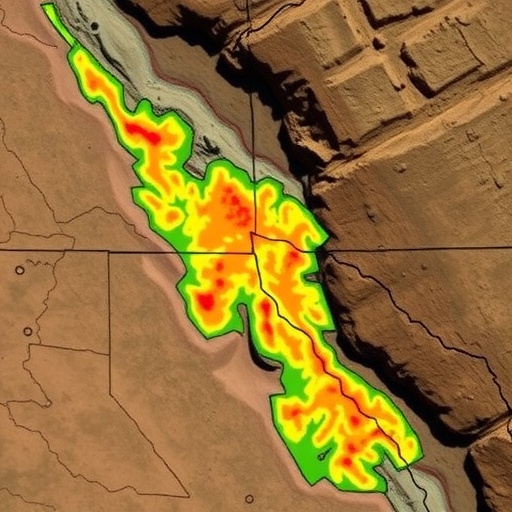
Recent advancements in mineral exploration have led researchers to focus on modulated mineral prospectivity mapping as a tool for uncovering valuable orogenic gold deposits. In a pioneering study spearheaded by Mutele and Carranza, the spotlight is placed squarely on the Pietersburg Greenstone Belt in South Africa, a region ripe with geological complexity and untapped potential. Their work illustrates how a mineral systems approach can substantially enhance exploration targeting, ultimately aiding in identifying areas with higher probabilities of gold mineralization.
Mutele and Carranza delve into the intricacies of gold mineralization, particularly emphasizing the geological conditions fostering its occurrence. Orogenic gold deposits, formed during tectonic processes, are often situated within deformed greenstone belts, characterized by ancient volcanic and sedimentary rocks. The study outlines how understanding the spatial distribution of these formations correlates with the likelihood of gold deposits, offering a scientific basis for mineral exploration that combines historical geology with contemporary geophysical methods.
Central to this research is the implementation of a modulated prospectivity mapping technique that incorporates various geological and geochemical parameters. This multifaceted approach allows for a more holistic view of the mineralization processes at play. The authors meticulously detail how factors such as tectonic settings, rock types, and alteration patterns can be integrated into a predictive model. By processing these parameters using advanced algorithms, they identified zones that exhibit enhanced potential for gold mineralization.
Furthermore, the study illustrates the significant role of a mineral systems approach in transforming traditional exploration methodologies. Not only does this approach streamline data collection and analysis, but it also maximizes the efficacy of exploration efforts by pinpointing specific regions for further investigation. Mutele and Carranza present compelling evidence showing that integrating system-level thinking with localized geological insights can lead to more successful outcomes in resource discovery.
At the core of their findings lies a robust examination of the Pietersburg Greenstone Belt itself. Rich in geological history, this region presents an array of structures conducive to gold formation. By mapping these structures and assessing their attributes, the authors can infer where gold is most likely to reside. The study emphasizes that the strategic evaluation of geological formations can unveil hidden exploration opportunities that may have otherwise gone unnoticed.
The paper’s findings resonate with the growing need for innovative approaches in mineral exploration, particularly in regions where traditional methods have failed to yield satisfactory results. As the demand for gold continues to rise, the study highlights the urgency for mining companies to adopt more scientifically rigorous techniques, such as the modulated prospectivity mapping presented by Mutele and Carranza.
Anchored in comprehensive field studies and real-world application, the authors bolster their claims with an array of data supporting the effectiveness of their model. By meticulously analyzing past mineralization events and geological developments, the paper draws parallels that justify the predictive power of their mapping technique. Case studies from other gold-bearing regions lend credence to their approach, suggesting that a shift towards a mineral system perspective can yield high rewards.
Moreover, the implications of this research extend beyond mere mineral exploration. It also raises critical questions about sustainable mining practices and environmental stewardship. As exploration intensifies, the balance between resource extraction and ecological preservation becomes increasingly vital. The authors advocate for responsible exploration methodologies, emphasizing that utilizing science-driven approaches can help mitigate the environmental impacts often associated with mining.
Equipped with these insights, the mining industry faces a transformative period where data science and geology converge. Mutele and Carranza’s research serves as a pivotal reference, showcasing how integrating mineral systems thinking with advanced mapping techniques can redefine resource exploration. The study not only captures the potential for discovering new gold deposits but also heralds a new era for mineral exploration technologies.
In conclusion, the study of Mutele and Carranza presents an innovative lens through which we can understand gold mineralization in complex geological terrains. Their emphasis on a modulated mineral prospectivity mapping technique marks a significant step forward in mineral exploration strategies, particularly within the context of orogenic gold deposits. As the scientific community continues to refine these methodologies, one can anticipate a remarkable shift in the mining industry, driven by data-driven insights and a deeper appreciation for mineral systems.
This research not only enhances our understanding of mineral deposits but sets the stage for future investigations that blend geological science with technological advancements. The journey towards more sustainable and effective mineral exploration is ongoing, as scholars and mining professionals alike strive to unravel the secrets buried within the Earth’s crust. Through the lens provided by Mutele and Carranza, the path forward is illuminated, promising exciting developments in the realm of ore discovery.
Their findings are an essential call to action for geologists and mining companies, stressing the importance of melding traditional exploration techniques with modern, data-rich methodologies. This study serves as a blueprint for future exploration initiatives, underscoring the notion that the next major gold discovery could be just beyond the horizon, awaiting those equipped with the right tools and insights.
In summary, the intersection of advanced geological mapping and mineral systems thinking provides a pathway to uncovering previously inaccessible resources. Mutele and Carranza’s work highlights the necessity for a scientific approach in a rapidly evolving mining landscape, where the insights gleaned from complex geological data can drive success in exploration missions across the globe.
Opportunity awaits those ready to embrace scientific innovation in mining, and the Pietersburg Greenstone Belt stands as a case study rich with revelations and potential discoveries.
Cite Scienmag News
Violet Maxwell. (December 11, 2025). Mapping Gold Potential in Pietersburg Greenstone Belt. Scienmag. https://scienmag.com/mapping-gold-potential-in-pietersburg-greenstone-belt/
Violet Maxwell. "Mapping Gold Potential in Pietersburg Greenstone Belt." Scienmag, 11 December 2025, https://scienmag.com/mapping-gold-potential-in-pietersburg-greenstone-belt/. Accessed 5 September 2026.
Violet Maxwell. "Mapping Gold Potential in Pietersburg Greenstone Belt." Scienmag. December 11, 2025. https://scienmag.com/mapping-gold-potential-in-pietersburg-greenstone-belt/


