


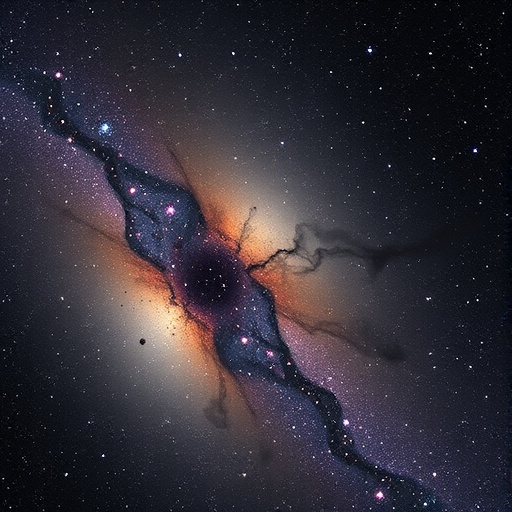
In a groundbreaking study published in Nature Astronomy, astronomers and cosmologists have uncovered compelling new evidence linking the morphology of distant galaxies to the nature of the dark matter that permeates the universe. Using state-of-the-art hydrodynamical simulations and the latest deep-space imaging from the James Webb Space Telescope (JWST) and the Hubble Space Telescope (HST), the researchers have revealed that the elongated, prolate shapes observed in young galaxies at redshifts greater than three (z > 3) owe their origins to the intrinsic smoothness and structure of the cosmic web’s underlying dark matter filaments. This transformative work sheds new light on the fundamental role dark matter plays in shaping the earliest visible structures in our cosmos.
Galaxies do not form randomly; rather, they emerge amid an intricate network of dark matter filaments formed during the initial gravitational collapse in the universe’s infancy. This filamentary skeleton, made invisible by its nature yet discernible through gravitational effects, guides the accretion of gas and dark matter, ultimately influencing galaxy formation and evolution. Until recently, our understanding of how dark matter properties affect galaxy morphology during these primordial epochs was constrained by observational limits and theoretical uncertainties. Leveraging unparalleled computational simulations in conjunction with cutting-edge observational campaigns, the research team has now bridged this critical knowledge gap.
The study undertakes a comparative analysis of three leading dark matter models: cold dark matter (CDM), warm dark matter (WDM), and wave or fuzzy dark matter (ψDM). These models differ fundamentally in particle properties, affecting the formation and smoothness of the cosmic web. For decades, the CDM paradigm has dominated cosmological models, predicting a clumpy filamentary structure where fragmented filaments and frequent subhalo mergers sculpt predominantly spheroidal stellar structures. However, emerging inconsistencies with observations have led researchers to explore alternatives like WDM and ψDM, which predict smoother cosmic filaments and fewer small-scale structures.
To rigorously test these theoretical predictions, the researchers executed extensive hydrodynamical simulations with volumes exceeding 10^3 Mpc/h^3, sufficient to produce galaxies with stellar masses above 10^9 solar masses at z > 2. This scale allowed a statistically significant comparison with observations from the Cosmic Evolution Early Release Science (CEERS) and Cosmic Assembly Near-infrared Deep Extragalactic Legacy Survey (CANDELS). The results from simulations incorporating WDM aligned strikingly with the observed predominance of elongated, prolate-shaped galaxies, reflecting formation along smooth, coherent filaments within the first 500 million years of cosmic history.
Contrastingly, CDM-based simulations yielded galaxies with mainly spheroidal morphologies, formed through the merging of fragmented filaments that generate dynamically complex environments. These mergers produce a clumpy subhalo distribution, resulting in a variety of stellar shapes but rarely matching the observed elongated forms prevalent in the early universe. The ψDM scenario, while sharing some similarities with WDM in producing smoother filaments, predicts even less early merging, further supporting the notion of filament smoothness playing a dominant role in shaping early galaxy geometry.
One of the most profound conclusions from this research is that the stellar morphologies of young galaxies and their sizes are exquisitely sensitive to the fine-scale smoothness of the underlying dark matter structures. This sensitivity acts as a unique observational constraint on the physical nature of the dark matter particle itself, offering an indirect but powerful probe that complements other techniques such as gravitational lensing and cosmic microwave background studies.
Among the key observational campaigns informing this work are the JWST’s unparalleled deep-space imaging capabilities, surpassing previous HST observations in resolution and sensitivity. JWST’s observations of galaxies across different epochs, particularly beyond redshift 3, have revealed a surprising excess of prolate-shaped galaxies—elongated rather than the expected round or disk-like early galactic configurations. Capturing these shapes across diverse stellar masses strengthens the argument for filament-driven growth under certain dark matter conditions rather than mergers dominating morphological evolution.
The simulation framework incorporated realistic gas dynamics, star formation, and feedback mechanisms to replicate observable properties such as stellar mass and morphology robustly. By tuning these simulations against the CEERS and CANDELS surveys, the researchers ensured their predictive power for galaxy shapes at cosmic dawn. This synergy between simulation and observation marks a significant advancement in cosmological modeling, moving beyond mere population statistics to detailed morphological fingerprinting of the early universe.
Furthermore, the paper’s findings challenge conventional wisdom that heavily favors CDM, providing strong motivation for reevaluating dark matter candidates consistent with warm or wave-like particle properties. It is noteworthy that the WDM scenario’s predictive success in reproducing observed galaxy elongations arises because smooth accretion along uninterrupted filaments prevents premature fragmentation, fostering the formation of extended prolate stellar systems rather than spheroidally dominated structures.
An additional implication concerns the predicted visibility of subhaloes within early galaxy systems. While CDM anticipates multiple luminous subhaloes resulting from frequent mergers and filament breakups—features that should be detectable in high-resolution deep field imaging—the observed dearth of such subhaloes favors the smoother filament realization in WDM or ψDM frameworks. This further corroborates the hypothesis that early cosmic structures’ texture is a direct window into dark matter behavior at sub-galactic scales.
These insights evoke broader consequences for galaxy formation theory and the interpretation of cosmic large-scale structure data. If early morphology is indeed intimately related to dark matter smoothness, models will need to integrate filamentary network dynamics more holistically, accounting for environmental influences on baryonic collapse and subsequent star formation. Such integration might redefine our understanding of galaxy maturation pathways, from early elongated progenitors into the diverse morphologies observed today.
Anticipated follow-up studies are expected to refine the parameter space for WDM and ψDM particle mass and interaction models, using morphological statistics as a guiding metric. Additional JWST observational programs pushing deeper into the cosmic dawn era, along with adaptive optics-enhanced ground-based telescopes, will provide even sharper morphological catalogs to benchmark simulations. The interplay of multi-wavelength data, including radio and X-ray emissions tracing energetic feedback and gas inflows, will enrich these morphological analyses.
Critically, these developments underscore the transformative power of marrying theoretical physics with observational cosmology. The detection, quantification, and interpretation of galactic shape distributions are evolving into a precision tool alongside other dark matter probes, potentially guiding us to uncover the fundamental particles weakly interacting yet ubiquitously shaping our cosmos. This intersection opens promising avenues to address longstanding enigmas, like the ‘missing satellites problem’ and core-cusp distribution inconsistencies that have long puzzled astronomers.
This work also highlights the JWST’s pivotal contribution to resolving early universe mysteries, providing unprecedented clarity into galaxy morphology and cosmic web characteristics. With each new imaging campaign and simulation refinement, the contours of our dark matter understanding become more vivid yet intriguingly complex, inviting deeper exploration into the universe’s first billion years.
In essence, the advent of detailed structural analysis of early galaxies propels us closer to unveiling the dark sector’s elusive nature. By tracing how galaxies’ shapes are forged by the invisible scaffolding of dark matter filaments, scientists gain a novel investigative dimension, one that transcends traditional dynamical or luminous measures. This study thus represents a significant leap forward in cosmology, blending computational innovation, observational prowess, and theoretical insight to decode the universe’s formative epochs.
With the landscape of galaxy formation permanently altered by these revelations, the quest to identify dark matter’s true identity gains fresh impetus. The identification of filament smoothness as a distinguishing cosmic signature paves the way for refined experiments and theoretical models, inching us toward solving one of modern science’s most profound puzzles: what is the universe largely made of if not the familiar matter we see? The answers unfolding may well redefine physics as we know it.
Cite Scienmag News
Grant Pearson. (December 8, 2025). Smooth Filament Origins of Distant Prolate Galaxies. Scienmag. https://scienmag.com/smooth-filament-origins-of-distant-prolate-galaxies/
Grant Pearson. "Smooth Filament Origins of Distant Prolate Galaxies." Scienmag, 8 December 2025, https://scienmag.com/smooth-filament-origins-of-distant-prolate-galaxies/. Accessed 3 September 2026.
Grant Pearson. "Smooth Filament Origins of Distant Prolate Galaxies." Scienmag. December 8, 2025. https://scienmag.com/smooth-filament-origins-of-distant-prolate-galaxies/


