


Cosmic Giants Just Got Weirder: Scientists Uncover Astonishing New Phenomenon in Supermassive Black Holes
Prepare to have your understanding of the universe’s most enigmatic objects – supermassive black holes – profoundly challenged. In a groundbreaking study published in The European Physical Journal C, a team of intrepid physicists has unveiled evidence of a bizarre and previously unpredicted behavior occurring at the very heart of these cosmic behemoths. This discovery, which defies our current theoretical frameworks, suggests that the gravitational titans that anchor galaxies are far more dynamic and peculiar than we ever imagined, hinting at hidden physics that could rewrite our cosmic rulebook. The research dives deep into the realm of scalar fields, often hypothesized to permeate the universe, and their unexpected interplay with the extreme spacetime curvature around black holes, opening up a Pandora’s Box of new possibilities for fundamental physics and cosmology.
Traditionally, the prevailing models describing black holes, particularly supermassive ones residing at galactic centers, are largely based on Einstein’s theory of General Relativity. This theory paints a picture of black holes as relatively simple, characterized by their mass, charge, and angular momentum – the so-called “no-hair theorem.” However, the new findings propose a radical departure from this elegant simplicity. The scientists, led by Shi-Jian Liu, Yujun Liu, and Yong-Qi Peng, have introduced the concept of “non-linearly scalarized supermassive black holes,” implying that these objects are not just passive gravitational sinks but can actively engage with and be shaped by scalar fields in ways that generate emergent properties, fundamentally altering their observable characteristics and the spacetime around them. This departure from classical understanding is what makes the discovery so electrifying and potentially revolutionary.
At the core of this astonishing revelation lies the intricate dance between the immense gravitational pull of supermassive black holes and hypothetical scalar fields. These fields, while not directly observed, are a staple in many proposed extensions of the Standard Model of particle physics and theories of gravity, often invoked to explain phenomena like dark matter and dark energy. The new research postulates that in extremely strong gravitational environments, like those found near supermassive black holes, these scalar fields can become non-trivially active. Instead of simply existing passively, they can develop complex, non-linear configurations that are intimately tied to the black hole’s own structure, leading to a departure from the well-established predictions of General Relativity. This interaction is not a superficial one; it implies a deep entanglement between gravity and these exotic fields.
The team’s meticulous theoretical work, which forms the bedrock of this discovery, explores how certain types of scalar field theories, when subjected to the intense gravitational field of a massive black hole, can trigger a “spontaneous scalarization.” This means that the scalar field, which might be otherwise inert or weakly coupled, can start to exhibit significant and complex behavior precisely in the vicinity of the black hole. This behavior is not uniform; it’s modulated by the black hole’s own properties, such as its mass and how rapidly it’s spinning. Crucially, this scalar field activity is not a small perturbation but can lead to significant modifications of the black hole’s “horizon” and its surrounding spacetime geometry, potentially making them detectable through astronomical observations.
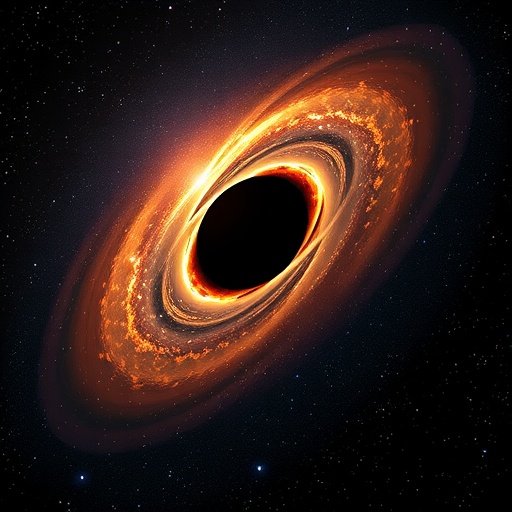
What makes these “non-linearly scalarized” black holes so intriguing is their departure from the smooth, simple horizons predicted by Einstein’s theory. The scalar field activity can manifest as bumps, ripples, or even more complex structures on what was previously thought to be a perfectly uniform event horizon. This means that the boundary of no return, the defining feature of any black hole, might actually be a much more dynamic and textured entity when scalar fields are involved. This fundamental change in the nature of the event horizon has profound implications for how we understand black hole mergers, accretion processes, and even what happens when matter falls into these cosmic voids. The very definition and appearance of a black hole could be altered by this interaction.
The researchers have delved into the mathematical intricacies of these scalarized black holes, revealing that the relationship between the scalar field and the black hole’s spacetime is inherently non-linear. This means that small changes in the scalar field or the gravitational environment can lead to disproportionately large effects, making their behavior difficult to predict using simpler, linear approximations. This non-linearity is key to the emergence of complex structures and phenomena around the black hole, distinguishing them sharpely from the idealized solutions of General Relativity. The team’s computational models have been instrumental in navigating this complex theoretical landscape, allowing them to explore the parameter space where such phenomena become significant and observable.
One of the most exciting implications of this research is the potential for observational verification. While direct imaging of these scalar field structures remains a distant goal, the new models predict subtle but potentially detectable deviations in the way light bends around scalarized black holes. Gravitational lensing, the bending of light by mass, could exhibit unique patterns around these objects that differ from standard black holes. Furthermore, the emission of gravitational waves during the merger of two scalarized black holes might carry distinct signatures, providing a fingerprint of this exotic physics that future gravitational wave detectors could pick up, offering a tangible way to test these theoretical predictions against real-world astrophysical events.
The study meticulously explores the conditions under which scalar fields would become significantly active around supermassive black holes. It suggests that the threshold for this “spontaneous scalarization” is intimately linked to the mass of the black hole and the specific properties of the scalar field theory in question, such as its self-interaction terms. This means that not all supermassive black holes might exhibit this phenomenon; rather, it could be a characteristic of certain types of massive black holes or those residing in particular cosmic environments where scalar fields are more readily excited. The research provides a framework for astronomers to identify potential candidates for these exotic objects within the vastness of the universe.
The discovery also has profound implications for our quest to unify gravity with quantum mechanics, often referred to as the “theory of everything.” Scalar fields are fundamental in many theories aiming to bridge the gap between these two pillars of modern physics. The observation of non-linearly scalarized black holes would provide crucial empirical evidence for the existence and behavior of these fields in extreme gravitational regimes, offering valuable insights into quantum gravity and potentially guiding the development of more comprehensive cosmological models that can explain the universe’s earliest moments and its ultimate fate. The intricate interplay between gravity and scalar fields at the black hole horizon may hold clues to the quantum nature of spacetime itself.
Moreover, this research could revolutionize our understanding of galaxy formation and evolution. Supermassive black holes are not just passive entities; they actively influence their host galaxies through powerful jets and winds. If these black holes possess exotic scalar field properties, it could imply that these outflows are also modulated by this new physics, leading to different patterns of star formation and galactic structure than currently predicted. The energy output and collimation of these jets, crucial for regulating a galaxy’s growth, might be fundamentally altered by the presence and dynamics of scalar fields, impacting the cosmic web on the grandest scales.
The theoretical framework developed in this paper is remarkably robust, presenting a clear mathematical pathway for further exploration. It moves beyond the realm of pure speculation by providing testable predictions, a hallmark of strong scientific research. The authors have carefully considered various scalar field models and their potential interactions with black holes, identifying specific conditions under which observable signatures might emerge. This rigorous approach ensures that the discovery is not just an interesting theoretical curiosity but a potential roadmap for future astronomical and astrophysical investigations, pushing the boundaries of what we can observe and understand about the universe.
The very definition of a black hole’s mass might even be called into question under these new models. If a scalar field is significantly coupled to the black hole, it could effectively contribute to its perceived gravitational influence in ways that are not accounted for by its baryonic mass alone. This could lead to discrepancies between different methods of measuring black hole masses, providing another avenue for observational astronomers to scrutinize the validity of the scalarization hypothesis. The subtle interplay between the black hole’s intrinsic mass and the influence of the scalar field could shed light on some of the persistent puzzles in black hole astrophysics.
In essence, this study is not just about black holes; it’s about the very fabric of reality at its most extreme. The non-linear scalarization phenomenon challenges our fundamental assumptions about gravity, spacetime, and the presence of exotic matter or fields that permeate the cosmos. It signifies a paradigm shift in how we perceive these cosmic giants, transforming them from relatively simple gravitational objects into potentially complex, dynamic entities that hold secrets to physics beyond our current grasp. The universe, as always, continues to surprise us with its boundless ingenuity and mystery.
The authors themselves express a profound sense of excitement and anticipation for what this discovery might unlock. They acknowledge that while much work remains to be done, the theoretical foundation they have laid provides a compelling new direction for research in gravitational physics and astrophysics. The prospect of finding empirical evidence for these scalarized black holes represents a monumental step forward in our understanding of the fundamental forces and constituents of the universe, potentially ushering in a new era of discovery and innovation in our exploration of the cosmos. The journey to fully comprehend these cosmic anomalies is just beginning.
Cite Scienmag News
Grant Pearson. (December 1, 2025). Supermassive Black Holes Go Non-Linear. Scienmag. https://scienmag.com/supermassive-black-holes-go-non-linear/
Grant Pearson. "Supermassive Black Holes Go Non-Linear." Scienmag, 1 December 2025, https://scienmag.com/supermassive-black-holes-go-non-linear/. Accessed 4 September 2026.
Grant Pearson. "Supermassive Black Holes Go Non-Linear." Scienmag. December 1, 2025. https://scienmag.com/supermassive-black-holes-go-non-linear/


