


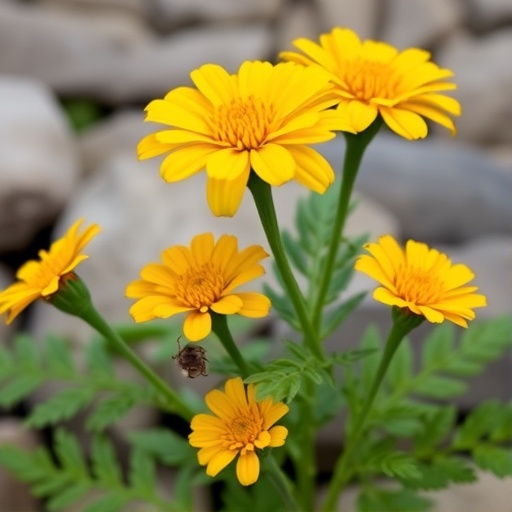
In a groundbreaking study that blends the age-old wisdom of herbal medicine with cutting-edge computational science, researchers have unveiled the promising potential of Calendula officinalis—commonly known as marigold—as a source of novel anticancer agents targeting KRAS mutations. These findings pave the way for alternative therapeutic strategies against cancers driven by this notoriously “undruggable” oncogene, offering fresh hope in the relentless battle against cancer.
KRAS mutations are among the most frequent genetic alterations in human cancers, particularly those affecting the pancreas, lung, and colon. Despite decades of intense research, directly targeting KRAS has remained a formidable challenge, earning the molecule a reputation as a “holy grail” and, simultaneously, as “undruggable” in oncology. This study’s computational assessment aims to navigate this complex terrain by exploring phytochemicals derived from Calendula officinalis, a medicinal plant long celebrated for its anti-inflammatory and wound-healing properties.
Using a wide array of sophisticated in silico techniques, including molecular docking, molecular dynamics simulations, and binding free energy calculations, the research team systematically screened numerous bioactive compounds isolated from Calendula officinalis. These techniques permit scientists to predict how small molecules might physically and chemically interact with target proteins—in this case, mutant KRAS variants—without the need for costly and time-consuming laboratory experiments.
The initial virtual screening identified several lead compounds with strong binding affinities toward the KRAS protein, particularly those exhibiting mutations such as G12C and G13D, which are prevalent in aggressive cancer subtypes. These compounds demonstrated remarkable specificity, suggesting that they could preferentially inhibit the mutant forms of KRAS while sparing the normal, wild-type protein function, thereby reducing potential off-target effects.
Molecular docking results illuminated how these compounds fit snugly into the switch II pocket of KRAS, a promising druggable site that has recently become a focal point for targeted cancer therapy. The binding modes revealed multiple non-covalent interactions including hydrogen bonds, hydrophobic contacts, and pi-stacking with critical amino acid residues responsible for maintaining KRAS’s active state, implying potential disruption of its oncogenic signaling.
Further, molecular dynamics simulations reinforced these findings by showcasing the stability of the ligand-KRAS complexes over time under physiological conditions. These simulations mimic the real-time behavior of molecules, accounting for the dynamic nature of proteins and providing insights into the durability and efficacy of potential inhibitors in a living system.
Complementing the structural analyses, binding free energy calculations employed in the study yielded quantitative measures of the thermodynamic favorability of these interactions. Impressively, several compounds from Calendula officinalis exhibited negative binding free energies surpassing those of known KRAS inhibitors, underlining their potential as high-affinity binders.
Beyond computational assessments, the researchers also explored the pharmacokinetic properties and drug-likeness of these compounds through ADMET (absorption, distribution, metabolism, excretion, and toxicity) profiling. This crucial step ensures that candidate molecules possess characteristics amenable to drug development, such as adequate bioavailability, low toxicity, and favorable metabolic profiles, factors often responsible for the failure of promising drugs in later clinical stages.
The study’s integration of traditional botanical knowledge with modern computational drug discovery tools exemplifies a paradigm shift in oncology research, leveraging natural product libraries enriched by centuries of human use. Calendula officinalis, long valued for its medicinal attributes, now emerges as a reservoir for potential KRAS inhibitors, shining a spotlight on phytochemicals as viable candidates in targeted cancer therapy.
These findings also open avenues for experimental validation, including in vitro and in vivo studies, to ascertain the biological activity and anticancer efficacy of these natural compounds. The computational groundwork has effectively narrowed down the vast chemical space, streamlining the path toward clinical translation and ultimately patient benefit.
Moreover, this research underscores the growing relevance of artificial intelligence and computational prowess in drug discovery, especially for challenging targets like mutant KRAS where conventional approaches have often faltered. By harnessing these technologies, scientists can expedite the identification of promising candidates, democratizing access to innovative treatments and possibly curbing the exorbitant costs associated with drug development.
The implications of discovering KRAS-targeting agents derived from Calendula officinalis are profound. KRAS-driven cancers often exhibit resistance to standard chemotherapy and have poor prognoses, highlighting the urgent need for novel modalities. Plant-derived compounds with specific inhibitory action can complement or even surpass existing therapies, potentially reducing side effects and enhancing patient survival rates.
While challenges remain, including optimization of compound potency, specificity, and delivery mechanisms, the path forward is illuminated by this comprehensive computational assessment. It fuels optimism within the scientific community and among patients for more effective, natural-product-based oncological therapeutics.
In conclusion, the fusion of traditional medicinal plants with state-of-the-art computational drug discovery shines new light on the fight against cancer. The identification of KRAS-targeted anticancer agents from Calendula officinalis sets a promising precedent for future research endeavors attempting to conquer previously “undruggable” molecular targets. This research heralds a new era where ancient wisdom meets technological innovation to transform cancer treatment and bring hope to millions worldwide.
Cite Scienmag News
Nathaniel Bowman. (December 1, 2025). Calendula officinalis: Potential KRAS-Targeted Cancer Therapy. Scienmag. https://scienmag.com/calendula-officinalis-potential-kras-targeted-cancer-therapy/
Nathaniel Bowman. "Calendula officinalis: Potential KRAS-Targeted Cancer Therapy." Scienmag, 1 December 2025, https://scienmag.com/calendula-officinalis-potential-kras-targeted-cancer-therapy/. Accessed 3 September 2026.
Nathaniel Bowman. "Calendula officinalis: Potential KRAS-Targeted Cancer Therapy." Scienmag. December 1, 2025. https://scienmag.com/calendula-officinalis-potential-kras-targeted-cancer-therapy/


