


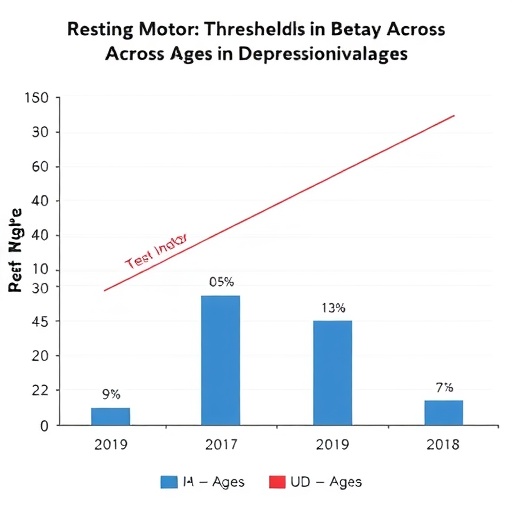
In a groundbreaking study set to reshape the understanding of depression treatment modalities, researchers have unveiled new insights into the resting motor threshold (RMT) in depressed individuals spanning a wide age range. Published in BMC Psychiatry, this extensive retrospective analysis provides the first comprehensive portrait of how RMT varies not only with age but also in relation to gender and interhemispheric brain asymmetries. These findings have the potential to revolutionize the ways clinicians optimize repetitive transcranial magnetic stimulation (rTMS), a cutting-edge therapeutic intervention for depression.
Repetitive transcranial magnetic stimulation has gained widespread recognition as a safe, non-invasive method to alleviate depressive symptoms by stimulating specific brain regions. At the heart of the effective application of rTMS lies the accurate calibration of stimulation intensity, which is directly guided by the measurement of resting motor threshold. RMT reflects the excitability of neuronal membranes within the corticomotor pathways, serving as an indispensable biomarker to tailor rTMS treatments according to individual neurophysiological profiles. However, prior to this study, a detailed characterization of how RMT changes across different ages in depressed populations had not been fully explored.
The investigative team retrospectively analyzed data from a substantial cohort of 258 patients diagnosed with depression, segmented into precise age groups to capture developmental and aging trends in RMT. One of the most compelling observations was that older adults, defined as individuals aged 50 years and above, exhibited significantly higher RMT values compared to their prime-age counterparts between 26 and 49 years. This elevation in RMT among older adults suggests an age-related decline in corticomotor excitability or changes in neural membrane properties, which could influence the efficacy of rTMS protocols if not properly accounted for in treatment planning.
Surprisingly, the study also identified elevated RMT levels in depressed adolescents younger than 18 years, a subgroup often overlooked in neurophysiological studies of depression. Notably, this effect was most pronounced among female adolescents, indicating a possible interaction between neurodevelopmental processes, sex hormones, and neuronal excitability. Such findings underline the necessity of considering puberty and gender-specific factors when devising neurostimulation strategies in younger populations, to ensure optimal therapeutic responsiveness and safety.
An additional layer of complexity emerged from the examination of interhemispheric asymmetries in RMT, particularly within a subset of young female adults aged 18 to 25 years. This group displayed a marked difference between the left and right hemispheres, with the left hemisphere exhibiting higher motor thresholds. This asymmetry may reflect underlying neurobiological divergences that contribute to depressive pathophysiology or may affect the directional responses to unilateral rTMS targeting. Clinicians must therefore consider hemispheric differences during treatment planning to enhance precision and therapeutic outcomes.
Interestingly, the study reported minimal evidence of a straightforward gender effect on RMT values when examined across the entire sample. This suggests that gender alone may not be a reliable predictor of cortical excitability in major depressive disorder but rather interacts with age and hemispheric factors in more nuanced ways. The interplay of these variables paints a complex picture requiring refined neurophysiological profiling in clinical settings.
From a methodological standpoint, the research utilized robust statistical models to control for potential confounders and ensure the reliability of the findings. The retrospective design allowed for the aggregation of rich data over diverse patient groups, providing a solid foundation for future prospective studies aimed at personalizing rTMS treatment protocols based on age and neurophysiological markers.
This investigation holds significant implications not only for scientific understanding but also for clinical practice. By delineating how RMT evolves throughout the lifespan in depressed individuals, the study prompts a reevaluation of current rTMS dosage and targeting parameters. Tailoring stimulation intensity and site according to age-related and hemispheric nuances could enhance therapeutic efficacy, reduce side effects, and improve overall patient outcomes.
Moreover, this research opens new avenues for exploring the underlying mechanisms driving RMT changes in depression. The biophysical properties of neuronal membranes and synaptic connectivity alterations associated with aging and development may be critical to understanding differential responses to rTMS. Integrating advanced neuroimaging and electrophysiological techniques could further elucidate these processes, driving innovation in personalized psychiatry.
Clinicians and researchers alike are encouraged to integrate these findings into both experimental designs and treatment frameworks. Awareness of RMT variability across the lifespan reinforces the importance of individualized assessment before commencing rTMS therapy. Custom protocols that reflect patient-specific neurophysiological characteristics signal a move towards precision medicine in mental health care.
The study’s revelations also highlight the importance of considering sex-specific developmental trajectories when investigating neuropsychiatric conditions. As female adolescents demonstrated distinct RMT patterns, future research might explore hormonal influences, genetic predispositions, and environmental factors that uniquely shape brain excitability in females during critical developmental windows. Such insights could inform gender-sensitive approaches to depression treatment.
In summary, this pioneering large-scale retrospective study profoundly enhances the understanding of resting motor threshold dynamics in depression across different age groups, factoring in gender and brain hemispheric asymmetries. By unmasking complex interrelations between these variables, it sets the stage for more individualized, effective rTMS interventions. The promise of improved treatment outcomes for patients with depression hinges on the adaptive application of these nuanced neurophysiological insights. Future research expanding on this foundation is poised to transform the landscape of neurological and psychiatric care.
Cite Scienmag News
Glenn Wilkins. (November 15, 2025). Resting Motor Thresholds in Depression Across Ages. Scienmag. https://scienmag.com/resting-motor-thresholds-in-depression-across-ages/
Glenn Wilkins. "Resting Motor Thresholds in Depression Across Ages." Scienmag, 15 November 2025, https://scienmag.com/resting-motor-thresholds-in-depression-across-ages/. Accessed 6 September 2026.
Glenn Wilkins. "Resting Motor Thresholds in Depression Across Ages." Scienmag. November 15, 2025. https://scienmag.com/resting-motor-thresholds-in-depression-across-ages/


