


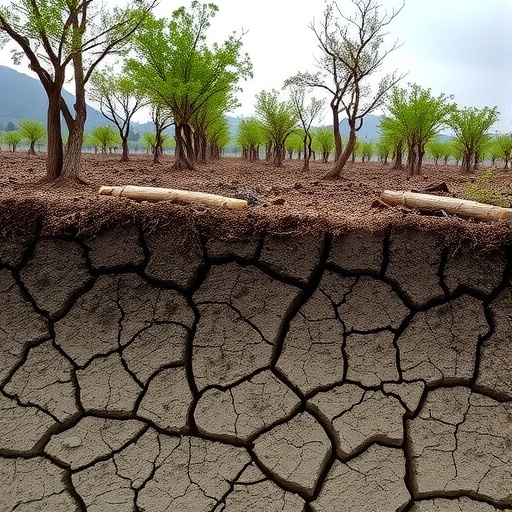
In the relentless march of climate change, droughts have emerged as a silent, creeping threat—especially beneath the surface of the Earth where moisture dynamics are less visible yet critically important. Recent groundbreaking research reveals that soil moisture droughts are not only becoming more frequent and intense but that their vertical structure is evolving in alarming ways, challenging existing drought monitoring systems and threatening countless ecosystems worldwide.
Traditional drought monitoring primarily focuses on surface soil moisture, utilizing satellite data to track and predict drought conditions. However, this approach misses a critical aspect of drought dynamics: the subsurface moisture deficits. New evidence indicates that a distinct class of droughts—referred to as “deep droughts”—is emerging and growing in severity. These droughts are characterized by severe moisture deficits concentrated in deeper soil layers, forming bottom-heavy profiles that traditional surface-focused detection methods entirely overlook.
The research, conducted by Guan, Gu, Dai, et al., utilizes a sophisticated Lagrangian four-dimensional tracking framework—an innovative method capable of capturing contiguous drought events across both horizontal and vertical dimensions and over time. This approach allows scientists to identify and monitor the spatiotemporal evolution of droughts in a way that was previously impossible. By focusing on soil moisture profiles extending deep underground, the study reveals that these deep droughts account for approximately one-quarter of all drought events, a staggering figure that underscores this hidden threat.
Decades of reanalysis datasets and advanced climate modeling paint a concerning picture: the duration and intensity of deep droughts have increased significantly over the past forty years. This intensification correlates strongly with anthropogenic climate change, driven by greenhouse gas emissions and global temperature rise. As the climate warms, the evaporation rates increase, and precipitation patterns shift unevenly, leading to more persistent moisture deficits in deep soils.
Moreover, model projections suggest that in the coming decades, deep droughts will become even longer-lasting and more intense worldwide. This trend is especially pronounced under high-emission scenarios, where the root zones of plants and the water reservoirs that support terrestrial ecosystems are subjected to profound stress. The vertical profile of soil moisture deficits is expected to deepen further, exacerbating conditions that are already dire in many regions.
This phenomenon has profound implications for agriculture, water resources, and ecological stability. Plants depend heavily on soil moisture not just near the surface but deep in the soil where roots access water during dry spells. When deeper soils dry out, crops and natural vegetation face increased water stress, reducing yield and resilience. Yet, because these bottom-heavy droughts evade detection by surface monitoring systems, farmers and policymakers remain unaware of the full extent of the problem, limiting their capacity to respond effectively.
Satellite-based drought monitoring, a cornerstone of modern agricultural and environmental management, is thus confronted with an urgent challenge. The invisibility of deep droughts means that early warning systems are blind to these subterranean crises. Decisions based on surface measurements alone risk underestimating drought severity, delaying mitigation efforts, and ultimately leading to more severe economic, environmental, and social consequences.
The study’s innovative four-dimensional approach—a union of space and time tracking across soil depth—adds a crucial new dimension to drought science. This method captures the complex interactions of soil moisture dynamics with atmospheric conditions and land surface processes in unprecedented detail. In doing so, it provides a framework for future monitoring systems that can integrate vertically resolved soil moisture data, offering a more complete picture of drought risk.
Deep droughts also complicate the understanding of hydrological cycles under climate change. Soil moisture is a vital component of terrestrial water balance, influencing groundwater recharge, surface runoff, and evapotranspiration. Changes in soil moisture profiles affect these processes, potentially altering regional water availability patterns and feedbacks to the climate system itself. Recognizing and quantifying deep droughts is thus fundamental to improving climate models and water resource management.
The implications extend beyond agriculture and water security to ecosystem health and biodiversity. Many plant species and ecosystems depend on stable moisture conditions deep in the soil profile to survive seasonal droughts. Longer-lasting and more intense deep droughts increase the risk of vegetation stress and mortality, potentially leading to shifts in species composition, loss of habitat, and declines in ecosystem services.
This research marks a pivotal advancement in understanding the complexity of drought phenomena under the influence of human-driven climate change. By unveiling the overlooked threat of subsurface soil moisture deficits, the study calls for a reevaluation of drought monitoring methodologies and climate adaptation strategies worldwide. It emphasizes the urgency of developing technologies and models that integrate vertical soil moisture data to safeguard food security, ecosystems, and water resources in an increasingly uncertain future.
The study serves as a stark reminder that the impacts of climate change are multifaceted and often hidden beneath the surface—literally. Addressing these challenges will require interdisciplinary collaboration among climate scientists, hydrologists, ecologists, and technologists to innovate monitoring and management systems that are as dynamic and layered as the land itself.
In conclusion, the anthropogenic enhancement of subsurface soil moisture droughts reveals a critical vulnerability in global drought assessment and response frameworks. As these deep droughts become more prevalent and severe, the need for comprehensive, vertically resolved soil moisture data and integrated monitoring approaches becomes imperative. Only through such advances can we hope to anticipate, mitigate, and adapt to the multifaceted drought risks posed by climate change in the decades ahead.
Cite Scienmag News
Sloane Callahan. (November 14, 2025). Human Activity Deepens Subsurface Soil Moisture Droughts. Scienmag. https://scienmag.com/human-activity-deepens-subsurface-soil-moisture-droughts/
Sloane Callahan. "Human Activity Deepens Subsurface Soil Moisture Droughts." Scienmag, 14 November 2025, https://scienmag.com/human-activity-deepens-subsurface-soil-moisture-droughts/. Accessed 3 September 2026.
Sloane Callahan. "Human Activity Deepens Subsurface Soil Moisture Droughts." Scienmag. November 14, 2025. https://scienmag.com/human-activity-deepens-subsurface-soil-moisture-droughts/


