


Pathfinder program of the European Innovation Council supports the development of highly innovative, exploratory new technologies at the very earliest stage of their development likely to have major potential impact

Credit: ill./©: Dongwook Go / JGU
Pathfinder program of the European Innovation Council supports the development of highly innovative, exploratory new technologies at the very earliest stage of their development likely to have major potential impact
It is becoming increasingly apparent that manufacturers in the European Union largely rely on obtaining their microelectronic devices and raw materials from outside the EU. This makes them vulnerable to associated difficulties, such as problems with the availability of materials. In order to promote high-tech developments within the EU and augment greater self-sufficiency of the industry, innovative technologies based on radical new concepts are required. In the EU’s OBELIX project, researchers will be designing such concepts. Over the next four years, the European Innovation Council (EIC) will be funding OBELIX through its Pathfinder program with about EUR 3.9 million. “We are collaborating with renowned institutions in France and Sweden as well as with Martin Luther University Halle-Wittenberg (MLU) on the development of economical, environmentally friendly microelectronic technologies. This field will be central to our research in the coming years,” stated Professor Mathias Kläui of Johannes Gutenberg University Mainz (JGU).
New technologies for innovative microelectronics
The project OBELIX, which is an acronym for “Orbital Engineering for Innovative Electronics”, will be coordinated by the Centre national de la recherche scientifique (CNRS) and will run for four years until 2028. The main aim of the project is to ensure that the new innovative technologies will be both sustainable and resilient to possible interruptions in the supply chain. At the same time, new approaches must also reduce the ecological footprint of this rapidly growing sector. “We intend to create particularly efficient magnetic switching, for instance in memory devices by exploiting the new options offered by orbital angular momentum, the motion of particles through space,” added Mathias Kläui. To date, the intrinsic angular momentum of particles, in other words, their spin, has been used for this purpose. The new technique, once made practicable, should increase efficiency tenfold – by reducing energy consumption by a factor of ten or, alternatively, enabling switching at a rate ten times that achieved at the same level of energy use. “Secondly, we’ll be focusing on systems that require fewer rarer materials,” continued Kläui, who is a professor at JGU’s Institute of Physics. This mainly concerns materials based on rare earth elements that are indeed scarce or the sources of which are located or produced primarily in China or Russia. “We intend to generate orbital angular momentum using matter that is neither rare nor harmful to the environment.” Kläui cites copper-based compounds as examples of this.
EIC Pathfinder support for bold ideas for radically new technologies in an early development stage
The purpose of the Pathfinder program of the European Innovation Council is to identify radically new technologies that have the potential to create new markets. Grants are thus awarded to groundbreaking and highly speculative projects that are still in an early stage of development and for which fundamental research has demonstrated promise of specific technological development potential. The participants in a project that has been awarded EIC Pathfinder support are typically visionary and entrepreneurial-minded specialists and researchers at universities, research institutes, start-ups, high-tech SMEs, and individuals working in the industrial realm who have a particular interest in investigating and creating technological innovations.
Other OBELIX partners in addition to the CNRS, JGU, and MLU are CRNS Innovation, Aix-Marseille University, Uppsala University, Commissariat à l’énergie atomique et aux énergies alternatives in France as well as the French companies Imagine Optic and Thales.
Professor Mathias Kläui who, together with Professor Yuriy Mokrousov, will be supervising the OBELIX-related research in Mainz, is also spokesperson of the TopDyn – Dynamics and Topology Top-level Research Area and the Mainz spokesperson of the Collaborative Research Center / Transregio (CRC/TR) 173 “Spin+X – Spin in its collective environment” based at the University Kaiserslautern-Landau (RPTU) and JGU. The German Research Foundation (DFG) is providing the research teams in Spin+X consisting of physicists and chemists with funding of roughly EUR 11 million in the third phase of the project that commenced in early 2024.
Images:
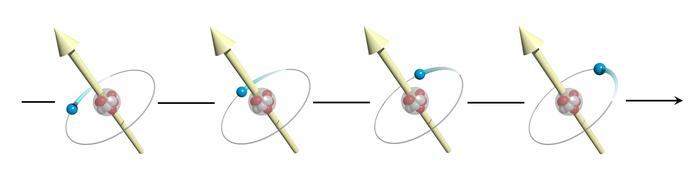
The objective in the OBELIX project is to create new and efficient technologies using readily available materials, thereby focusing on the generation, manipulation, and exploitation of so-called orbital angular momentum currents. If equilibrium is disrupted by means of an electric current, for example, the motion of electrons (small blue spheres) around atomic nuclei (transparent spheres) is transformed into intense orbital angular momentum (yellow arrow) and the corresponding current (black arrow). (ill./©: Dongwook Go)
short: The objective in the OBELIX project is to create new and efficient technologies on the basis of readily available materials, thereby focusing on the generation, manipulation, and exploitation of so-called orbital angular momentum currents. (ill./©: Dongwook Go)
Professor Dr. Mathias Kläui (photo/©: Peter Pulkowski / JGU)
Related links:
- – Kläui Lab at the JGU Institute of Physics
- – Topological Nanoelectronics Group at the JGU Institute of Physics
- – Collaborative Research Center / Transregio (CRC/TR) 173: Spin+X – Spin in its collective environment
- – Top-level Research Area TopDyn – Dynamics and Topology
- – EIC Pathfinder
Read more:
- – press release “Magnetic whirls pave the way for energy-efficient computing” (11 Sept. 2023)
- – press release “Energy-efficient computing with tiny magnetic vortices ” (6 Dec. 2022)
- – press release “Long-range information transport in antiferromagnets” (6 Dec. 2022)
- – press release “Efficient read-out in antiferromagnetic spintronics” (25 Nov. 2021)
Cite Scienmag News
Bethany Barker. (June 6, 2024). Innovative, self-sufficient, eco-friendly: EU sponsors new microelectronics project. Scienmag. https://scienmag.com/innovative-self-sufficient-eco-friendly-eu-sponsors-new-microelectronics-project/
Bethany Barker. "Innovative, self-sufficient, eco-friendly: EU sponsors new microelectronics project." Scienmag, 6 June 2024, https://scienmag.com/innovative-self-sufficient-eco-friendly-eu-sponsors-new-microelectronics-project/. Accessed 3 September 2026.
Bethany Barker. "Innovative, self-sufficient, eco-friendly: EU sponsors new microelectronics project." Scienmag. June 6, 2024. https://scienmag.com/innovative-self-sufficient-eco-friendly-eu-sponsors-new-microelectronics-project/

