


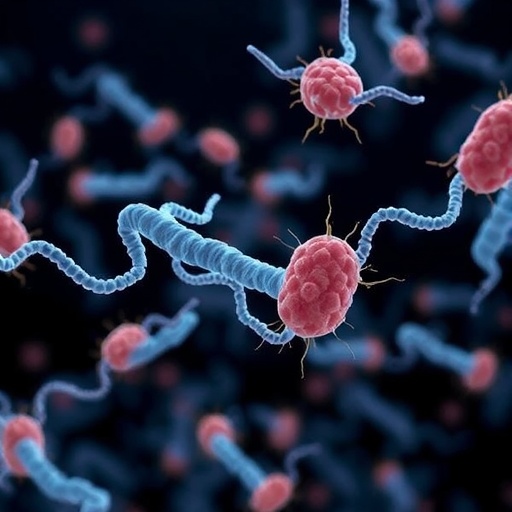
In a remarkable breakthrough that challenges long-held assumptions about bacterial locomotion, scientists at Arizona State University have uncovered novel mechanisms by which bacteria traverse surfaces even in the absence of their well-known flagella. These slender, whip-like appendages have traditionally been regarded as essential for propelling bacteria forward. However, recent research has revealed that microorganisms like Salmonella and Escherichia coli possess alternative strategies for movement that could play a pivotal role in infection and biofilm formation.
The conventional wisdom in microbiology has long emphasized flagella as the principal engines of bacterial motility, enabling these cells to swim in fluid environments or swarm across moist surfaces. Yet, the new findings demonstrate that even when these mechanical propellers are disabled, bacteria employ a form of passive movement driven by chemical gradients. This process, coined “swashing,” involves bacteria exploiting the metabolic by-products of sugar fermentation to generate microscale chemical currents on moist surfaces, facilitating their displacement.
Swashing arises because during the fermentation of sugars such as glucose, maltose, and xylose, bacteria release acidic compounds like acetate and formate. These acidic by-products cause water to be drawn from the environment onto the surface, establishing subtle fluid flows that push bacterial colonies outward, reminiscent of leaves floating on a gentle stream. This effect underscores the crucial role of environmental chemistry, particularly local pH and sugar concentration, in modulating microbial mobility.
Significantly, the researchers observed that swashing can be selectively inhibited by the introduction of surfactants—detergent-like molecules that disrupt fluid surface tension. Unlike swarming, which is an active, coordinated movement powered directly by flagella, swashing relies on these passive physicochemical interactions, suggesting that different physical principles underlie the two forms of bacterial surface migration. This distinction offers promising avenues for selectively targeting bacterial dissemination by controlling specific aspects of their environment without relying solely on genetic or mechanical interventions.
The implications of swashing extend deeply into clinical and industrial domains. Medical devices such as catheters and implants, often colonized by bacteria leading to persistent infections, may be vulnerable to contamination via swashing mechanisms. Traditional antimicrobial strategies predominantly focus on disabling flagella or killing bacteria outright, but these new insights suggest that interventions targeting the chemistry of bacterial habitats—altering sugar presence or pH—might more effectively prevent harmful surface colonization.
Moreover, in food processing environments where pathogens like Salmonella and E. coli pose significant risks, understanding swashing provides a fresh lens through which to design more effective sanitation protocols. The microfluidic currents generated by bacterial metabolism could facilitate contamination of equipment even in the absence of active swimming, emphasizing the need for meticulous environmental control. Adjusting acidity and nutrient availability on surfaces could be key to limiting microbial proliferation in food-related settings.
Inside the human body, the ecological niches where bacteria reside—such as gut mucus layers or wound exudates—are inherently moist and chemically dynamic. Swashing may therefore enable bacterial pathogens to navigate these complex terrains, even when their flagella are impaired or inhibited by the host immune system or pharmaceuticals. This reinforces the urgency of integrating metabolic and physicochemical factors into the development of anti-infective therapies.
Parallel to these findings, another intriguing avenue of bacterial motility was uncovered in flavobacteria, a group that lacks flagella entirely. Instead, these organisms employ a sophisticated molecular machine known as the type 9 secretion system (T9SS), which acts as a rotary conveyor belt propelling cells forward. This apparatus moves an adhesive-coated protein belt around the cell surface, effectively allowing the bacterium to glide across surfaces with precision and control.
Within the T9SS machinery, a pivotal protein named GldJ functions akin to a gear-shifter, dictating the rotational direction of the motor. By modulating the spin from counterclockwise to clockwise, bacteria can dynamically alter their movement patterns. Such molecular gear mechanisms endow the cells with the ability to finely steer through heterogeneous environments, maximizing their survival and colonization potential in diverse ecological niches.
The biological sophistication of this molecular gearbox extends beyond motility. T9SS is also interlinked with the secretion of proteins implicated in human disease, especially in the oral microbiome where certain bacteria contribute to gum disease and systemic inflammatory conditions, including heart disease and neurodegenerative ailments like Alzheimer’s. Conversely, in the gut, T9SS-secreted molecules can enhance immune defenses and vaccine efficacy, highlighting the dualistic nature of this system in human health.
Dissecting the structural and functional intricacies of the T9SS gearbox represents a tantalizing frontier. Achieving atomic-resolution models of this nano-machine will unravel how mechanical force is transmitted and regulated within bacterial cells, potentially inspiring novel bioengineered devices and therapeutic interventions. Such insights could lead to approaches that not only immobilize harmful bacteria but also curb their ability to secrete virulence factors.
Collectively, these discoveries reveal that bacterial motility is far more diverse than previously appreciated, incorporating passive physicochemical processes and elaborate molecular machinery. This multiplicity of strategies complicates efforts to contain infections by undermining defenses that target singular motility pathways like flagella. Instead, these findings advocate for an integrated approach that considers microbial metabolism, environmental conditions, and molecular motor regulation.
The revelation of swashing and the molecular gear-shifting conveyor system underscores the adaptability and resilience of bacterial life. As pathogens continually evolve new mechanisms to colonize and spread, our scientific and medical strategies must keep pace by targeting not only the microorganisms themselves but the complex ecosystems they exploit. This paradigm shift opens new possibilities for combating bacterial diseases and harnessing beneficial microbes to improve human health.
These groundbreaking studies underscore the necessity of transcending traditional paradigms in microbiology. By expanding our understanding of the physical and biochemical basis of bacterial motility, researchers are forging pathways toward innovative solutions for infection control and microbiome management. The convergence of fluid dynamics, molecular biology, and evolutionary biology in these findings sets the stage for a new era of microbiological discovery and translational impact.
Cite Scienmag News
Morgan Morrow. (November 7, 2025). Unveiling Microbial Motion: How Bacteria Swash, Glide, and Shift Gears to Thrive. Scienmag. https://scienmag.com/unveiling-microbial-motion-how-bacteria-swash-glide-and-shift-gears-to-thrive/
Morgan Morrow. "Unveiling Microbial Motion: How Bacteria Swash, Glide, and Shift Gears to Thrive." Scienmag, 7 November 2025, https://scienmag.com/unveiling-microbial-motion-how-bacteria-swash-glide-and-shift-gears-to-thrive/. Accessed 31 August 2026.
Morgan Morrow. "Unveiling Microbial Motion: How Bacteria Swash, Glide, and Shift Gears to Thrive." Scienmag. November 7, 2025. https://scienmag.com/unveiling-microbial-motion-how-bacteria-swash-glide-and-shift-gears-to-thrive/


