


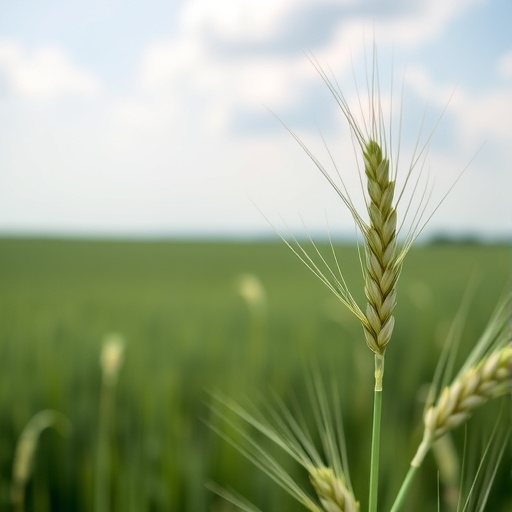
New research unravels the intricate genetic architecture behind seed dormancy in barley, focusing on the Mitogen-Activated Protein Kinase Kinase 3 (MKK3) gene. This groundbreaking work delineates how subtle genetic modifications in MKK3 regulate whether barley grains remain dormant or sprout prematurely, a factor of immense agricultural significance. Seed dormancy, a vital adaptive trait, enables wild cereals to synchronize germination with favorable environmental conditions, thus ensuring survival and propagation. Conversely, domestication has historically favored shorter dormancy periods to allow rapid and uniform crop establishment, enhancing yield but simultaneously increasing susceptibility to pre-harvest sprouting (PHS).
PHS is a phenomenon where grains germinate while still in the ear, typically triggered by warm and wet weather during maturation. This premature sprouting deteriorates grain quality, affecting malting, baking, and overall yield, leading to substantial economic losses worldwide. As climate change intensifies, with rising global temperatures and erratic precipitation patterns becoming increasingly common, the incidence and severity of PHS in barley and other cereals are anticipated to escalate, threatening food security on a global scale.
Despite the agronomic importance of seed dormancy and its direct relation to PHS resistance, the molecular mechanisms steering this trait have remained elusive until now. Previous studies have implicated variation within the MKK3 gene as a pivotal controller of dormancy, but the complexity of its genetic variants and evolutionary history have not been fully elucidated. Led by Morten Jøgensen and collaborators, an extensive genomic and molecular investigation was conducted, encompassing a wide spectrum of wild and domesticated barley accessions, to decode the role of MKK3 in modulating seed dormancy.
The researchers discovered that domesticated barley differs from its wild ancestors not only in sequence-level polymorphisms within MKK3 but also in copy number variation (CNV) of this gene. Specifically, cultivated varieties often harbor multiple MKK3 gene copies, a genetic feature absent or rare in wild genotypes. These gene duplications, coupled with amino acid substitutions that affect MKK3’s kinase enzymatic activity, create a nuanced regulatory system fine-tuning the degree of seed dormancy. This system balances the competing demands of rapid germination for agriculture and dormancy needed to resist PHS under variable environmental conditions.
Further genetic dissection revealed that MKK3 haplotypes have undergone region-specific adaptive evolution, influenced both by local climatic pressures and agricultural practices. In northern Europe, for example, where malting and beer production are economically significant, hyperactive MKK3 variants that reduce seed dormancy have been selected, facilitating uniform and rapid germination. In stark contrast, East Asian barley landraces retain more dormant MKK3 alleles, an adaptation to humid and monsoon-prone environments where PHS risk is elevated. This geographical mosaic of functional MKK3 variants underscores how human cultivation practices intertwined with climatic variables continue to shape the barley genome.
Delving deeper into molecular function, the study highlights how specific amino acid changes alter the kinase domain activity of MKK3, influencing signal transduction pathways related to seed germination regulation. These kinase activity shifts modulate hormonal pathways, notably abscisic acid (ABA) signaling, which is integral to enforcing dormancy. The heterogeneity of MKK3 variants thus creates a spectrum of dormancy phenotypes, from very low dormancy suited for rapid agronomic cycles to robust dormancy that guards against premature germination.
While these genetic insights open promising avenues for crop breeding, the complexity posed by MKK3 haplotype diversity and copy number variants complicates traditional crossbreeding efforts. Classical breeding methods might inadvertantly select undesirable alleles or disrupt favorable gene dosage effects. The authors advocate for leveraging pangenomic resources and precision genome editing techniques to harness beneficial MKK3 alleles tailored to specific environments. This strategy holds promise for developing barley cultivars optimized for resilience amid ongoing climate shifts.
This research also sets a precedent for examining seed dormancy mechanisms in other cereal crops, such as wheat and rice, where PHS poses parallel challenges. Integrative approaches combining population genomics, molecular biology, and phenotypic analyses can illuminate the parallel evolutionary trajectories of dormancy genes across species, potentially revealing conserved pathways and novel targets for breeding.
The findings presented emphasize the critical role of MKK3 as a genetic nexus integrating environmental adaptation, domestication history, and agronomic traits. Through fine-tuning kinase activity and gene dosage, barley plants orchestrate seed dormancy levels that maximize fitness across diverse climates and cultivation systems. Such molecular finesse underscores the evolutionary ingenuity embedded in crop genomes, sculpted under millennia of natural selection and human intervention.
As climate unpredictability escalates, understanding the genetic frameworks controlling seed dormancy is more than an academic endeavor—it is imperative for securing global food supply chains. Cultivars engineered with precise control over MKK3 functionality may fulfill dual goals: ensuring rapid crop establishment when conditions allow and preventing crop losses due to PHS under adverse weather. This duality is critical for sustainable agriculture in a warming world.
In summary, the post-domestication selection and diversification of the MKK3 gene constitute a keystone event shaping barley’s seed dormancy and end-use quality. The revelation of copy number variation and amino acid changes fine-tuning kinase activity provides unprecedented genetic tools. Harnessing this knowledge through advanced genomics and breeding will empower the development of barley varieties resilient to climatic perturbations while meeting diverse industrial needs.
The study by Jøgensen et al. published in Science on November 6, 2025, heralds a new era of precision agriculture grounded in the molecular genetics of dormancy. By unraveling the sophisticated MKK3-based dormancy regulatory mechanisms, this work lays the foundation for next-generation cereal breeding paradigms, combining evolutionary insight with cutting-edge biotechnology to sustainably feed a changing planet.
News Publication Date: 6-Nov-2025
Web References: 10.1126/science.adx2022
Cite Scienmag News
Alan Morgan. (November 6, 2025). Genetic Variants Refine Grain Dormancy to Enhance Barley Crop Resilience. Scienmag. https://scienmag.com/genetic-variants-refine-grain-dormancy-to-enhance-barley-crop-resilience/
Alan Morgan. "Genetic Variants Refine Grain Dormancy to Enhance Barley Crop Resilience." Scienmag, 6 November 2025, https://scienmag.com/genetic-variants-refine-grain-dormancy-to-enhance-barley-crop-resilience/. Accessed 1 September 2026.
Alan Morgan. "Genetic Variants Refine Grain Dormancy to Enhance Barley Crop Resilience." Scienmag. November 6, 2025. https://scienmag.com/genetic-variants-refine-grain-dormancy-to-enhance-barley-crop-resilience/


