


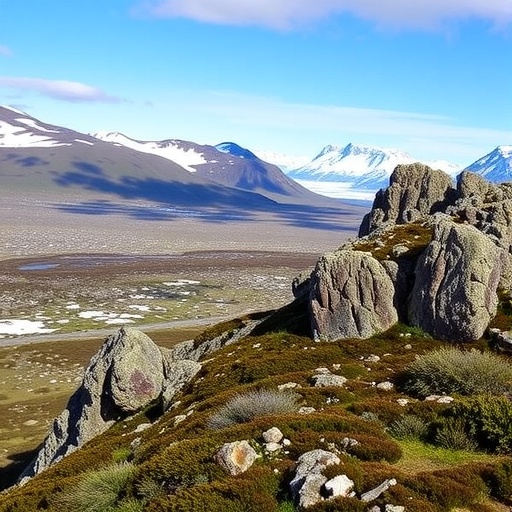
In a groundbreaking study set to redefine our understanding of climate history, researchers have unveiled a meticulously constructed 500-year paleoclimate record derived from the ancient wood of Greenland Juniper. This remarkable archive not only sheds new light on historical climate variability but also offers unprecedented context for the rapid climatic shifts we are witnessing today. The study, conducted by Opała-Owczarek, Büntgen, Owczarek, and their colleagues, weaves together dendrochronological precision with state-of-the-art analytical techniques to reconstruct environmental conditions that spanned five centuries.
The Greenland Juniper, a resilient species thriving in one of Earth’s harshest environments, served as a natural climatological beacon. By transforming this hardy tree’s growth rings into a chronological ledger, the team decoded fluctuations in temperature, precipitation patterns, and broader atmospheric phenomena that have shaped the Arctic landscape over the last half millennium. The researchers exploited the inherent sensitivity of tree-ring width and isotopic composition to environmental factors, coupling these indicators with sophisticated climate models to extract a high-resolution record of past climates.
Central to the study’s innovation was the cross-validation of multiple dendrochronological proxies, including ring-width chronologies, stable isotope ratios of carbon and oxygen within the cellulose, and wood density measurements. This multi-proxy approach minimized uncertainties inherent in single-indicator studies and enabled a robust reconstruction of annual to decadal climate variability. Such a methodological framework is pivotal for discerning subtle trends often obscured by episodic anomalies or local disturbances.
Crucially, the paleoclimate reconstruction unveiled intriguing episodes of climate extremes, including protracted cold spells and warming phases that correspond with documented volcanic eruptions, solar minima, and anthropogenic influences. These findings underscore the complex interplay between natural forcings and internal climate dynamics in the Arctic region. Moreover, the Greenland Juniper record bridges a critical temporal gap in high-latitude climate archives, which have historically suffered from fragmentation and dating challenges.
A remarkable revelation from the study is the unprecedented rate of warming observed in recent decades, starkly contrasting with historical variability preserved in the tree-ring records. The data unambiguously demonstrate that contemporary warming exceeds the natural variability envelope documented over the past five centuries. This insight fuels the ongoing discourse regarding the anthropogenic acceleration of global climate change and the vulnerability of polar ecosystems.
The temporal and spatial resolution afforded by this study has profound implications for climate modeling and forecasting. High-precision paleoclimate data serve as indispensable benchmarks for validating the fidelity of general circulation models (GCMs) and Earth system models (ESMs). By anchoring simulations in empirically derived past climate states, researchers can refine projections of future climate trajectories, enabling better-informed policy and mitigation strategies.
Furthermore, the Greenland Juniper chronologies offer a window into hydrological patterns, illuminating shifts in precipitation seasonality and severity. These insights are critical given the increasing frequency of extreme weather events linked to altered moisture regimes in the Arctic and sub-Arctic zones. Arming scientists and regional planners with such data is pivotal for anticipating ecological and societal impacts under changing climate conditions.
The study also highlights the resilience and adaptability of Greenland Juniper populations amidst environmental stresses. Analysis of growth patterns suggests episodic stress responses correlated with climatic oscillations such as the North Atlantic Oscillation (NAO) and Arctic Oscillation (AO). Understanding these biological feedbacks enhances our grasp of ecosystem responses and thresholds under fluctuating environmental pressures.
Beyond its scientific contributions, this research exemplifies international collaboration and interdisciplinary synthesis, bridging dendrochronology, climatology, ecology, and geochemistry. The integrative nature of the work stands as a testament to the advancing frontiers of climate science, where multi-faceted approaches yield more comprehensive narratives about Earth’s climate past and future.
On a broader scale, the high-latitude climatic insights derived from this juniper record hold relevance for global climate dynamics. The Arctic acts as a bellwether for planetary climatic shifts, and understanding its long-term variability enriches global perspectives on feedback mechanisms, such as albedo changes and carbon cycle perturbations. These factors influence global temperature regulation and inform international climate negotiations.
Importantly, the study also stimulates dialogue about the limits of natural adaptation and the critical thresholds beyond which ecosystems may undergo irreversible change. By contextualizing current warming within an extensive paleoclimate framework, the researchers provide a sobering reminder of the scale and rapidity of human-induced disruptions compared to historical baselines.
Methodologically, advancements in radiocarbon dating, microscopic imaging, and stable isotope mass spectrometry empowered the detailed analysis required for this study. The refined temporal resolution challenges traditional assumptions in Arctic paleoclimatology and sets new standards for future climate reconstructions relying on arboreal proxies.
As climate science faces escalating demand for reliable data underpinning urgent policy decisions, the integration of long-lived biological archives like Greenland Juniper into global datasets becomes ever more critical. Their capacity to preserve climatic signals over centuries imbues them with unique value for both retrospective analysis and predictive modeling frameworks.
In conclusion, the 500-year paleoclimate record harnessed from Greenland Juniper wood constitutes a scientific tour de force, providing crucial context for interpreting modern climate warming in one of Earth’s most sensitive regions. It underscores the necessity of coupled observational and modeling approaches to tackle the complexities of climate change and highlights the multifaceted narratives written in the natural archives surrounding us.
Cite Scienmag News
Violet Maxwell. (November 26, 2025). 500-Year Greenland Juniper Record Reveals Climate Trends. Scienmag. https://scienmag.com/500-year-greenland-juniper-record-reveals-climate-trends/
Violet Maxwell. "500-Year Greenland Juniper Record Reveals Climate Trends." Scienmag, 26 November 2025, https://scienmag.com/500-year-greenland-juniper-record-reveals-climate-trends/. Accessed 3 September 2026.
Violet Maxwell. "500-Year Greenland Juniper Record Reveals Climate Trends." Scienmag. November 26, 2025. https://scienmag.com/500-year-greenland-juniper-record-reveals-climate-trends/


