


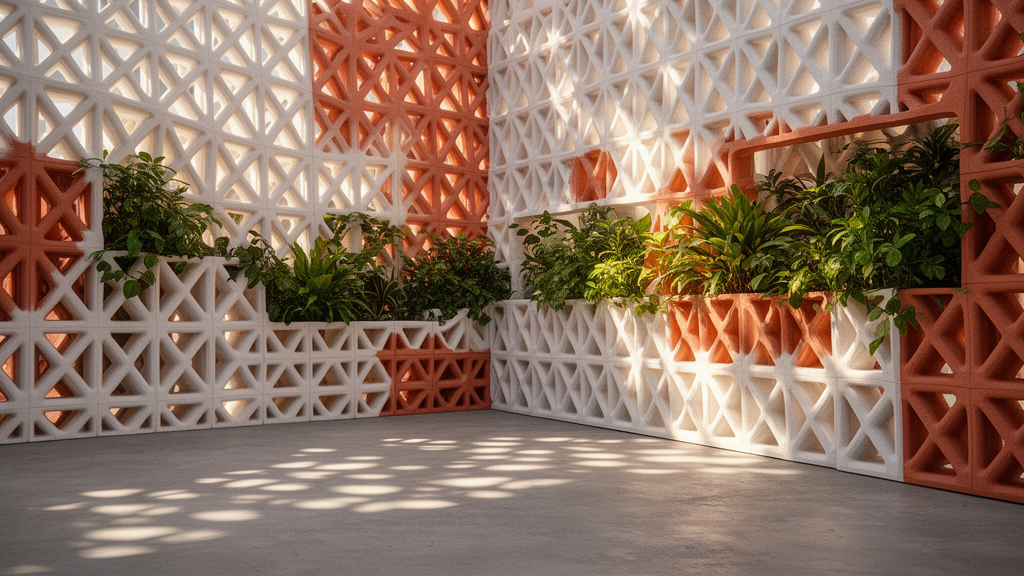
Researchers have designed, simulated, and fabricated a scaled prototype of a building facade made from two 3D-printed materials at once: a rigid, translucent polymer that tunes how daylight enters a room, and a porous, water-absorbing medium in which plants can germinate and grow. The case study, published in the journal Architectural Intelligence, applied the system to a real retrofit scenario — the UCL Institute of Archaeology in central London, a brick building with small, densely distributed windows, limited internal natural lighting, and poor thermal insulation — and reported improved daylight uniformity in simulation compared with the existing facade.
The project addresses a familiar problem in existing buildings. Fixed facade geometries, small openings, and materially homogeneous components often produce uneven interior light, forcing occupants to rely on additional shading and artificial lighting, which the authors note accounts for roughly 5 to 15 percent of total electric energy consumption in buildings. Conventional facades are layered assemblies of discrete parts, and single materials generally address only one performance aspect, such as strength or light transmission. Multi-material 3D printing offers an alternative: rather than assembling separate components, performance differences are achieved through spatial variation in material composition within a single printed structure, reducing reliance on mechanical joints that can cause cold bridging, water ingress, and maintenance difficulties.
The team, led by Changle Liu with colleagues including Kostas Grigoriadis, selected two materials after comparing candidates. Among common printable transparent plastics, PLA offered the best balance of rigidity, with an elastic modulus of roughly 3.5 gigapascals, printing stability, dimensional accuracy reaching 98 percent, and biodegradability. For the planting layer, alternatives such as clay, coir pith composites, and soil-based printing were ruled out for reasons including cracking, swelling under humidity fluctuations, and instability without binders. Growlay, a porous capillary material with a density of about 500 kilograms per cubic metre, proved print-stable and capable of absorbing and storing water and nutrients to support root and mycelial growth.
Before designing the facade, the researchers tested how the two materials bond. They printed samples measuring 100 by 25 by 12.5 millimetres with five connection geometries of increasing geometric coverage, from simple edge-to-edge contact to interlocking, pocket, and gradient transitions. After two days of water immersion, the pocket configuration — in which one material is enclosed by the other — showed the highest stability, while open geometries delaminated and deformed. Separate tests confirmed Growlay’s strong capillary water absorption, though moisture evaporated rapidly without supplemental watering, pointing to the need for geometric enclosure or controlled irrigation. In preliminary seed-growth experiments, seeds germinated within three days and visible root systems formed and embedded in the material’s pores after seven days.
The digital workflow then linked annual daylight simulation to generative design. Using weather data from London’s St James’s Park weather station in Ladybug tools, the team analysed solar radiation on the building at the solstices and equinoxes. Sunlight exposure ranged from 12 hours in spring to 17 hours in summer and fell to 7 hours in winter, with the main facade receiving between 1 and 7 hours on 21 December. Because winter represents the most light-limited condition, the December dataset became the primary reference for design iteration, producing a spatial gradient of exposure that guided where each material should go.
Facade geometry was generated parametrically from two sets of curves whose number, amplitude, and spacing controlled pore size, density, and material distribution, with the geometry built procedurally in SideFX Houdini through a traceable sequence from input curves to mesh extraction. Particle-based rainwater simulations then informed cavity placement: increasing surface curvature and cavity depth raised the simulated water storage rate from 0.11 to 0.37, and localised thickness and micro-cavities were added where flow converged. Growlay was concentrated in well-lit zones for planting and internal shading, while transparent PLA dominated shaded regions to preserve interior daylight. Of three distribution strategies tested — point-based, linear, and reaction-diffusion — the reaction-diffusion approach was selected because its patterns created planting depths of 60 to 300 millimetres, matching the soil depth requirements of the plant species considered, whereas the linear scheme’s 10 to 70 millimetre units were too shallow for full root development.
Eight design options were evaluated through indoor illuminance simulation at the case-study building, where the target for teaching and research spaces is 200 to 1,000 lux. The existing facade, modelled with inferred double low-E glass, left only about 50 percent of the space suitably illuminated while roughly 30 percent was excessively bright. Options with sparse, horizontal, diagonal, vertical, large-region, and fragmented Growlay distributions achieved suitable-illumination proportions of roughly 45 to 70 percent, with over-lit zones between 10 and 25 percent. Two options performed markedly better: a woven thread configuration and a radiation-responsive distribution in which Growlay density tracked solar radiation intensity, each reaching about 90 percent suitable illumination with virtually no excessive-brightness zones. Testing six PLA transparency levels from 0 to 100 percent showed optimal performance at 80 percent transparency, where appropriately lit areas covered more than 80 percent of the interior; this radiation-responsive option at 80 percent transparency was selected for fabrication.
The researchers also proposed a prototype-level internal water network. Rainwater collected on the roof would enter the facade through top-mounted inlets and percolate down a branching, gravity-driven conduit network aligned with the Growlay planting zones, with conduit density increased in sunny, high-evaporation areas and reduced in shaded ones, forming a closed rainwater collection, irrigation, and reuse loop. The authors frame this as a design proposition demonstrating integrated logic rather than a validated long-term system, noting that maintenance, durability, and regulatory constraints require further study.
Fabrication proceeded in two experimental stages as a proof of concept under controlled conditions. In the first, a segment of the selected design was printed on a dual-extruder Gemini IDEX printer with PLA at 210 degrees Celsius and Growlay at 220 degrees Celsius, a 0.2 millimetre layer height, and 10 percent infill; each unit took around 16 hours to print and showed stable bonding with no noticeable delamination or warping. Seeds germinated and grew through the porous structure in sealed, daily-watered containers. In the second stage, the facade geometry was subdivided into a four-by-six grid of modules printed on a Bambu Lab P1S, producing a scaled prototype of 880 by 1,370 millimetres that visually reproduced the digital model’s geometry and material distribution, though the authors note three-dimensional scanning would be needed to verify dimensional accuracy. For full 1:1 construction, they propose modules of roughly 2.25 by 4 metres, sized around UK road transport limits, joined with tongue-and-groove edges and a transparent sealant to protect embedded irrigation channels.
The study’s authors are careful about scope. Performance assessment focused on daylighting metrics within one renovation context, without systematic time-based evaluation using established indicators such as spatial daylight autonomy, annual sun exposure, or daylight glare probability. Thermal and structural performance, long-term durability, and maintenance remain unaddressed, and plant growth evaluations were limited to early-stage experiments validating feasibility rather than long-term ecological performance. Future work, they write, will include long-term material testing, comprehensive daylight, thermal, and structural evaluation, longer-term plant growth studies and their effect on shading, and validation of the workflow across diverse climates and building types — steps needed to move multi-material facades from experimental prototypes toward broader architectural implementation.
Subject of Research: A multi-material 3D-printed facade system integrating daylight regulation and plant growth for building retrofit
Article Title: Vertical pond: design, analysis, and scaled model fabrication of a multi-material façade
Article References: Liu, C., Liu, Y., Lyu, Y., Rodriguez, A. L., & Grigoriadis, K. (2026). Vertical pond: design, analysis, and scaled model fabrication of a multi-material façade. Architectural Intelligence, 5(1), Article 10. https://doi.org/10.1007/s44223-026-00118-6
Image Credits: AI Generated
DOI: 10.1007/s44223-026-00118-6
Keywords: 3D printing, facade retrofit, daylighting, multi-material fabrication, PLA, Growlay, bio-receptive design, UCL Institute of Archaeology, plant growth, simulation, architecture, sustainable building
Cite Scienmag News
Denise Maddox. (October 30, 2026). 3D-Printed Multi-Material Facade Combines Daylight Control with Plant Growth. Scienmag. https://scienmag.com/3d-printed-multi-material-facade-combines-daylight-control-with-plant-growth/
Denise Maddox. "3D-Printed Multi-Material Facade Combines Daylight Control with Plant Growth." Scienmag, 30 October 2026, https://scienmag.com/3d-printed-multi-material-facade-combines-daylight-control-with-plant-growth/. Accessed 4 November 2026.
Denise Maddox. "3D-Printed Multi-Material Facade Combines Daylight Control with Plant Growth." Scienmag. October 30, 2026. https://scienmag.com/3d-printed-multi-material-facade-combines-daylight-control-with-plant-growth/




