

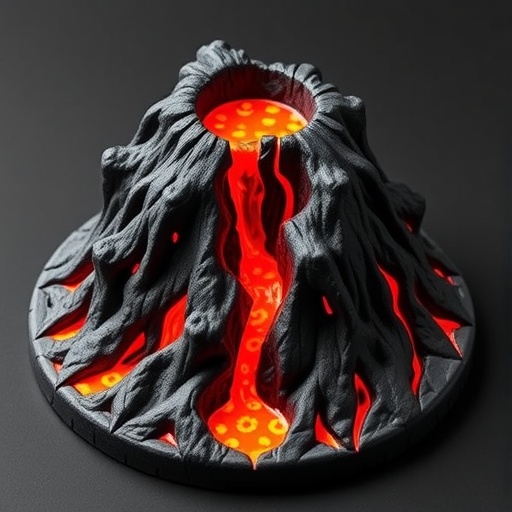
In a groundbreaking study set to reshape our understanding of volcanic activity and lava flow dynamics, a team of researchers led by L. Ai and T.R. Walter has explored innovative methodologies utilizing photogrammetry and 3D printing technologies. Their investigative journey at the Lascar Volcano in Chile, amid the significant eruptions that characterized 2022 and 2023, presents a compelling intersection of technology and natural science. The collaboration also involved the expertise of F. Aguilera and other prominent geoscientists, who collectively delved into the intricate processes that govern lava emplacement.
The Lascar Volcano, known for its explosive history and active lava flows, has long been a focal point for volcanologists seeking to understand the complex behavior of magma systems. During the recent eruptions, researchers were afforded a unique opportunity to observe and document the lava’s morphological transformations in real-time. As molten rock surged down the slopes of this South American giant, the research team employed photogrammetry—a technique that captures a series of photographs from various angles—to create highly detailed three-dimensional models of the eruptive features and lava flows.
One of the key findings of this research lies in the application of 3D-printed molds that emulate the physical properties of basaltic lava. By fabricating these molds, the team was able to conduct analogue experiments that simulated real-world lava behavior under controlled conditions. This approach not only allowed for an enhanced understanding of lava flow dynamics but also provided insights into potential hazards associated with future eruptions. The ability to replicate volcanic processes in a laboratory setting represents a significant advancement in volcanological research.
The photogrammetry technique played a pivotal role in this study by enabling the team to gather vast quantities of spatial data regarding the volcanic landscape. By documenting the lava’s surface elevation, the researchers were able to analyze flow rates, thicknesses, and the overall morphology of the lava flows. Such comprehensive data collection methods are essential in forecasting volcanic activity and developing more effective risk mitigation strategies for communities residing near active volcanoes.
The use of 3D-printed molds, designed to replicate specific structures formed by lava during an eruption, further enriched the researchers’ findings. These molds allowed them to precisely manipulate variables such as viscosity and flow rate, which are fundamental to understanding how lava moves and solidifies. By varying these parameters, the team gained valuable insights into the conditions that lead to different types of lava formations, ranging from smooth pahoehoe flows to rough aa flows. Their experiments yielded data that could improve models used to predict lava trajectories during explosive events.
Moreover, this research underscores the potential of integrating modern technology into traditional geological fieldwork. The use of high-resolution imagery captured through photogrammetry, combined with the analytical power of 3D printing, represents a forward-thinking approach to studying dynamic geological processes. This innovative methodology not only increases the accuracy of data collected but also fosters collaboration across interdisciplinary fields, illustrating how engineering and geoscience can work hand in hand.
One of the broader implications of this research is its relevance to volcanic hazard assessment. By understanding the factors that influence lava flow behavior, emergency response teams can better prepare for and respond to eruptions. This aspect is particularly crucial for Lascar Volcano, given that it is located near populated areas that could be adversely affected by volcanic activity. The findings of this study could potentially influence local policies related to land use, urban planning, and disaster readiness.
As the researchers detailed their findings in the upcoming publication in Commun Earth Environ, it is expected to attract considerable attention not only from volcanologists but also from geologists, engineers, and environmental scientists. The integration of advanced technological methods with traditional geological practices paves the way for a new era in volcanology, where enhanced predictive models and improved safety measures are prioritized.
The magnificent yet volatile nature of volcanoes like Lascar serves as a reminder of the power of nature and the need for ongoing scientific inquiry. The research conducted by Ai, Walter, Aguilera, and their colleagues is not an isolated endeavor; it is part of a larger effort to enhance our understanding of one of Earth’s most formidable natural phenomena. By combining cutting-edge technology and comprehensive field studies, the team has set a benchmark for future volcanic research.
This study holds promise for future research endeavors, as the methodologies developed can be adapted to other volcanic systems worldwide. The possibility of applying 3D-printing technology in geological research expands the toolkit available for scientists, offering innovative ways to tackle complex geological questions. With ongoing advancements in technology, future investigations will likely yield even more detailed insights into the processes that drive volcanic activity.
Overall, the meticulous research conducted during this project exemplifies not just the importance of technological integration in scientific study but also the necessity for collaborative efforts in addressing pressing environmental issues. The findings hold vital implications for understanding volcanic processes and improving community preparedness in the face of eruptions.
In conclusion, the study carried out at Lascar Volcano marks a significant contribution to the fields of volcanology and geological sciences. The innovative combination of photogrammetry and 3D printing techniques promises to enhance both academic understanding and practical applications in volcano monitoring and disaster management. As research like this continues to evolve, it brings us one step closer to demystifying the processes that govern our planet’s most dynamic landscapes.
Subject of Research:
Volcanic activity and lava flow dynamics through innovative methodologies
Article Title:
Photogrammetry and analogue experiments in 3D-printed mold applied to the 2022-2023 lava emplacement at Lascar Volcano in Chile
Article References:
Ai, L., Walter, T.R., Aguilera, F. et al. Photogrammetry and analogue experiments in 3D-printed mold applied to the 2022-2023 lava emplacement at Lascar Volcano in Chile. Commun Earth Environ (2025). https://doi.org/10.1038/s43247-025-03011-8
Image Credits: AI Generated
DOI:
Keywords: Volcanology, Lava flow dynamics, Photogrammetry, 3D printing, Lascar Volcano, Hazard assessment, Geological research.


