


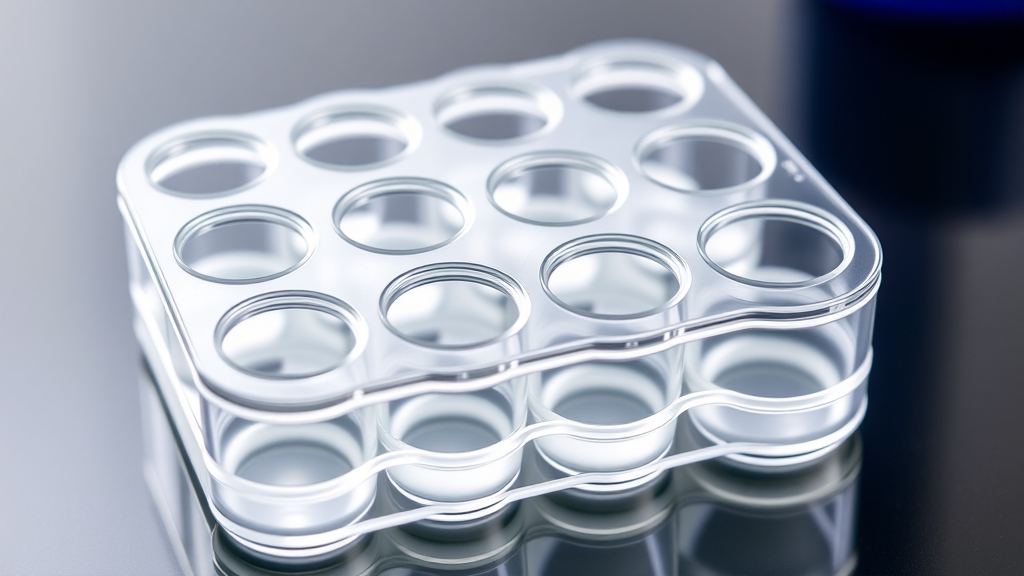
A benchtop 3D printer may soon be as essential to a cell biology laboratory as the incubator itself. Researchers in Barcelona have shown that ordinary, widely available 3D printing materials can be turned into reusable, sterilizable, glass-bottomed multiwell plates that support long-term cell culture and immunostaining, provided the right combination of material and sterilization protocol is chosen. The study, published in Applied Microbiology and Biotechnology, offers a practical roadmap for laboratories that want to design custom culture devices in-house without sacrificing the sterility standards that cell work demands.
The appeal is obvious. Commercial multiwell plates are inexpensive enough at small scale, but custom formats, unusual geometries, and specialized fixtures for microscopy or mechanical testing are either unavailable or prohibitively costly. As 3D printers have proliferated in wet laboratories, researchers have increasingly printed jigs, holders, and even culture chambers on demand. The catch is that a printed object is not automatically a culture device. It must survive sterilization, remain mechanically stable, and, crucially, prove non-toxic to living cells. Those three requirements, the new work shows, do not always travel together.
The team, led by Sergio Noé and Núria Gavara of the Universitat de Barcelona with collaborators at the Universitat Politècnica de Catalunya-BarcelonaTech, focused on two of the most common 3D printing materials: Poly-Lactic Acid (PLA) filament, the workhorse of fused filament fabrication, and Acrylonitrile Butadiene Styrene (ABS)-like photopolymer resins used in vat photopolymerization. Specimens printed from each material were subjected to the three sterilization methods most familiar to cell biologists: ultraviolet light exposure, immersion in ethanol, and steam autoclaving. The researchers then interrogated the treated samples at both macroscopic and nanoscopic scales, using tensile testing to measure bulk mechanical behavior and nanoindentation to probe local stiffness and surface integrity.
The results revealed a striking material-specific pattern of vulnerability. ABS-like resin, which measured 0.31 ± 0.07 GPa in stiffness in its baseline state, remained mechanically viable after UV illumination, which actually raised its measured modulus to 1.19 ± 0.02 GPa, and after autoclaving, at 0.36 ± 0.05 GPa. Ethanol, however, proved catastrophic: submerged specimens deteriorated to a modulus of just 0.01 ± 0.00 GPa, effectively losing their structural integrity. For a material that otherwise tolerates heat and radiation, this solvent sensitivity is a decisive limitation, since ethanol immersion is one of the simplest and most ubiquitous sterilization methods in any laboratory.
Mechanical survival, however, turned out to be only half of the story. Even when ABS-printed devices were successfully sterilized by methods they could tolerate, they proved toxic to cultured cells. Switching to Formlabs Grey resin, an inert photopolymer, did not rescue the situation; the cytotoxic effect persisted. This finding carries a cautionary message for the growing community of laboratory makers: a printed device can pass every mechanical test and still quietly kill the cells it is meant to house. Residual monomers, unreacted photoinitiators, or surface chemistry introduced during printing and post-processing may leach into culture medium in ways that standard material characterization does not detect.
PLA told a different story. Untreated PLA specimens measured 1.22 ± 0.09 GPa and remained essentially unchanged after ethanol immersion, at 1.23 ± 0.15 GPa, and after UV exposure, at 1.21 ± 0.01 GPa. The autoclave, however, was its undoing: steam sterilization dropped the modulus to 0.75 ± 0.20 GPa, a substantial degradation consistent with the hydrolytic and thermal sensitivity of PLA at autoclave temperatures. Here the researchers found an elegant workaround. By switching to Heat-Treated PLA, or HTPLA, a filament that has been thermally annealed to improve its thermal and dimensional stability, the autoclave problem disappeared. HTPLA specimens retained a stiffness of 1.07 ± 0.13 GPa after autoclaving, remaining well within the range compatible with structural use in a culture device.
With a material that could survive the full sterilization arsenal in hand, the team assembled complete glass-bottomed multiwell devices and subjected them to a sequential sterilization protocol combining autoclaving, ethanol treatment, and UV illumination. The resulting platforms were then validated in the most direct way possible: by growing cells on them. Using A549 human lung epithelial cells, the researchers confirmed that the sterilized HTPLA devices supported healthy long-term culture. Cell morphologies appeared normal, and the cells proliferated with a doubling time of 21.06 ± 4.66 hours, a figure consistent with expectations for this cell line in standard culture vessels. The devices also proved compatible with immunostaining workflows, extending their utility beyond simple culture to fixed-cell imaging and molecular labeling experiments.
The combination of a glass optical bottom with a printed polymer body is central to the design’s value. Glass remains the gold standard surface for high-resolution microscopy, offering optical clarity, low autofluorescence, and well-characterized cell adhesion properties that many printed polymers cannot match. By bonding standard glass coverslips into printed well frames, the researchers created devices that behave optically like commercial glass-bottom dishes while retaining the geometric freedom of additive manufacturing. Laboratories can now print multiwells with custom well counts, spacings, or integrated features tailored to specific microscopes, assays, or experiments, and sterilize them with equipment already present in the facility.
The broader significance of the work lies in its systematic approach. Rather than assuming that any sterilization method will suit any printing material, the study provides quantitative mechanical data across a matrix of material-sterilization combinations, exposing failure modes that would otherwise be discovered the hard way, through warped devices, failed cultures, or unexplained cell death. It also demonstrates that the sterilization protocols already standard in cell biology laboratories, UV light, ethanol, and autoclaving, can be applied directly to 3D-printed materials when the material is chosen wisely. The authors frame their contribution as a set of open designs and protocols: in-house 3D-printing and assembly instructions for glass-bottomed multiwells based on HTPLA, paired with optimized sterilization sequences validated for long-term culture and immunostaining.
For laboratories weighing the cost of specialized culture formats, the message is empowering but disciplined. A few hundred euros of printer and filament can replace custom-machined or commercially unavailable devices, but only if researchers respect the material science underneath. Ethanol will destroy ABS-like resins; the autoclave will weaken standard PLA; and even a mechanically sound, sterilized resin print may still poison cells. Heat-treated PLA, processed through a deliberate sequence of autoclave, ethanol, and UV sterilization, currently offers the most reliable path from the printer bed to the incubator. As 3D printing continues its march into wet laboratories, studies like this one supply the evidence base that turns a promising workshop trick into dependable laboratory practice, allowing researchers to print, sterilize, and culture with confidence that their custom devices will protect, not compromise, the cells within.
Subject of Research: Design and sterilization of 3D-printed glass-bottomed multiwell devices for cell culture and immunostaining
Article Title: Design and sterilization of 3D-printed glass-bottomed multiwells for cell culture and immunostaining
Article References: Noé, S., Barberá-Flichi, F., Sanz-Fraile, H., Padilla, J. A., Jorba, I., Buj-Corral, I., Xuriguera, E., Jiménez-Piqué, E., & Gavara, N. (2026). Design and sterilization of 3D-printed glass-bottomed multiwells for cell culture and immunostaining. Applied Microbiology and Biotechnology. https://doi.org/10.1007/s00253-026-14032-4
Image Credits: AI Generated
DOI: 10.1007/s00253-026-14032-4
Keywords: 3D printing, cell culture, sterilization, HTPLA, PLA, ABS-like resin, glass-bottomed multiwells, immunostaining, additive manufacturing, biomaterials, nanoindentation, autoclaving
Cite Scienmag News
Denise Maddox. (September 20, 2026). 3D-Printed Glass-Bottomed Multiwells Bring Sterile Cell Culture to the Lab Bench. Scienmag. https://scienmag.com/3d-printed-glass-bottomed-multiwells-bring-sterile-cell-culture-to-the-lab-bench/
Denise Maddox. "3D-Printed Glass-Bottomed Multiwells Bring Sterile Cell Culture to the Lab Bench." Scienmag, 20 September 2026, https://scienmag.com/3d-printed-glass-bottomed-multiwells-bring-sterile-cell-culture-to-the-lab-bench/. Accessed 5 October 2026.
Denise Maddox. "3D-Printed Glass-Bottomed Multiwells Bring Sterile Cell Culture to the Lab Bench." Scienmag. September 20, 2026. https://scienmag.com/3d-printed-glass-bottomed-multiwells-bring-sterile-cell-culture-to-the-lab-bench/


