


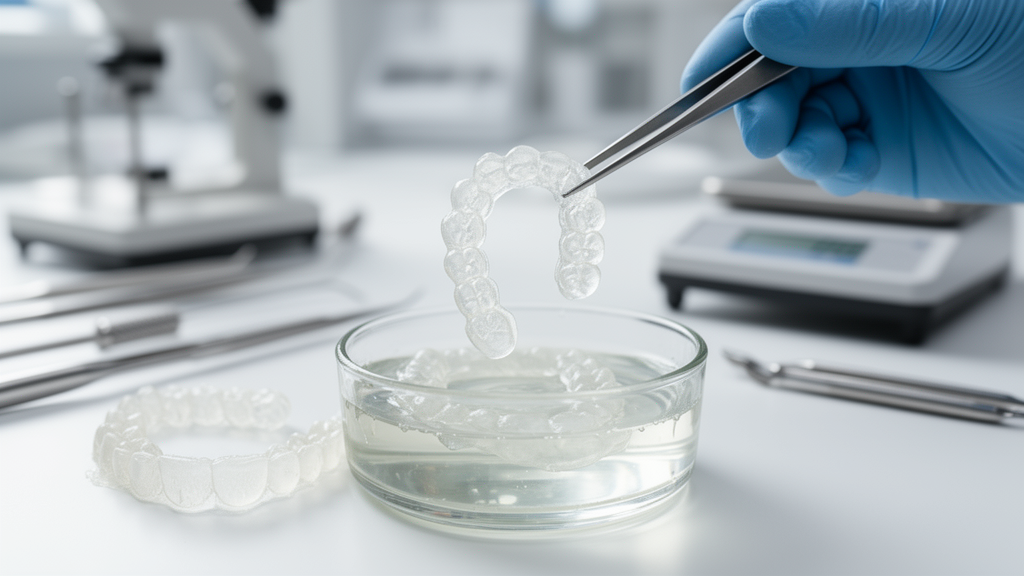
Clear aligners produced by direct 3D printing absorb water when immersed in artificial saliva, gaining up to 3.6 percent of their initial weight within the first four hours and up to 5.4 percent over eleven days, according to an in vitro study published in Digital and Aligner Orthodontics.
The study addressed a growing question in orthodontics. Direct 3D printing of clear aligners has recently become possible with novel resin materials, and compared with the traditional thermoforming method it streamlines the workflow, decreases plastic waste and produces aligners with a better fit. Among the limited number of materials on the market for this purpose, Tera Harz TC-85, produced by Graphy Inc. of Seoul, has received biocompatibility approval from the Korean and US Food and Drug Administrations and has been reported to deliver light forces with reduced force decay. Clear-A, made by Senertek in Turkey, is another resin designed for direct printing that is already commercially available.
Because a polymeric material immersed in a liquid medium undergoes a microstructural transformation that depends on how its polymer chains interact with the medium and how much liquid enters the polymer matrix, the researchers set out to quantify that uptake. The liquid flow can be reversible, but it can also drive a release of monomeric species into the surrounding fluid. Since the raw materials are considered toxic before the printing process, and since large numbers of people use orthodontic aligners, the team argued that assessing the leaching of hazardous compounds is essential for patient safety. Water sorption may also affect dimensional stability and clinical effectiveness, because an absorbed liquid adds weight and causes expansive volumetric change that can loosen the fit of an aligner against the dental arches.
The experimental design was deliberately simplified. Dog-bone shaped specimens, 40 millimeters long, 10 millimeters wide overall with a 5-millimeter gauge width and 2 millimeters thick, were designed in CAD software and printed on a Phrozen Sonic XL 4k 2022 printer. Three groups were created: group A0S used TC-85 resin printed in successive layers of 100 micrometers in the Z direction, group B0S used the same resin at 50 micrometers, and group E0S used Clear-A resin at 50 micrometers. After printing, excess resin was removed in a centrifuge spinning at 1000 revolutions per minute for five minutes twice, and the samples were post-cured for 20 minutes in a curing unit. The TC-85 samples were post-cured with a nitrogen generator, while the Clear-A samples were cured without one, following each manufacturer’s instructions. The samples then received a two-minute ultrasonic bath at 80 degrees Celsius and washing sequences in running water ending with a one-minute bath in boiling water.
Five samples per group, fifteen in total, were weighed dry on a precision balance with an accuracy of 0.001 grams and then placed in test tubes containing 10 milliliters of artificial saliva composed of 99 percent water and 1 percent electrolytes, with a final pH of 7.0. The tubes sat in a thermostatic bath at 37 degrees Celsius. Excess surface liquid was gently removed with damp blotting paper before each weighing. Reliability was high: intraclass correlation coefficients calculated for seven randomly selected samples exceeded 0.98.
The statistical analysis centered on a repeated measures analysis of variance with group and time as factors, preceded by Shapiro-Wilk normality testing and checks of variance homogeneity and sphericity, with a Greenhouse-Geisser correction applied when needed. The results showed a significant longitudinal difference in the relative weight increase of the samples, with p less than 0.001. However, no significant differences were observed among the three groups overall, with p equal to 0.059. A significant group-by-time interaction did emerge, with p less than 0.001, meaning the groups did not follow the same trajectory over time.
Post hoc comparisons clarified where those differences lay. Groups B0S and E0S, printed from different resins at the same 50-micrometer layer thickness, differed significantly in relative weight variation after 10 minutes, 15 minutes, 30 minutes and 240 minutes, with p values of 0.048, less than 0.001, 0.002 and 0.031 respectively. Between groups A0S and B0S, which used the same resin at different resolutions, a significant difference appeared only after one hour, with p equal to 0.016. On that basis the researchers rejected their null hypothesis of no difference between groups. The mean percentage weight increase in the first hour was estimated between 1.5 and 3 percent, with local variations depending on the group, and the trend curves over eleven days showed growth with oscillations within an acceptable experimental uncertainty of 0.005. The maximum relative weight increase over the full 11-day period, 0.054 or 5.4 percent, was reached after 54 hours in the Clear-A group, E0S.
To look for leaching, the team used Fourier-transform infrared spectroscopy with attenuated total reflectance, analyzing the artificial saliva that had been in contact with the samples against a control tube of saliva in which no sample had been immersed. Four saliva samples were taken from group A0S and two each from groups B0S and E0S, and the operator was blinded to the tube labels. All spectra showed residual water vapor and carbon dioxide background features. Only in the saliva from one TC-85 sample, A04S, and possibly a second, A03S, did the researchers observe two very weak bands in the 3000 to 2800 per centimeter range, corresponding to carbon-hydrogen stretching modes that could indicate organic species dissolved from the resin. The authors cautioned that the very low intensity of these signals limits any unambiguous assignment, and that under the simplified experimental conditions no clear FTIR-detectable leaching was observed. Crucially, they emphasized that the absence of detectable FTIR signals should not be interpreted as the absence of trace-level leachables.
The discussion placed these findings in context. Previous work on thermoformed aligners made of multilayer aromatic thermoplastic polyurethane and copolyester polymers found no weight loss after aging in various solutions, though one polymer gained about 2 percent in phosphate-buffered saline and almost 20 percent in strongly acidic solution. Other studies using FTIR on thermoformed aligners exposed to coffee, tea, cola and ultraviolet radiation found chemical properties largely preserved, and no traceable monomer release after ethanol-water immersion. The authors also cited their own unpublished tensile testing, in which dog-bone samples of TC-85 resin kept dry showed a median tensile modulus of 454.42 megapascals, compared with 111.82 megapascals after a one-minute bath at 80 degrees Celsius, a significant difference suggesting that a wet environment, and possibly temperature, alters mechanical behavior.
The study carries clear limitations. The specimens were 2-millimeter-thick dog-bone samples, whereas real aligners are thinner, geometrically more complex, have variable thickness and a larger surface-area-to-volume ratio, and face dynamic oral conditions including bacterial flora, plaque, pH changes, enzymatic activity, thermal cycling, occlusal loads and mechanical stress from insertion and removal. The FTIR analysis was qualitative only, with no calibration curves, so no conclusions could be drawn about which amount of leaching would be clinically relevant. The authors noted that water absorption and leaching may be influenced by residual unreacted acrylate groups, incomplete polymerization and crosslinked network density, and that more sensitive quantitative methods such as high-performance liquid chromatography, gas chromatography-mass spectrometry or liquid chromatography-mass spectrometry are needed. They also observed that the Clear-A group, the only one cured without a nitrogen generator, showed a lower though not significant weight increase, raising the hypothesis that nitrogen-assisted post-curing may be a critical parameter deserving systematic investigation. Further studies under patient-dependent conditions, they concluded, are needed to fully understand the clinical implications of leaching from directly printed aligners.
Subject of Research: Water absorption and leaching of 3D-printed orthodontic aligner resins in artificial saliva
Article Title: Water absorption and leaching inside artificial saliva of resins for 3D direct printing of orthodontic aligners
Article References: Drago, S., Lagazzo, A., Finocchio, E., Pastore, E., Maria, M., & Migliorati, M. (2026). Water absorption and leaching inside artificial saliva of resins for 3D direct printing of orthodontic aligners. Digital and Aligner Orthodontics, 1(1), Article 12. https://doi.org/10.1007/s44525-026-00012-6
Image Credits: AI Generated
DOI: 10.1007/s44525-026-00012-6
Keywords: 3D printing, clear aligners, orthodontics, water absorption, artificial saliva, leaching, FTIR-ATR spectroscopy, dental resins, biocompatibility, post-curing, in vitro study, Tera Harz TC-85
Cite Scienmag News
Ophelia Keating. (October 28, 2026). 3D-Printed Aligner Resins Soak Up Water in Artificial Saliva, Lab Study Finds. Scienmag. https://scienmag.com/3d-printed-aligner-resins-soak-up-water-in-artificial-saliva-lab-study-finds/
Ophelia Keating. "3D-Printed Aligner Resins Soak Up Water in Artificial Saliva, Lab Study Finds." Scienmag, 28 October 2026, https://scienmag.com/3d-printed-aligner-resins-soak-up-water-in-artificial-saliva-lab-study-finds/. Accessed 28 October 2026.
Ophelia Keating. "3D-Printed Aligner Resins Soak Up Water in Artificial Saliva, Lab Study Finds." Scienmag. October 28, 2026. https://scienmag.com/3d-printed-aligner-resins-soak-up-water-in-artificial-saliva-lab-study-finds/









