


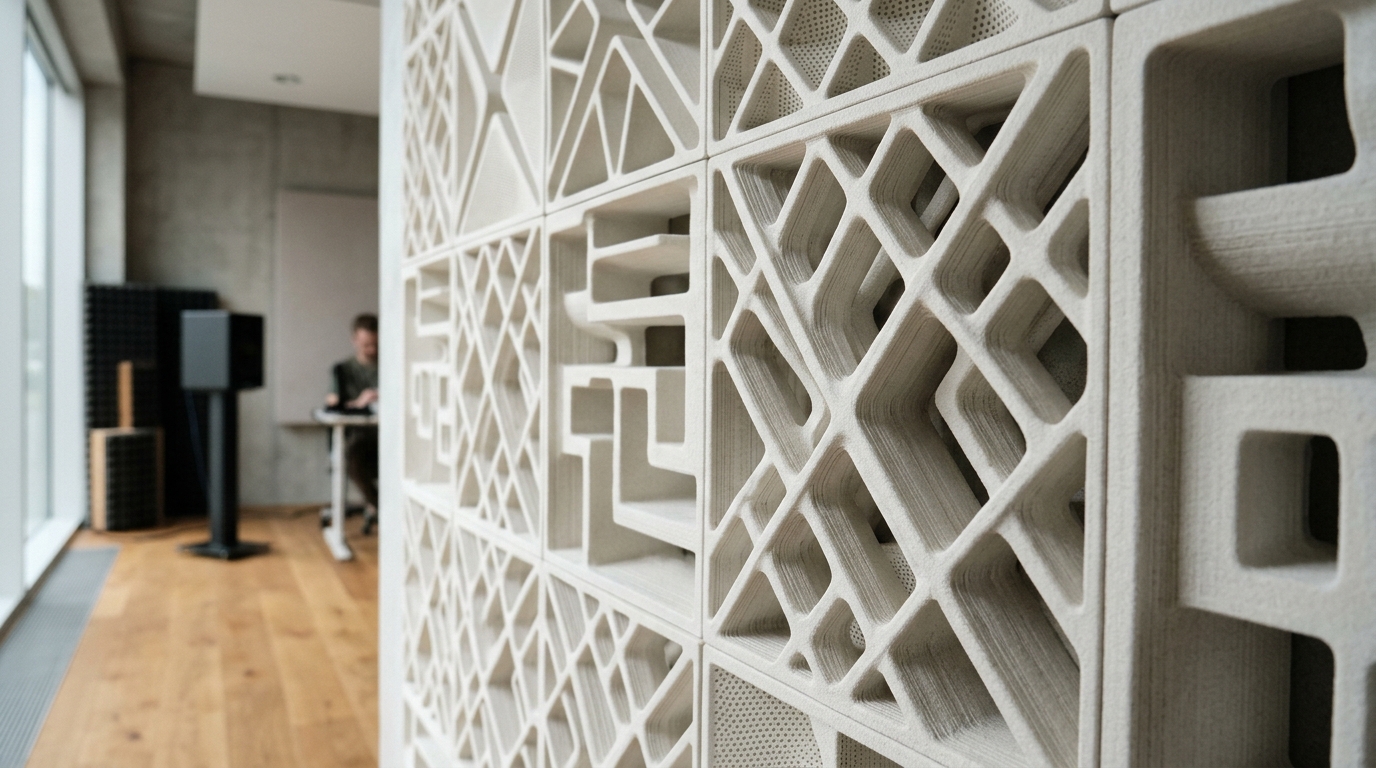
A wide-ranging review of 3D-printed acoustic panels finds that additive manufacturing gives designers a flexible route to porous, lattice, micro-perforated, resonant, and metamaterial architectures that are difficult to realize with conventional manufacturing. The review, published in Frontiers in Mechanical Engineering, combines a bibliometric analysis of Scopus-indexed literature spanning 1980 to 2026 with a critical synthesis of experimental, analytical, numerical, and machine-learning studies on the design, fabrication, modelling, and acoustic performance of 3D-printed sound-absorbing structures.
Across the reviewed literature, a consistent set of design variables emerges as decisive for sound absorption, particularly in the low- and mid-frequency ranges. Porosity, cell topology, perforation geometry, cavity depth, layer thickness, lattice orientation, airflow resistance, and printing parameters repeatedly govern how effectively a printed panel absorbs sound. Because these variables can be controlled precisely in a print file, additive manufacturing allows acoustic geometries to be tuned in ways that traditional fabrication struggles to match.
The review also maps which modelling tools suit which problems. Empirical models remain useful for rapid assessment when limited material information, especially airflow resistivity, is available. JCA-type equivalent-fluid models provide a more physically representative description when reliable microstructural transport parameters are known. Transfer-matrix and resonator-based analytical methods are computationally efficient for layered and geometrically regular systems, while finite-element and other numerical approaches are better suited to complex geometries, manufacturing imperfections, and coupled vibro-acoustic behaviour, although at higher computational cost.
Machine-learning methods show potential for rapid forward prediction, optimization, and inverse design of printed acoustic structures. However, the review notes that their wider use is currently constrained by limited standardized datasets and limited experimental validation, meaning that data-driven design has not yet replaced measurement-backed modelling in this field.
On sustainability, the evidence is more cautious than popular claims suggest. The reviewed studies show that additive manufacturing can improve geometric tunability and, in selected designs, reduce material usage or structural mass. But broader claims of superior performance or sustainability remain application-dependent, the authors caution, and should account for fabrication energy, material durability, recyclability, and end-of-life treatment rather than assuming printed panels are automatically greener.
Barriers to practical implementation are substantial. Manufacturing-induced dimensional deviations can shift resonant frequencies away from design targets. Inconsistent testing protocols make it difficult to compare results across laboratories. Limited diffuse-field and full-scale validation leaves real-room performance uncertain. Material durability, multifunctional design requirements, production scalability, and cost add further hurdles between laboratory demonstrations and deployed acoustic panels.
The review concludes that future progress requires integrated experimental, numerical, and data-driven frameworks, standardized validation procedures, sustainable material selection, and scalable manufacturing strategies. In other words, the field needs better measurements, better shared data, and better links between printing parameters and acoustic outcomes before 3D-printed panels can move from promising prototypes to routine building products.
Subject of Research: A review of experimental, numerical, and machine-learning research on 3D-printed acoustic panels and their sound-absorbing performance.
Article Title: Advances in 3D-printed acoustic panels: experimental investigations, numerical modelling, and machine learning applications
Article References: Kekan, G., Bhojwani, V., Pawar, S. S., & Deshpande, T. (2026). Advances in 3D-printed acoustic panels: experimental investigations, numerical modelling, and machine learning applications. Frontiers in Mechanical Engineering, 12, Article 1975352. https://doi.org/10.3389/fmech.2026.1975352
Image Credits: AI Generated
DOI: 10.3389/fmech.2026.1975352
Keywords: 3D printing, acoustic panels, sound absorption, additive manufacturing, porous materials, machine learning, finite element modelling, airflow resistivity, lattice structures, sustainability, Advances, D-printed
Cite Scienmag News
Denise Maddox. (November 7, 2026). 3D-printed acoustic panels reviewed from experiments to machine learning. Scienmag. https://scienmag.com/3d-printed-acoustic-panels-reviewed-from-experiments-to-machine-learning/
Denise Maddox. "3D-printed acoustic panels reviewed from experiments to machine learning." Scienmag, 7 November 2026, https://scienmag.com/3d-printed-acoustic-panels-reviewed-from-experiments-to-machine-learning/. Accessed 12 November 2026.
Denise Maddox. "3D-printed acoustic panels reviewed from experiments to machine learning." Scienmag. November 7, 2026. https://scienmag.com/3d-printed-acoustic-panels-reviewed-from-experiments-to-machine-learning/




