


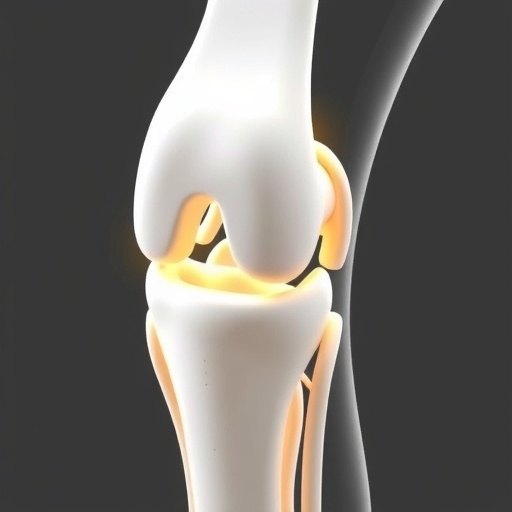
In a significant breakthrough for sports engineering and rehabilitation technology, researchers have pioneered the development of a revolutionary three-dimensional knee brace joint. This research, spearheaded by a team including Q.T. Schmid, S. Ruschke, and D.C. Karampinos, employs advanced MRI data and innovative genetic algorithms to create a knee brace that adapts to the individual needs and movements of the wearer. Their findings, set to be published in the journal Sports Engineering in 2025, could transform the landscape of knee brace technology, offering enhanced comfort, better support, and improved recovery outcomes for athletes and patients alike.
The genesis of this revolutionary knee brace lies in the fusion of cutting-edge imaging technology and sophisticated computational techniques. Magnetic Resonance Imaging, or MRI, has long been pivotal in medical diagnostics, providing detailed images of soft tissues, including ligaments, tendons, and cartilage. In this case, the researchers harnessed MRI data to precisely map the intricate anatomy of the human knee joint. This mapping serves as the foundation for the brace’s personalized design, ensuring that it mirrors the unique geometry and biomechanics of the users’ knees.
At the heart of the development process is the utilization of genetic algorithms, a method inspired by the principles of natural selection and evolution. By simulating various design iterations, the researchers systematically ‘evolved’ the knee brace’s structure to maximize its efficacy. Each iteration undergoes rigorous testing to assess its performance metrics, such as range of motion, stability, and pressure distribution. This iterative process not only speeds up the design phase but also significantly enhances the likelihood of creating a brace that optimally meets the functional demands of its users.
This adroit integration of MRI data and genetic algorithms underscores a promising direction in medical device development. Traditional knee braces often suffer from issues related to comfort and fit, resulting in user noncompliance. By utilizing detailed anatomical imaging, the researchers have overcome many of these challenges, creating a brace that provides superior support where it is needed most while allowing for natural movement. The tailored design is likely to offer enhanced stability during physical activity, reducing the risk of injuries and promoting better athletic performance.
Moreover, the implications of this research extend beyond sports. For individuals recovering from knee surgeries, such as ACL reconstructions, the need for rehabilitation devices that afford both support and mobility is paramount. The dynamic nature of this new knee brace allows for modifications in response to the user’s rehabilitation progress. As they regain strength and range of motion, the brace can adapt accordingly, fostering an environment conducive to healing while minimizing the risk of re-injury.
In addition to its practical applications, the development of this knee brace reflects a broader trend toward personalized medicine and customized healthcare solutions. As advancements in technology make it increasingly feasible to tailor medical devices to individual anatomical and functional profiles, we can expect to see a paradigm shift in how healthcare professionals approach treatment. This knee brace is not just a product; it’s indicative of a transformative approach to medical device design that prioritizes the user’s experience and outcomes.
Furthermore, this research sets a precedent for future innovations within the field of sports engineering. The blend of advanced imaging techniques with computational modeling opens the door to a myriad of possibilities, allowing engineers and researchers to develop more sophisticated solutions for various orthopedic problems. As the technology evolves, we can envision the creation of fully customizable prosthetics, orthotics, and other assistive devices designed with the user’s specific needs and activity levels in mind.
As athletes become more aware of the critical role that equipment plays in performance and injury prevention, they are likely to welcome advancements such as this knee brace with open arms. By providing enhanced functionality and comfort, this knee brace could very well become a staple for athletes across various sports. While the prototype is still in development, the promise of more stable and adaptable knee support tools is generating excitement among sports professionals and biomechanical engineers alike.
The ultimate goal of this research extends beyond mere comfort—it aims to empower users to engage fully in their physical activities. The increased mobility and support that this knee brace offers could be the key to unlocking new levels of performance for many athletes. Whether on the soccer field, basketball court, or in the gym, the ability to rely on a well-fitting, adaptive knee brace will allow for greater freedom of movement without the constant worry of sustaining an injury.
Moreover, the collaboration among the researchers signifies the importance of multidisciplinary teamwork in driving innovation. The integration of engineering principles, medical insights, and user experience design illustrates how multifaceted approaches can yield groundbreaking results. The work of Schmid, Ruschke, and Karampinos serves as a model for future research initiatives that seek to harness diverse expertise to tackle complex challenges in sports engineering and rehabilitation.
As anticipation builds for the release of this groundbreaking work, we recognize the profound impact it could have on not only athletes but also the broader medical community. The successful alignment of MRI technology and genetic algorithms exemplifies the potential for transformative advancements in designing devices that are more effective and user-friendly. The future looks bright for those in need of orthopedic support, as the industry moves closer to developing solutions that genuinely accommodate individual needs and preferences.
The next steps in this research will undoubtedly focus on further refining the prototype and evaluating its performance in real-world settings. Clinical trials will be instrumental in assessing how this knee brace performs during typical daily activities and rigorous athletic endeavors. With continued advancements in the field, we may soon see this innovative brace on the market, providing users with a degree of support and comfort never before realized in a knee brace design.
For now, the future remains optimistic. Innovations such as this one highlight the transformative capabilities of modern technology and serve to inspire future exploration and research in biomechanics, sports science, and rehabilitation. As new findings emerge and evolve, we stand on the front lines of a revolution in how we understand and support the human body in motion.
In conclusion, the development of a 3D knee brace joint utilizing MRI data and genetic algorithms marks a pivotal moment in sports engineering. With the potential to redefine how knee support is approached, this research not only aims to enhance athletic performance but also fosters a commitment to individualized care in rehabilitation. As we await further findings and the eventual rollout of this knee brace, we are reminded of the endless possibilities when technology, research, and human physiology intersect.
Schmid, Q.T., Ruschke, S., Karampinos, D.C. et al. Development of a 3D-knee brace joint using MRI data and a genetic algorithm.
Sports Eng 28, 5 (2025). https://doi.org/10.1007/s12283-025-00486-8
Cite Scienmag News
Denise Maddox. (September 2, 2025). 3D Knee Brace Joint Created via MRI and Algorithms. Scienmag. https://scienmag.com/3d-knee-brace-joint-created-via-mri-and-algorithms/
Denise Maddox. "3D Knee Brace Joint Created via MRI and Algorithms." Scienmag, 2 September 2025, https://scienmag.com/3d-knee-brace-joint-created-via-mri-and-algorithms/. Accessed 3 September 2026.
Denise Maddox. "3D Knee Brace Joint Created via MRI and Algorithms." Scienmag. September 2, 2025. https://scienmag.com/3d-knee-brace-joint-created-via-mri-and-algorithms/


