


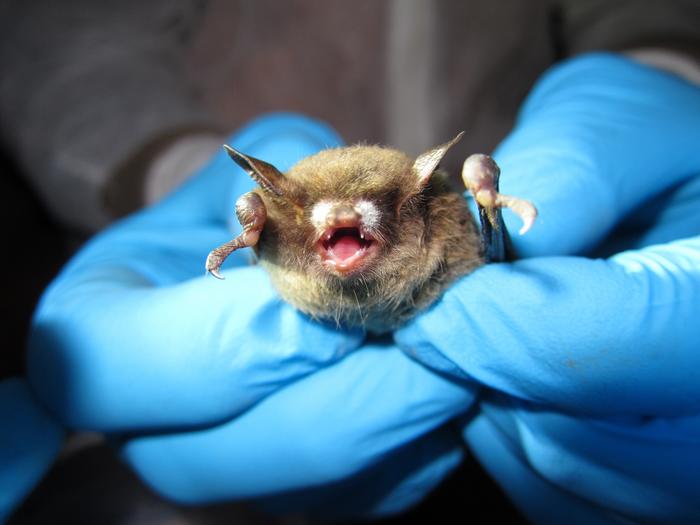
MISSOULA – Since 2006, a fast-moving disease known as white-nose syndrome has killed an estimated 6.7 million bats, wiping out entire colonies and decimating creatures that provide an integral means of pest control.

Credit: Photo by Steve Taylor
MISSOULA – Since 2006, a fast-moving disease known as white-nose syndrome has killed an estimated 6.7 million bats, wiping out entire colonies and decimating creatures that provide an integral means of pest control.
In response, a first-of-its-kind study by the University of Montana recently was funded by the National Science Foundation to provide critical insights on three North American bat species that are adapting to the dual threats of this disease and climate change.
Awarded nearly $3 million dollars, the project will officially start Sept. 1, but groundwork already is well underway this summer.
Although infectious diseases occur naturally in wildlife populations, globalization and rapid environmental shifts are worsening the impact of wildlife diseases and increasing the likelihood of spillover to humans. The UM research will explore this phenomenon and is led by Erin Landguth, a public health sciences associate professor and ecological modeling researcher. She will be joined by Julie Weckworth, a UM research scientist in wildlife disease genetics, and Casey Day, a UM research scientist in computational landscape and behavior ecology.
The NSF-funded work will focus on three North American bat species significantly impacted by white-nose syndrome, a fungal disease that has devastated bat populations across the continent.
WNS is a disease that was born in Eurasia but is significantly impacting bats in North America, infecting 12 types of bats and killing millions. UM researchers are collaborating with United Kingdom scientists, including Dr. Orly Razgour, a molecular ecologist and conservation biologist who specializes in bats, and experts in bioinformatics (Dr. Rhys Farrer) and fungal pathogens (Dr. Duncan Wilson).
Collectively, the scientists will explore how certain bats have genetic traits that enable them to survive WNS and adapt to changing environmental conditions. With this data, the collaborators plan to build a sophisticated computer model that forecasts bat movement across landscapes and investigate the genetic factors that contribute to population resilience.
Using a computational model Landguth created, the research will build upon previous work by layering in climate change variables, species biological patterns and disease factors. The main objective is to more accurately understand the different aspects of tracking wildlife disease across large landscapes. The team will collaborate with U.S. Fish and Wildlife, which already has a WNS response team, and other species-specific agencies.
“Modeling disease, genetics and population movement is complex from every angle,” Landguth said. “By integrating genetic and disease processes with ecological and biological data, we can generate more accurate forecasts that can be vital for wildlife conservation and public health planning.”
The project boasts researchers with a wide range of expertise, including wildlife biology, disease ecology, microbiology, bioinformatics, computational ecology and conservation biology. Beyond scientific advancements, the project will offer practical benefits such as developing wildlife health planning maps and public education on the nuances of disease transmission in wildlife.
By identifying critical bat populations capable of resisting and tolerating disease while coping with climate shifts, this research also will aid conservation efforts. This comes at a time when the Endangered Species Act already has listed several bats species because of WNS, with other species being considered for enlistment.
“For someone who is interested in wildlife conservation, this is a disease that is super concerning,” Weckworth said. “This NSF grant will be a springboard to build more research that can help us apply tools to explicitly understand disease modeling.”
She said the study represents a significant step forward in understanding and mitigating the impacts of disease and climate change on wildlife populations, with far-reaching implications for conservation and public health.
###
Cite Scienmag News
Sloane Callahan. (July 11, 2024). $3 million federal grant to fund University of Montana research on bats, climate change. Scienmag. https://scienmag.com/3-million-federal-grant-to-fund-university-of-montana-research-on-bats-climate-change/
Sloane Callahan. "$3 million federal grant to fund University of Montana research on bats, climate change." Scienmag, 11 July 2024, https://scienmag.com/3-million-federal-grant-to-fund-university-of-montana-research-on-bats-climate-change/. Accessed 3 September 2026.
Sloane Callahan. "$3 million federal grant to fund University of Montana research on bats, climate change." Scienmag. July 11, 2024. https://scienmag.com/3-million-federal-grant-to-fund-university-of-montana-research-on-bats-climate-change/

