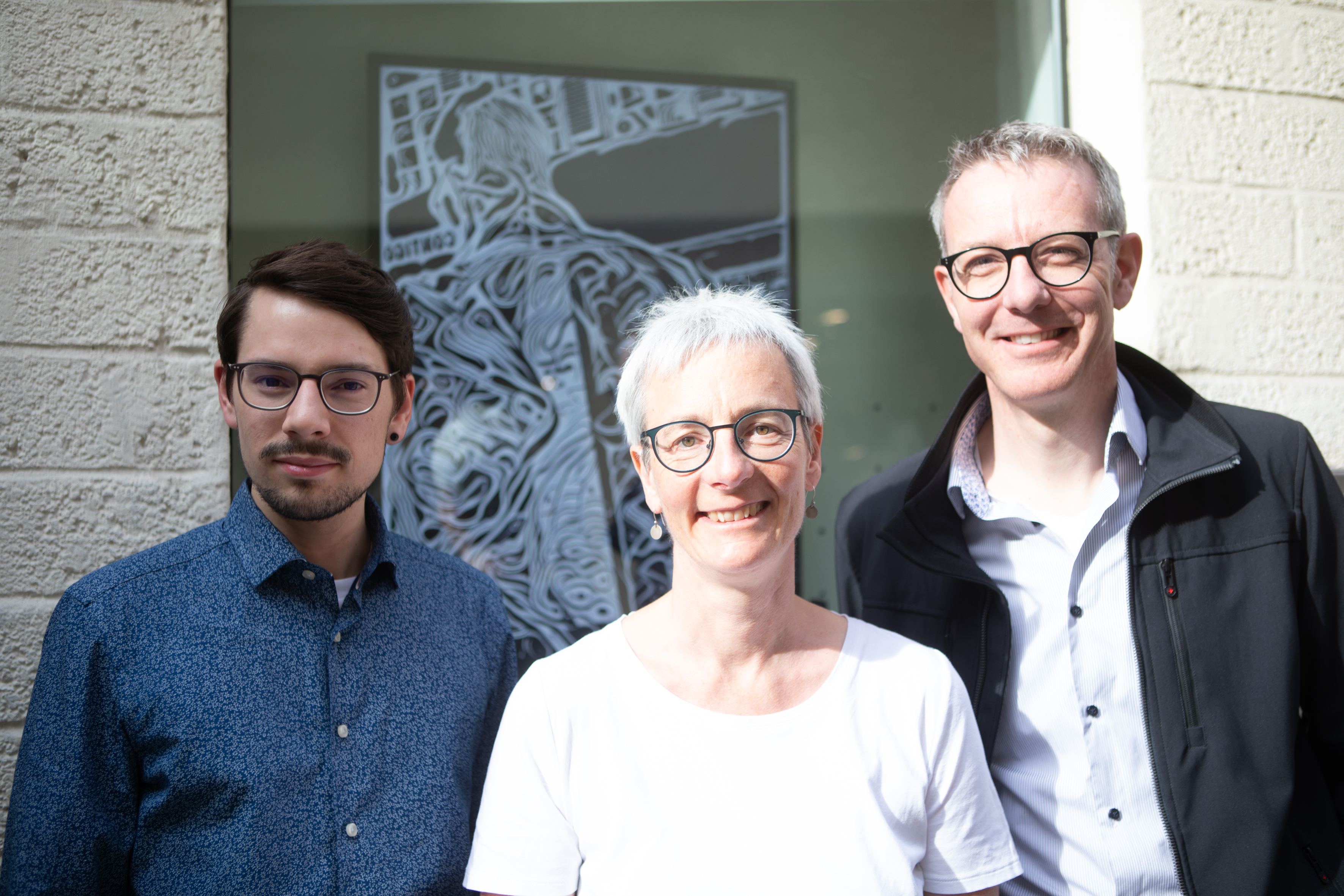
This year’s Communicator Award presented by the Deutsche Forschungsgemeinschaft (DFG, German Research Foundation) and Stifterverband goes to an interdisciplinary research team consisting of one computer scientist and two cultural scholars, all of whom are based in Tübingen: Ulrike von Luxburg, Professor for the Theory of Machine Learning at the University of Tübingen, Tim Schaffarczik, doctoral researcher at the Institute of Historical and Cultural Anthropology, University of Tübingen, and Thomas Thiemeyer, Professor of Museum Studies, likewise at the Institute of Historical and Cultural Anthropology in Tübingen. They receive the award worth €50,000 in recognition of their outstanding and diverse science communication in developing and implementing of the exhibition “Cyber and the City: Artificial Intelligence Moves Tübingen”, which also provides a role model for how to engage in dialogue on other controversial topics relating to science and technology.
This year’s Communicator Award presented by the Deutsche Forschungsgemeinschaft (DFG, German Research Foundation) and Stifterverband goes to an interdisciplinary research team consisting of one computer scientist and two cultural scholars, all of whom are based in Tübingen: Ulrike von Luxburg, Professor for the Theory of Machine Learning at the University of Tübingen, Tim Schaffarczik, doctoral researcher at the Institute of Historical and Cultural Anthropology, University of Tübingen, and Thomas Thiemeyer, Professor of Museum Studies, likewise at the Institute of Historical and Cultural Anthropology in Tübingen. They receive the award worth €50,000 in recognition of their outstanding and diverse science communication in developing and implementing of the exhibition “Cyber and the City: Artificial Intelligence Moves Tübingen”, which also provides a role model for how to engage in dialogue on other controversial topics relating to science and technology.
Chaired by DFG Vice President Professor Dr. Johannes Grave and made up of science journalists as well as communication and PR experts, the jury said in its decision that the “Cyber and the City” team had transported the abstract and controversial topic of artificial intelligence into the world of people’s day-to-day lives and experience, while also opening up a space for dialogue that allowed negotiation of starkly differing points of view and interests.
In order to achieve this, the jury’s statement went on, the team had engaged in a productive interdisciplinary collaboration between computer science and empirical cultural studies to create an exhibition at Tübingen City Museum, complete with accompanying programme. Students of the two disciplines did the groundwork for the exhibition and the other communication channels, involving interest groups, citizens, activists and decision-makers in both conception and implementation. According to the Communicator Award jury, the result was a communication platform that finds a common language to address the challenges and opportunities of artificial intelligence while allowing both supporters and sceptics of AI to have their say.
An extensive accompanying programme was developed which enabled exhibition participants to organise their own events. The latter included a “Retro Gaming Night meets AI” and also a panel discussion entitled “Who controls AI?”, organised in cooperation with broadcaster SWR. From February to early December 2023, the exhibition attracted approximately 40,000 visitors from different age groups – in a city with a population of around 90,000. Taken as a whole, the exhibition and accompanying programme established a framework for dialogue that provided an objective basis for the highly controversial debate surrounding artificial intelligence in Tübingen without neglecting emotions and standpoints.
The Communicator Award jury emphasised that one vital element of the project was the fact that communication is locally oriented: despite being something that takes effect on a global scale while also being an issue that was difficult for most people to grasp, AI was negotiated here based on concrete examples, informed by impassioned debate in the city and involving local actors. What is more, the whole thing did not take place in digital forums but in direct dialogue between the participants. The jury said that this demonstrated how successful the team had been in exploring a tough issue in a light, humorous way while still maintaining objectivity and a keen sense of judgement. All in all, the jury saw the team’s work as a fine example of dialogue-based science communication that went well beyond the location and the specific topic. According to the jury, this was an especially encouraging project in the light of a contemporary dialogue culture which barely permitted constructive exchange between different arguments and standpoints.
The Communicator Award – Science Award of the Stifterverband has been awarded every year since 2000 and is regarded as Germany’s most important prize of its kind. The award goes to researchers who are particularly creative in their science communication, taking new, courageous paths and addressing their target groups in suitable and effective ways. They must also recognise the societal dimension of their research and contribute their knowledge to public debate, opinion-forming and decision-making processes. The prize money supports the recipient’s public engagement activities and enables them to implement new projects.
The jury selected the winning team by means of a multi-stage selection process out of 38 applications and nominations. The Communicator Award will be presented by DFG President Professor Dr. Katja Becker and former Stifterverband President and Honorary Member Professor Dr. Dr. Andreas Barner at the DFG annual meeting in Potsdam on Monday, 01 July 2024.
Further information
For information on the Communicator Award, see:
Media contact:
Magdalena Schaeffer, DFG, Press and Public Relations, Tel. +49 228 885 2109, presse@dfg.de
Peggy Groß, Stifterverband, Press Officer, Tel. +49 30 322982-530, presse@stifterverband.de
Media contact at the award winners’ institute:
Oliver Häußler, University of Tübingen, University Communication, Tel: + 49 7071 29-77851
oliver.haeussler@uni-tuebingen.de
Theresa Authaler, Cluster of Excellence “Machine Learning”, Tel: +49 162 1788206,
theresa.authaler@uni-tuebingen.de
Photograph of the 2024 Communicator Award winners:
Download
Credit: Friedhelm Albrecht/University of Tübingen
The photograph shows (from left to right) Tim Schaffarczik, Ulrike von Luxburg, Thomas Thiemeyer
Cite Scienmag News
Denise Maddox. (April 19, 2024). 2024 Communicator Award goes to “Cyber and the City” research team based in Tübingen. Scienmag. https://scienmag.com/2024-communicator-award-goes-to-cyber-and-the-city-research-team-based-in-tubingen/
Denise Maddox. "2024 Communicator Award goes to “Cyber and the City” research team based in Tübingen." Scienmag, 19 April 2024, https://scienmag.com/2024-communicator-award-goes-to-cyber-and-the-city-research-team-based-in-tubingen/. Accessed 3 September 2026.
Denise Maddox. "2024 Communicator Award goes to “Cyber and the City” research team based in Tübingen." Scienmag. April 19, 2024. https://scienmag.com/2024-communicator-award-goes-to-cyber-and-the-city-research-team-based-in-tubingen/