


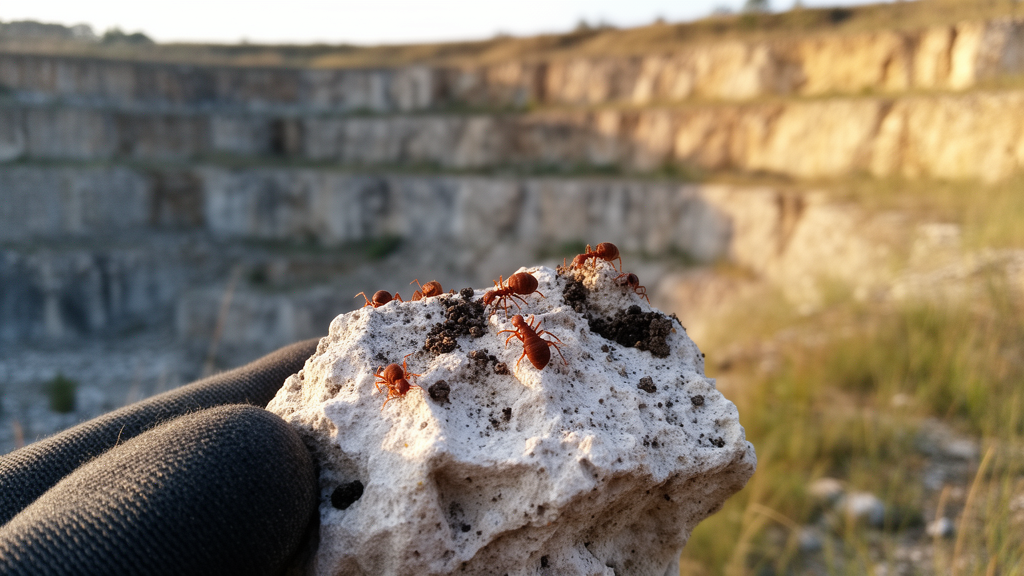
A 2022 field survey of oribatid mites at and around Georgia’s Saskhori limestone quarry recorded 52 species, including 23 species newly reported for the quarry and one species newly recorded for the Caucasus fauna. The survey sampled seven habitats before and during mining-related disturbance, providing a baseline for monitoring changes in the area’s soil fauna.
The study was conducted in the limestone quarry near the village of Saskhori, southeast of Kaspi in Georgia’s Kartli Region. The quarry is owned by the Heidelberg Cement Company, and mining began in 2018. A survey conducted in 2018 before mining activities started had recorded 51 oribatid mite species across the area. The 2022 investigation repeated sampling across the quarry and adjacent landscapes to examine community composition, diversity, abundance and possible changes associated with anthropogenic disturbance.
Researchers collected soil in February, April and July 2022 from seven locations. The habitats included degraded steppe with rural and invasive plants, Mediterranean-type deciduous drought-resistant shrubbery, bare limestone bedrock, degraded xero-thermophilous oak forest, shrubland, an almond garden and mixed oak-hornbeam woodland and shrubbery. At each site, three 10-cubic-centimetre soil samples were randomly collected with a steel corer. In total, 63 samples were extracted for seven days in Berlese-Tullgren apparatuses, and the recovered material was preserved in 96% alcohol.
Specimens were mounted on temporary slides with lactic acid and identified microscopically. The analysis used taxonomic identification keys, rarefaction and extrapolation with 100 bootstrap replicates, and comparisons of species richness, individual density, Shannon diversity, Pielou evenness and Sørensen similarity. Neighbour-joining clustering based on Euclidean distance was also applied. The deposited specimens were assigned to the collection of the Institute of Zoology at Ilia State University in Tbilisi.
The survey yielded 983 mites representing 52 species, 41 genera and 28 families. Site Sa2, in Mediterranean-type deciduous drought-resistant shrubbery, had the highest richness, with 27 species, while Sa1, Sa4 and Sa7 each contained 22. Across habitat types, shrubbery was richest with 37 species, followed by the xero-thermophilous oak forest and mixed oak-hornbeam vegetation with 32. The almond garden’s rural and urban habitat contained 10 species, the lowest total recorded. Sa2 also had the largest number of individuals, with 191, followed by Sa1 with 185 and Sa3 with 175.
Xenillus tegeocranus was the most abundant species, with 120 specimens from six sites. Aleurodamaeus setosus had 106 specimens, Punctoribates punctum 85 and Ceratoppia bipilis 66, also across six of the seven sites. Seventeen species occurred at only one location. Shannon diversity was highest at Sa2, where H equalled 2.72, and lowest at Sa6, where H was 1.97 in Table 3. Pielou evenness ranged from 0.77 at Sa1 to 0.87 at Sa5 and Sa6. Sørensen-based clustering placed Sa1 with Sa2 and Sa3 with Sa4, while the Sa6 community was the most distinct from those in natural and semi-natural habitats.
Rarefaction and extrapolation indicated that additional sampling was likely to detect more species. The model estimated a maximum expected richness of 67 species, with an upper confidence limit of 88. Only 29 species, or 39% of the taxa reported in the two surveys, were shared between the 2018 and 2022 studies. The authors said the large difference in composition was probably driven more by incomplete sampling in both investigations than by faunal turnover over such a short interval. They also observed changes in relative abundance: several species found at one location in 2018 occurred at multiple sites in 2022, and Aleurodamaeus setosus and Punctoribates punctum joined Xenillus tegeocranus and Scheloribates laevigatus as broadly distributed species.
One taxonomic finding was the first Caucasus record of Liacarus oribatelloides, a species described in 1956 from the Czech Republic. Before the Saskhori finding, it had been reported from several Central European locations, including southern Germany, Austria, Italy, Slovakia, Poland, the Central Alps and the Tatra Mountains. The Saskhori specimens measured 1084–1198 micrometres in body length and 657–728 micrometres in width. They were distinguished from L. coracinus by their elongated, dark-brown to black body, strongly elongated lamellar cusp tips, a longer leg IV and a distinct inner tooth on the femur of leg IV.
The taxonomic status of L. oribatelloides remains uncertain. The latest world catalogue cited by the study treats it as a senior synonym of L. coracinus, while other publications have treated it as valid. The authors therefore stated that molecular genetic analysis is needed to clarify its status and interspecific boundaries within Liacarus. At the community level, the survey found lower mite density and diversity at heavily grazed sites where soil structure was destroyed, while more natural vegetation supported richer communities. The authors associated the observed community change most probably with ongoing limestone mining, but emphasized that the study’s extent and design do not permit predictions about future faunal changes.
Subject of Research: A 2022 field survey of oribatid mite species diversity, abundance and taxonomy across a Georgian limestone quarry and adjacent habitats.
Article Title: Soil mite ( Acari : Oribatida ) communities in the limestone quarry of Saskhori (Gerogia)
Article References: Arabuli, T., & Gogshelidze, M. (2023). Soil mite (Acari: Oribatida) communities in the limestone quarry of Saskhori (Gerogia). Caucasiana, 2, 189-197. https://doi.org/10.3897/caucasiana.2.e110495
Image Credits: AI Generated
DOI: 10.3897/caucasiana.2.e110495
Keywords: oribatid mites, soil biodiversity, Saskhori quarry, Georgia, habitat disturbance, limestone mining, species richness, ecological monitoring, Caucasus fauna, Liacarus oribatelloides, Soil, mite
Cite Scienmag News
Margaret Porter. (October 20, 2026). 2022 field survey finds 52 oribatid mite species at Georgia’s Saskhori limestone quarry. Scienmag. https://scienmag.com/2022-field-survey-finds-52-oribatid-mite-species-at-georgias-saskhori-limestone-quarry/
Margaret Porter. "2022 field survey finds 52 oribatid mite species at Georgia’s Saskhori limestone quarry." Scienmag, 20 October 2026, https://scienmag.com/2022-field-survey-finds-52-oribatid-mite-species-at-georgias-saskhori-limestone-quarry/. Accessed 20 October 2026.
Margaret Porter. "2022 field survey finds 52 oribatid mite species at Georgia’s Saskhori limestone quarry." Scienmag. October 20, 2026. https://scienmag.com/2022-field-survey-finds-52-oribatid-mite-species-at-georgias-saskhori-limestone-quarry/


