


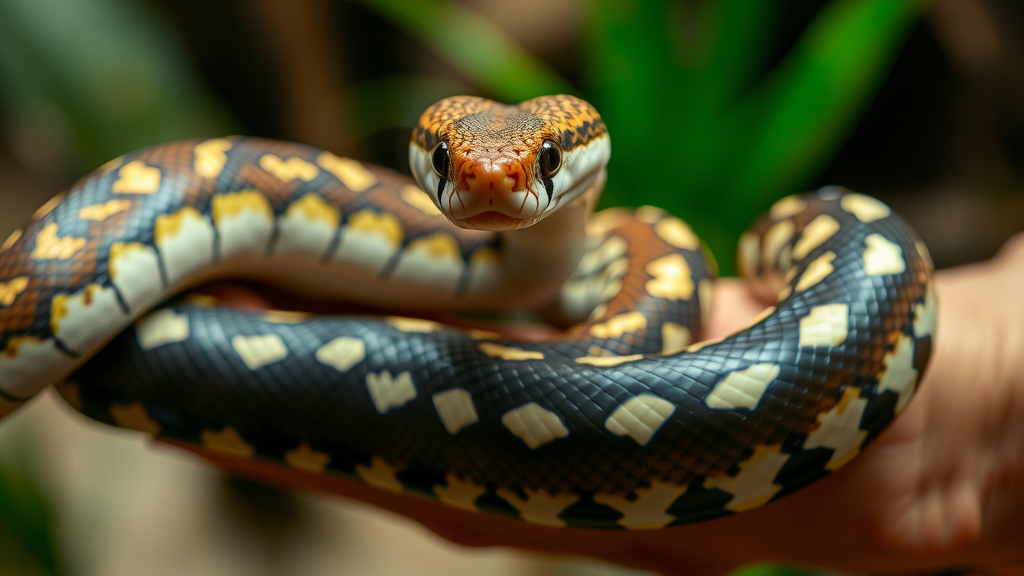
Snakes are among the most misunderstood animals in the world, and for decades, they have been a popular choice for zoo educators hoping to challenge public perceptions and foster conservation awareness. However, despite their frequent use in animal interaction programs, very little research has examined how direct human handling affects their welfare. A new study from Australia now offers rare experimental evidence, suggesting that when handled regularly by trained staff, captive pythons may experience no negative welfare effects—and may even benefit in some unexpected ways.
The research, conducted at Cleland Wildlife Park in South Australia, was led by scientists from the University of Adelaide and published in the journal Veterinary Medicine and Science. The team set out to fill a substantial knowledge gap. While enrichment studies in reptiles have grown steadily, direct handling by humans—an increasingly common practice in zoos and wildlife parks worldwide—has remained largely unstudied, particularly in snakes.
Three individual snakes were observed over several weeks: two children’s pythons and one woma python. All three were experienced animals, regularly used in the park’s education sessions prior to the study. Each snake was housed individually in a temperature-controlled enclosure with appropriate heating, lighting, hides, branches, and water. Staff led handling sessions in which snakes were held by trained education officers, and visitors could touch the caudal body with an open palm under supervision.
To capture a detailed picture of snake behaviour, the researchers installed time-lapse cameras outside each enclosure, recording 10-second clips at 5-minute intervals for 10 hours each day. The footage was then coded using a purpose-built ethogram adapted from established reptile behavioural studies. Sixteen distinct behaviours were grouped into four functional classes: active, inactive, abnormal, and out of sight. Behaviours considered potentially stress-related included freezing, window striking, boundary contact, rapid body movement, and tail flicking.
The researchers compared behaviour across two dimensions: handling days versus non-handling days, and the hours immediately before versus the hours immediately after a handling session. They analysed the data using Friedman’s two-way ANOVA by ranks, a non-parametric statistical test suited to repeated measures with non-normal distributions.
The results were striking. After handling events, the snakes showed a significant increase in inactive behaviour and a significant decrease in out-of-sight behaviour, suggesting they were more visible and resting calmly in view. On handling days compared to non-handling days, abnormal behaviours—particularly boundary contact, a behaviour associated with escape motivation—decreased significantly. Active and abnormal behaviours showed no significant change in the pre- versus post-handling comparison.
Taken together, these findings indicate that regular, staff-led handling had little to no negative welfare impact on the snakes studied. The authors suggest that the snakes may have habituated to handling over time, a process broadly defined as decreased responding after repeated exposure to a stimulus. In some zoo species, human interaction has even been shown to act as a form of environmental enrichment, and the reduced escape-motivated behaviour observed here hints that handling may be a neutral or potentially enriching experience for habituated individuals.
However, the researchers urge caution. The study involved only three snakes across two species, a small sample size typical of zoo welfare research but one that limits statistical power and generalisability. Observations were restricted to daytime hours, potentially missing nocturnal behaviours. The study also relied exclusively on behavioural indicators, without physiological measures of stress, and the snakes were moved from controlled enclosures to ambient handling environments where temperature and lighting differences could have influenced their behaviour independently of handling itself.
The findings also contrast with studies of other reptiles, such as tuataras and tortoises, where direct visitor handling has been shown to negatively impact welfare. The authors suggest these differences may reflect species-typical traits, handling protocols, husbandry conditions, and methodological variations between studies. Notably, the snakes in this study had long histories of regular handling, meaning the results may not apply to snakes unaccustomed to such interactions.
The research team hopes this study will encourage more rigorous welfare assessment for reptiles, a group that has long been overlooked in favour of mammals and birds. They advocate for combining behavioural ethograms with physiological indicators, behavioural diversity measures, and enclosure use variability to build a more complete picture of captive snake well-being. As animal interaction programs continue to grow in popularity, the study provides a valuable first step towards evidence-based handling practices—moving beyond anecdote and folklore towards a scientific understanding of what these remarkable animals actually experience when they are placed in human hands.
Beyond the immediate findings, the study contributes to a broader scientific conversation about how welfare should be defined and measured in reptiles, an animal class whose biology differs profoundly from the mammals and birds in which most welfare science was originally developed. Snakes lack limbs, rely heavily on chemical and thermal cues rather than vision, and express many of their most informative behaviours through posture, tongue flicking, and subtle changes in movement patterns. This means that conventional welfare indicators developed for mammals, such as facial expressions, vocalisations, or social withdrawal, are largely inapplicable, forcing researchers to build assessment tools from the ground up around reptile-specific behavioural repertoires.
The concept of behavioural diversity has become increasingly important in this context. Rather than tracking the frequency of any single behaviour, diversity measures capture the variety and evenness of behaviours an animal displays over time. A healthy captive animal typically shows a richer and more balanced behavioural profile, whereas chronic stress tends to compress behaviour into a narrow repertoire dominated by inactivity or repetitive actions. Incorporating such metrics alongside the ethogram used in this study could strengthen future work by distinguishing between simple habituation to handling and genuine positive engagement with the environment.
Habituation itself deserves careful consideration in zoo contexts. The decreased responding observed after repeated exposure to a stimulus is often framed as beneficial, reducing stress during necessary procedures such as veterinary examinations or transport. Yet the underlying mechanisms matter. Reduced responsiveness could reflect a calm, secure animal, or it could mask a state in which the animal has simply ceased responding because escape is impossible, sometimes described as a form of learned helplessness. Behavioural data alone cannot always separate these possibilities, which is why the study’s authors emphasise the need for physiological corroboration.
Physiological stress markers for reptiles remain less standardised than for endotherms. Corticosterone, the primary glucocorticoid in reptiles, can be measured in blood, faeces, saliva, and even shed skin, offering non-invasive or minimally invasive sampling routes. However, baseline concentrations vary widely with season, reproductive status, body temperature, and time of day in ectothermic species, complicating interpretation. Ectothermy itself introduces a methodological challenge the authors acknowledge: because snakes depend on ambient heat to regulate body temperature, moving them between the climate-controlled education centre and a different handling environment could alter activity levels through thermal effects alone, independent of any psychological response to human contact.
The python species involved bring their own biological context. Children’s pythons and woma pythons are Australian species with generally docile reputations and long histories in education and captive husbandry. Woma pythons, in particular, are known for relatively calm temperaments and inquisitive behaviour, which may predispose them to tolerate, or even benefit from, structured interaction. Species differences of this kind are central to explaining why the present results diverge from findings in tuataras and tortoises, where visitor handling produced measurable harm. Reptile taxa occupy vastly different ecological niches, and a protocol appropriate for one lineage cannot be assumed safe for another.
The timing of observations also carries relevance for snake welfare. Snakes are predominantly crepuscular or nocturnal, and many species, including several pythons, are most active outside daylight hours. By restricting recording to 10 daytime hours, the study may have captured rest periods rather than peak activity, potentially understating the full behavioural consequences of handling sessions. Future studies could extend monitoring into evening and overnight windows using infrared recording, providing a round-the-clock picture of how handling events ripple through an individual’s daily activity budget.
The irregular scheduling of handling sessions in this study was methodologically useful, since predictable routines could themselves shape anticipatory behaviour. Nevertheless, anticipatory responses in snakes remain poorly characterised. Whether these animals can learn to associate cues preceding handling with the event, and whether such anticipation produces positive or negative affective states, represents an open question for comparative cognition research with reptiles.
Scale is a persistent constraint in zoo-based welfare research. Facilities typically house few individuals of any given species, limiting statistical power, and animals cannot ethically be subjected to adverse conditions simply to generate contrast. This makes multi-zoo collaborations and accumulating replication across institutions especially valuable. Longitudinal designs that follow individuals across years, rather than weeks, would also help determine whether the apparent neutrality of handling persists as animals age, and whether subtle costs accumulate over hundreds of sessions.
Finally, the study carries practical implications for the hundreds of facilities worldwide that feature snakes in education programs. Documenting that regularly handled, well-housed pythons showed reduced escape-motivated behaviour on handling days supports a cautious but evidence-based case that such programs need not compromise welfare when conducted by trained staff with appropriate pre-handling screening, such as excluding animals in shed or recently fed. At the same time, the findings apply only to habituated individuals within carefully managed conditions, and institutions should not extrapolate them to novel animals, alternative taxa, or less controlled contact formats without dedicated assessment.
Subject of Research: Behavioural welfare effects of human handling practices on captive zoo snakes
Article Title: Behavioural Welfare Implications of Human Handling Practices in Zoo Snakes
Article References: Behavioural Welfare Implications of Human Handling Practices in Zoo Snakes. (n.d.). https://doi.org/10.1002/vms3.71218
Image Credits: AI Generated
DOI: 10.1002/vms3.71218
Keywords: zoo snakes, animal welfare, animal-visitor interactions, handling, pythons, reptile behaviour, stress behaviours, ethogram, habituation, environmental enrichment, captive reptiles, Cleland Wildlife Park
Cite Scienmag News
Margaret Porter. (September 20, 2026). Zoo Snakes May Find Regular Human Handling Surprisingly Stress-Free. Scienmag. https://scienmag.com/zoo-snakes-may-find-regular-human-handling-surprisingly-stress-free/
Margaret Porter. "Zoo Snakes May Find Regular Human Handling Surprisingly Stress-Free." Scienmag, 20 September 2026, https://scienmag.com/zoo-snakes-may-find-regular-human-handling-surprisingly-stress-free/. Accessed 4 October 2026.
Margaret Porter. "Zoo Snakes May Find Regular Human Handling Surprisingly Stress-Free." Scienmag. September 20, 2026. https://scienmag.com/zoo-snakes-may-find-regular-human-handling-surprisingly-stress-free/


