

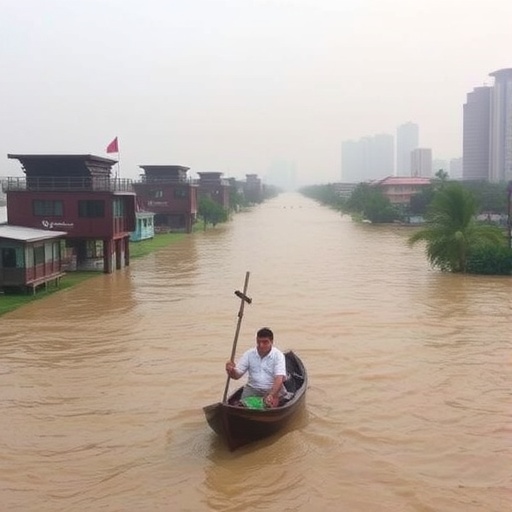
A groundbreaking new study published in Nature Communications in 2026 unveils a striking connection between the increased frequency of devastating floods in the Yangtze River basin and a fundamental shift in the wave dynamics of the Indian Ocean. This multidisciplinary research, conducted by Dasgupta, Nam, McPhaden, and colleagues, harnesses advanced climate modeling and oceanographic data to decode the complex teleconnections driving climate extremes in East Asia. The findings are poised to reshape scientific understanding of regional flood risks under global climate variability and may catalyze the redesign of flood management strategies for the Yangtze River region, home to hundreds of millions of people.
At first glance, the Yangtze River floods appear to be a localized phenomenon, influenced mainly by seasonal rainfall and upstream hydrological processes. However, the research team traced an intricate web of atmospheric and oceanic interactions that link flood events with alterations occurring thousands of kilometers away in the Indian Ocean’s wave regime. By analyzing satellite altimetry records, buoy data, and sophisticated wave climate models over multiple decades, the study exposes how a shift in Indian Ocean wave patterns modulates monsoon circulation and precipitation intensity over the Yangtze basin.
The researchers employed state-of-the-art numerical modeling techniques integrating ocean wave dynamics with atmospheric general circulation models, thereby enabling a mechanistic exploration of how wave energy propagation in the Indian Ocean basin influences weather systems far afield in East Asia. Evidence points to an emergent Indian Ocean wave mode change in recent decades, characterized by altered fetch lengths and wave directionality. This has indirectly modified the strength and seasonal timing of South Asian monsoons, which in turn regulate moisture influx into the Yangtze River catchment area.
One of the study’s pivotal technical contributions lies in connecting wave energy flux metrics in the Indian Ocean to statistically significant anomalies in precipitation patterns over the Yangtze watershed. The authors showed that during periods of enhanced wave energy activity in particular frequency bands, atmospheric circulation patterns tend to converge, fostering heavier and more prolonged rainfall. This chain reaction culminates in elevated soil moisture, reservoir overflow, and crucially, an increased likelihood of riverine flooding that has already wrought havoc on urban and rural communities alike.
The research team also integrated historical flood occurrence databases with contemporaneous oceanographic observations to robustly validate their hypotheses. The synthesis of multiple data streams revealed a consistent temporal alignment between episodes of anomalous wave behavior in the Indian Ocean and the timing of major flood events along the Yangtze. Importantly, these patterns persisted even after controlling for local land-use changes and direct anthropogenic effects, underscoring the dominant role of far-field climatic drivers.
Beyond uncovering a previously underappreciated physical linkage, the study provides critical insights into the dynamics of ocean-atmosphere feedback mechanisms. Specifically, the altered wave regime in the Indian Ocean appears to engage with heated sea surface temperature anomalies, collectively reinforcing atmospheric pressure systems that steer moisture-laden airflow across Asia. Such feedbacks highlight the delicate balance within Earth’s climate system and the potential for relatively subtle oceanic shifts to trigger dramatic environmental consequences halfway across the globe.
Moreover, this research introduces novel predictive indices based on Indian Ocean wave metrics that could enhance early warning systems for flood risk management in the Yangtze basin. By incorporating these indices into existing meteorological frameworks, local authorities and policymakers may gain improved lead times to prepare for and mitigate catastrophic flooding. Such advances are especially urgent given the growing human and economic toll associated with more frequent and intense flood events under a changing climate.
Notably, the findings emphasize the need to expand the geographic scope of climate monitoring beyond traditional atmospheric parameters. Ocean wave regimes, despite their integral role in modulating climate variability, have often been overlooked in large-scale predictive models. Integrating oceanographic wave data with monsoonal rainfall forecasts represents a promising frontier for climate science that could revolutionize hazard assessment in vulnerable regions worldwide.
The study’s methodological rigor is bolstered by the use of high-resolution, multi-modal datasets including real-time buoy arrays, synthetic aperture radar, and long-term satellite altimeter missions like TOPEX/Poseidon and Sentinel-3. These instruments have facilitated the unprecedented characterization of Indian Ocean wave dynamics and their far-reaching climatic impacts. Concurrently, advanced machine learning algorithms sifted through vast datasets to identify subtle but meaningful correlations, providing a modern analytical edge that traditional statistical methods lacked.
Climate change emerges as a critical underlying factor amplifying the identified wave regime shifts. Rising sea surface temperatures and altered wind patterns in the tropics are catalyzing changes in wave generation and propagation characteristics. The authors argue these influences are jointly driving the increasing volatility in the Yangtze River basin’s hydrology, thus painting a sobering picture of flood risk exacerbated by anthropogenic warming.
As the Yangtze River basin supports the livelihoods of more than 400 million people and underpins China’s agricultural productivity and industrial output, the socioeconomic stakes could hardly be higher. Flooding episodes not only cause direct losses of life and property but disrupt supply chains, displace vulnerable populations, and strain fiscal resources. Recognizing the oceanographic roots of these terrestrial disasters could fundamentally reshape flood risk governance and international climate adaptation paradigms.
In essence, this study serves as a clarion call to the scientific community about the deep interconnectedness of Earth’s climatic subsystems. It challenges outdated notions that treat rivers, rainfall, and ocean waves as separate entities. Instead, it advocates for holistic, cross-disciplinary approaches that weave together oceanography, meteorology, hydrology, and climate science to unravel complex risk landscapes.
The research team concludes with a roadmap for future investigations, highlighting the necessity of long-term, integrated observations that capture coupled ocean-atmosphere variability on multiple timescales. Expanded computational capacities, improved wave forecasting models, and international collaborative networks will be vital to advancing understanding and resilience efforts. Ultimately, such endeavors will be indispensable to safeguarding river basins like the Yangtze from the looming threats posed by a rapidly changing global climate system.
This study’s revelation of a shifted Indian Ocean wave regime as a hidden driver of frequent Yangtze floods marks a transformative advance in climate hazard science. By illuminating the far-reaching ripple effects of ocean wave dynamics, it opens new pathways to anticipate, adapt to, and hopefully mitigate one of the world’s most pressing natural disasters. As climate change accelerates, unlocking the ocean’s role in shaping atmospheric extremes will be paramount to protecting vulnerable communities and sustaining human prosperity in an uncertain future.
Subject of Research:
The study investigates the linkage between frequent flooding events in the Yangtze River basin and changes in the Indian Ocean’s wave regime, exploring ocean-atmosphere interactions and their influence on monsoon precipitation variability.
Article Title:
Frequent floods in the Yangtze River basin linked to a shifted Indian Ocean wave regime
Article References:
Dasgupta, P., Nam, S., McPhaden, M.J. et al. Frequent floods in the Yangtze River basin linked to a shifted Indian Ocean wave regime. Nat Commun (2026). https://doi.org/10.1038/s41467-026-70940-z
Image Credits:
AI Generated


