


When we gaze upon the effortless grace of birds as they glide through dense forests or witness bats darting through the night, we often marvel at nature’s engineering prowess. Professor Nitin Sanket from Worcester Polytechnic Institute (WPI) is one of those who sees beyond mere beauty. He perceives in these creatures the blueprint for the next generation of robotics. His groundbreaking research is set to redefine the capabilities of aerial robots, particularly in challenging environments where traditional navigational methods fail. Recently, this visionary has secured his inaugural grant from the prestigious National Science Foundation (NSF), marking a significant milestone in his career. Through the Foundational Research in Robotics (FRR) program, he has been awarded $704,908 spread over three years for his innovative project.
The project is aptly titled “Sound Navigation: Enabling Tiny Robots to Find Their Way Through Smoke, Dust, and Darkness.” This research aims to develop sound-based navigation systems tailored for small aerial robots, specifically designed to excel in conditions where light-based sensors and cameras falter. Traditional visual navigation systems rely heavily on clear sightlines, an aspect that can be compromised in environments with low visibility, such as smoke-filled rooms or foggy landscapes. By shifting the focus to echolocation, Professor Sanket draws inspiration from the way bats navigate through darkness using sound waves.
With a wealth of experience in vision-based autonomy for aerial robotics, Professor Sanket has been pioneering this field for over a decade. However, he recognizes that the limitations of conventional light-sensing technology call for an evolution in robotics design. His innovative project aims to mimic nature, employing bio-inspired echolocation techniques that will enable drones to “see” their surroundings through auditory signals rather than relying solely on visual data. This approach promises a leap forward in the functionality of autonomous machines in complex scenarios.
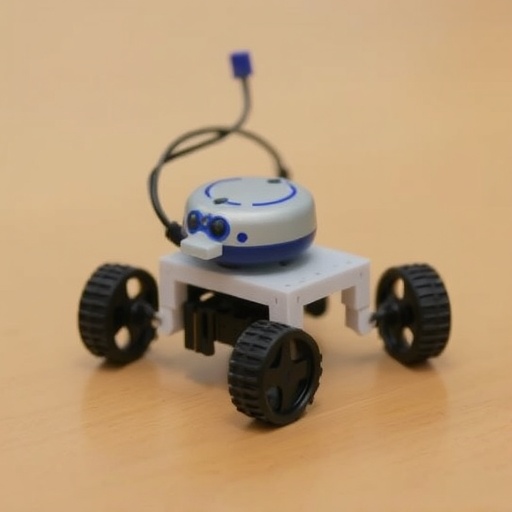
The primary focus of Sanket’s research hinges on the creation of tiny aerial robots that measure less than 100 millimeters in size and weigh under 100 grams. These diminutive devices must be engineered to navigate their environments independently using sound as the primary sensory input. Achieving this bold objective requires overcoming several formidable challenges. The first challenge pertains to hardware design, which entails developing specialized metamaterials capable of mitigating noise interference typically generated by the drone’s propellers.
Next comes the challenge of software innovation. Sanket’s team must employ advanced computational techniques, particularly physics-informed deep learning algorithms, to interpret the complex ultrasonic signals emitted by these tiny drones. This allows the robots to distinguish relevant auditory information from extraneous noise, which is critical for effective navigation. Additionally, sensor fusion plays a crucial role in this research. By integrating sound data with inertial measurements, the team aims to enhance navigation reliability, creating a robust system capable of functioning under a variety of adverse conditions.
The development of learning systems also poses an essential challenge. A reinforcement learning framework needs to be established that equips the drones not only to navigate but also to reach predetermined goals while skillfully avoiding obstacles in their path. The interplay of hardware, software, and machine learning is key to ensuring the efficacy of these miniature aerial robots, which promises to transform their application in real-world scenarios.
As these innovations take shape, the potential applications for sound-navigating drones extend far beyond mere academic curiosity. The capacity to operate efficiently in low-visibility environments opens doors to a range of practical uses, particularly in critical situations like search and rescue missions, disaster response operations, and environmental monitoring under hazardous conditions. Indeed, Professor Sanket envisions a future wherein these advanced robots could be deployed swiftly to assist first responders in the immediate aftermath of catastrophic incidents such as earthquakes or fires, where time is of the essence and human access is limited or impossible.
Furthermore, the broader principles derived from this pioneering work in sound-based navigation could have profound implications across diverse fields. The underlying technologies may eventually benefit sectors such as autonomous driving, where vehicles must navigate complex environments without reliance on visual cues. The principles could also enhance surveillance systems and environmental monitoring techniques, extending even to marine applications like coral reef monitoring and geological assessments near volcanoes. In each case, the aim is to overcome the limitations of traditional visual systems.
Beyond the technological advances, Professor Sanket emphasizes the intrinsic value of mentorship in his journey. He finds immense satisfaction in guiding students through their research endeavors, collaborating on problem-solving and fostering creativity in uncharted areas. His passion for the project is palpable, echoing a sentiment that resonates among early-career researchers: pursuing funding for ideas in which one truly believes can lead to unprecedented breakthroughs. This dedication is essential; it illuminates the importance of staying true to one’s vision even in the face of skepticism.
Envisioning the future, Professor Sanket sees a landscape where aerial robots become indispensable partners in daily life, impacting human existence positively—saving lives, safeguarding ecosystems, and transcending geographical barriers that typically hinder human exploration. His profound respect for nature’s solutions drives his innovation; it is a belief that understanding the intricacies of the natural world paves the way for building robots that not only enhance safety but also foster a better quality of life for all.
Ultimately, this research represents a significant leap into the future of robotics, navigating through the unknown realms of sound-based navigation. As the project unfolds, it promises intriguing advancements, shaping a new era where technology harmonizes with nature and enhances our ability to tackle complex challenges that face humanity today and in the future.
News Publication Date: [Insert Date Here]
Web References: [Insert Web References Here]
References: [Insert References Here]
Keywords
Robotics, Aerial Navigation, Sound Technology, Environmental Monitoring, Disaster Response, Bio-inspired Engineering, Autonomous Systems.
Cite Scienmag News
Denise Maddox. (October 21, 2025). Worcester Polytechnic Institute Professor Receives Esteemed NSF Grant to Advance Sound-Based Navigation Technology for Miniature Robots. Scienmag. https://scienmag.com/worcester-polytechnic-institute-professor-receives-esteemed-nsf-grant-to-advance-sound-based-navigation-technology-for-miniature-robots/
Denise Maddox. "Worcester Polytechnic Institute Professor Receives Esteemed NSF Grant to Advance Sound-Based Navigation Technology for Miniature Robots." Scienmag, 21 October 2025, https://scienmag.com/worcester-polytechnic-institute-professor-receives-esteemed-nsf-grant-to-advance-sound-based-navigation-technology-for-miniature-robots/. Accessed 4 September 2026.
Denise Maddox. "Worcester Polytechnic Institute Professor Receives Esteemed NSF Grant to Advance Sound-Based Navigation Technology for Miniature Robots." Scienmag. October 21, 2025. https://scienmag.com/worcester-polytechnic-institute-professor-receives-esteemed-nsf-grant-to-advance-sound-based-navigation-technology-for-miniature-robots/


