

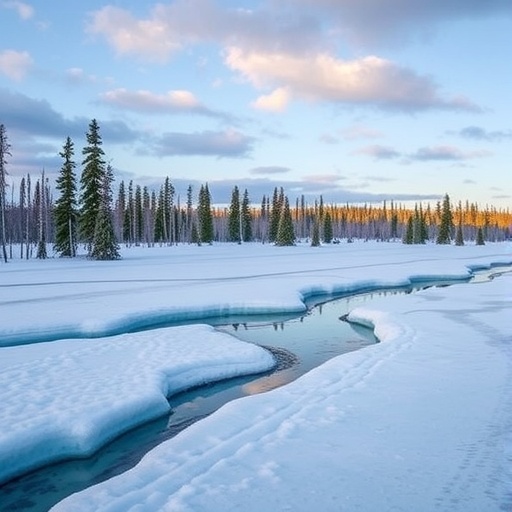
In a groundbreaking study poised to reshape our understanding of Arctic climate dynamics, researchers at the University of Massachusetts Amherst have meticulously documented the devastating thaw of permafrost across a vast expanse of Alaska’s North Slope. This region, comparable in size to the state of Wisconsin, contains an intricate network of rivers and streams that flow into the fragile Beaufort Sea. The work, led by geoscientist Michael Rawlins, leverages four decades of high-resolution modeling to reveal unprecedented details about the intensification of the hydrological cycle and the consequential surge in organic carbon export from thawing permafrost.
Permafrost, a subsurface layer of soil that remains frozen year-round, has historically acted as a formidable carbon reservoir. Within this layer exists an “active” portion that undergoes seasonal freeze-thaw cycles. Due to rising global temperatures, the depth of this active layer has increased steadily over recent decades, causing significant portions of previously frozen soil and organic material to thaw. The process mobilizes vast quantities of dissolved organic carbon (DOC) which is then carried through riverine systems towards the ocean, contributing to profound shifts in coastal and marine biogeochemistry.
Rawlins and his international research team conducted a 44-year retrospective analysis using the Permafrost Water Balance model, refined over 25 years to incorporate detailed simulations of snow dynamics, soil moisture, active layer thickness, and DOC mobilization. Notably, this investigation utilized a fine 1-kilometer grid resolution, a first of its kind for such an extensive Arctic terrain. This computational feat required ten consecutive days on a state-of-the-art supercomputer at the Massachusetts Green High Performance Computing Center, underscoring the complexity and scale of the study.
One of the most striking revelations from the study is the marked increase in the volume of freshwater runoff draining into the Beaufort Sea estuaries, which has jumped by as much as 25%, with subsurface flow augmenting more than 30%. This heightened hydrological activity is directly linked to the prolonged duration of the thaw season, now extending into September and October. This expansion in seasonal thaw length threatens to permanently alter the timing and magnitude of carbon and nutrient fluxes critical to coastal Arctic ecosystems.
The Arctic Ocean, though comprising a mere 1% of the global ocean volume, receives roughly 11% of the world’s river discharge. Riverine inputs here are integral in shaping oceanic chemistry, biota distribution, and carbon cycling. The newly mobilized carbon from deeper permafrost layers is of particular concern because it comes from ancient organic materials trapped for tens of thousands of years. As this carbon is released and subsequently oxidized, it generates carbon dioxide—an accelerant in the global warming feedback loop.
Interestingly, the study detects spatial heterogeneity in these processes. Northwest Alaska, characterized by relatively flat topography, exhibited the highest increases in DOC export. This occurs because the region’s extensive accumulation of decayed organic matter in permafrost is more readily mobilized under thawing conditions. In contrast, the eastern parts of Alaska’s North Slope, being more mountainous with rockier, sandier soil profiles, show significantly less organic carbon release as the permafrost thaws.
The scarcity of in situ observations in northern Alaska has historically limited scientists’ capacity to accurately quantify carbon export via rivers and streams. Rawlins emphasizes that direct measurement campaigns are insufficient to capture the complex interactions across the entire Alaskan coastline. Modeling, therefore, serves as a critical tool to fill this data gap and provide integrative projections that inform climate policy and ecosystem management.
Beyond hydrology and carbon fluxes, the study suggests profound implications for coastal ecosystems. Alterations in freshwater volume and DOC loading are anticipated to affect salinity gradients, nutrient availability, and biogeochemical cycling in the Beaufort Sea estuaries. These changes will ripple through Arctic food webs, potentially disrupting species composition and ecosystem services that Indigenous and local communities rely upon.
The researchers are particularly interested in the role of ice wedge polygons—common geomorphological features in the high Arctic—which may influence water and carbon pathways as they degrade. Understanding the interactions between landscape evolution and hydrological processes is a vital next step toward predicting future Arctic environmental trajectories.
Climate models frequently omit or oversimplify the land-to-ocean transfer of permafrost-derived carbon, but this study’s advancements underscore the need for integrated multidisciplinary approaches combining field observations with high-resolution modeling frameworks. Doing so will enable more accurate assessments of how permafrost thaw contributes to global carbon budgets and climate feedback mechanisms.
Rawlins advocates for expansive efforts to investigate these Arctic terrestrial-aquatic connections under accelerating warming scenarios. The data generated by this study not only aid local stakeholders and ecosystem managers but also provide essential inputs for global climate models seeking to account for the rapidly changing polar regions.
This research was principally supported by the U.S. National Science Foundation and NASA, reflecting a concerted effort by federal agencies to enhance our understanding of Arctic climate processes. The findings have been published in the journal Global Biogeochemical Cycles, offering critical insights into Arctic hydrology and biogeochemistry that will inform future climate mitigation and adaptation strategies worldwide.
Subject of Research: Arctic Permafrost Thaw and Its Impact on Hydrological Cycles and Carbon Fluxes in Northern Alaska
Article Title: Hydrological Cycle Intensification and Permafrost Thaw Drive Increased Freshwater and Organic Carbon Inputs to Northern Alaska Estuaries
News Publication Date: April 1, 2026
Web References:
DOI Link to Article
Image Credits:
Credit: Mike Rawlins
Keywords:
Permafrost thaw, Arctic rivers, dissolved organic carbon (DOC), hydrological cycle, Arctic Ocean, climate feedback, carbon cycle, Alaska North Slope, Beaufort Sea, active layer, ice wedge polygons, high-resolution modeling


