

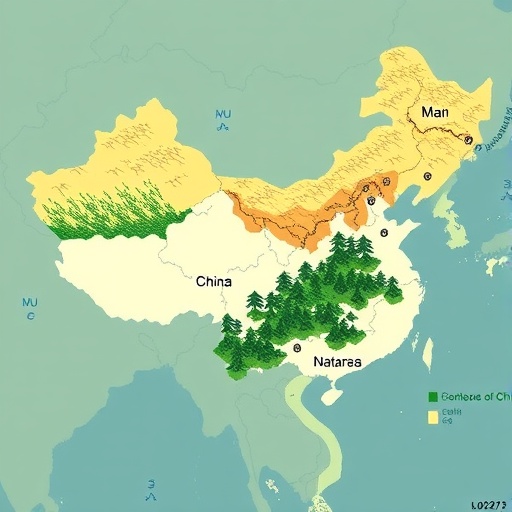
In a groundbreaking new study, scientists have uncovered compelling evidence linking the East Asian Winter Monsoon (EAWM) to significant cultural transitions during the Neolithic period in Central and Eastern China. By delving into marine sedimentary records, this research offers an unprecedented window into the climatic forces that shaped the early development of human societies in one of the world’s most complex and historically rich regions. The findings, published in Communications Earth & Environment in 2026, reveal how ancient monsoonal variations exerted profound environmental pressures that likely influenced the trajectory of human civilization during a critical era of cultural evolution.
The research team, led by Yuan, Zhang, and Jiang, focused on sediment cores retrieved from the marginal seas adjacent to East Asia. These sediments serve as natural archives, preserving geochemical and mineralogical signatures that correspond to historic fluctuations in monsoonal intensity. By analyzing isotopic compositions, grain size distributions, and other proxies within these layers, the researchers were able to reconstruct detailed records of past climate dynamics spanning thousands of years. The temporal resolution achieved enables direct correlation between climatic oscillations and periods of cultural change in Neolithic societies that thrived in the Yellow and Yangtze River basins.
Central to the findings is the identification of a strong, temporal relationship between the variability of the East Asian Winter Monsoon and key transitions in Neolithic culture, including shifts in agricultural practices, settlement patterns, and social organization. The sediments indicate intervals of enhanced monsoon strength, bringing colder and drier conditions, alternating with phases of weaker winter monsoons that corresponded to warmer, more humid environments. Such climatic oscillations would have influenced resource availability, agricultural yields, and mobility, exerting pressure on human populations to adapt their subsistence strategies and social structures.
One particularly remarkable aspect of the study is its illumination of the mechanistic underpinnings linking climate to human development. The winter monsoon, driven by differential heating between the Asian continent and the Pacific Ocean, modulates temperature and precipitation regimes over vast areas. When intensified, the monsoon brings harsh winters that limit crop productivity and water availability. Conversely, during weakened phases, milder winters create opportunities for agricultural intensification and population expansion. This dynamic interplay between environment and society likely acted as a catalyst for innovation, cultural divergence, and even migration during the Neolithic.
The authors caution that the monsoon’s influence was neither simple nor uniform. Their data demonstrates that while monsoonal forcing played a critical role, cultural transitions were also shaped by a mosaic of local environmental conditions, resource constraints, and interactions among emerging Neolithic communities. This nuanced perspective challenges earlier deterministic views that solely attributed cultural evolution to climatic change, emphasizing instead the feedbacks between human agency and environmental rhythms.
Technically, the study stands out for its multidisciplinary approach, employing advanced geochemical techniques such as stable isotope ratio mass spectrometry and X-ray diffraction analysis. These methods provided high-precision dating and comprehensive profiling of sediment components, allowing for intricate reconstruction of paleoenvironmental variables. Additionally, by integrating archaeological datasets with paleoceanographic evidence, the research navigates the complex nexus between climate science and anthropological inquiry, setting a new standard for interdisciplinary research in historical climatology and human prehistory.
The sedimentary records examined encompass a continuous timespan across multiple Neolithic phases, covering the onset and flourish of prominent cultures such as the Yangshao, Longshan, and Dawenkou. Their cultural hallmarks—ranging from pottery styles and settlement layouts to burial customs—coincide with climatic transitions identified in the marine archives. This correlation furnishes robust evidence that climatic shifts imposed tangible pressures on these communities, potentially accelerating technological innovation and social complexity as survival strategies.
Furthermore, the findings hold profound implications for the broader understanding of how climate shaped human history globally. They stress the vulnerability of early agrarian societies to environmental oscillations and highlight the role of climate as both a constraint and driver of cultural transformation. These insights enrich debates regarding the resilience of ancient civilizations and caution against ignoring climatic variability when evaluating the successes and failures of past human groups.
Importantly, this research also contributes vital baseline data for modern climate models. Understanding the patterns and impacts of natural monsoon variability over millennia sharpens predictive tools for how contemporary climate change might disrupt monsoonal systems. Given the East Asian Winter Monsoon’s pivotal role in regional weather patterns affecting millions today, such paleoenvironmental knowledge is crucial for anticipating future socio-environmental challenges.
The study’s integration of oceanographic, geological, and archaeological evidence exemplifies the frontier of earth system science, where unraveling Earth’s past environments sheds light on the complex interdependencies between nature and human culture. It calls for a continued expansion of multi-proxy studies across diverse sedimentary archives to refine our understanding of monsoon dynamics and their multifaceted impacts.
Critically, the research underscores the necessity of considering long-term climatic variability in archaeological interpretations and cultural reconstructions. By moving beyond static chronologies to dynamic environmental contexts, it redefines how shifts in ancient societies are understood—not merely as isolated cultural phenomena but as responses embedded within shifting climates.
As climate change continues to pose existential risks worldwide, lessons from the deep past offer vital perspectives on human adaptability and vulnerability. This study’s revelations about the East Asian Winter Monsoon’s role reiterate the intimate connection between climatic forces and human destiny, urging a closer appreciation of environmental influences in shaping the human narrative from Neolithic times to the present.
Ultimately, this pioneering work not only fills crucial gaps in both climatology and archaeology but also sparks new questions about the intricate feedback loops between atmosphere, ocean, and human systems. It invites future exploration into how ancient monsoon patterns intersected with other global climatic phenomena, potentially broadening the framework for understanding Neolithic cultural transitions within a planetary context.
The intricate dance between shifting winds, climatic pressures, and the rise of human culture documented in this study paints a vivid portrait of a world where natural forces propelled societal innovation. It challenges us to rethink simplistic cause-and-effect assumptions in human history and embrace the complexity of Earth’s dynamic biosphere and its profound influence on civilization’s earliest chapters.
This transformative research represents a watershed moment for scientists seeking to decode the past through the integrated lens of earth system science. By unveiling the hidden power of the East Asian Winter Monsoon over Neolithic cultural pathways, it reaffirms the enduring legacy of climate as a master architect of human history.
Subject of Research:
East Asian Winter Monsoon influence on Neolithic cultural transitions in Central and Eastern China
Article Title:
Marine sedimentary evidence reveals East Asian Winter Monsoon forcing on Neolithic Cultural transitions in Central and Eastern China
Article References:
Yuan, R., Zhang, R., Jiang, L. et al. Marine sedimentary evidence reveals East Asian Winter Monsoon forcing on Neolithic Cultural transitions in Central and Eastern China. Commun Earth Environ (2026). https://doi.org/10.1038/s43247-026-03335-z
Image Credits: AI Generated


