


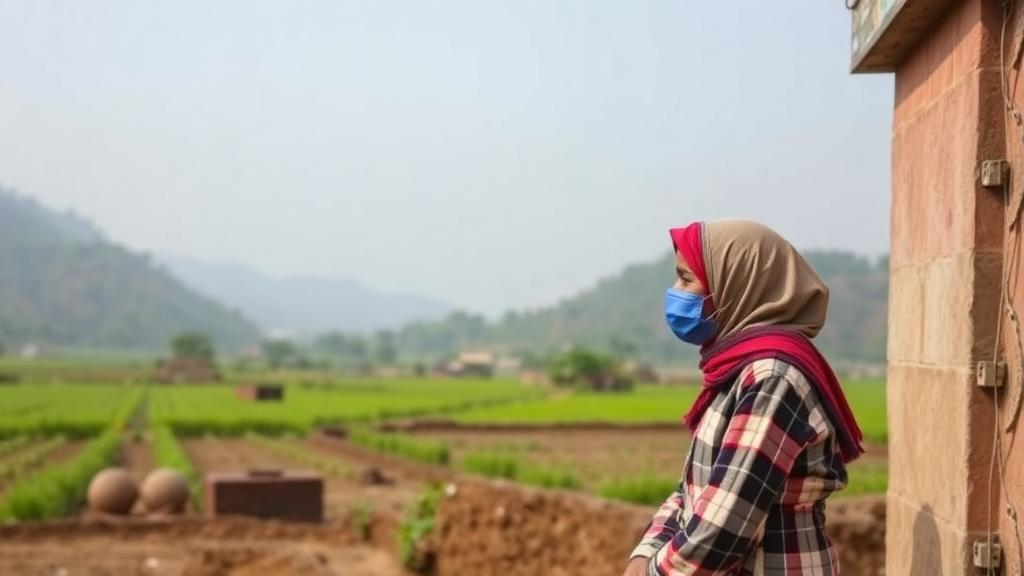
In the mountainous, multi-ethnic reaches of northwestern China, a government-led programme offers free breast and cervical cancer screening to rural women, yet participation remains stubbornly incomplete. A new two-phase exploratory study published in BMC Public Health has taken one of the most granular looks yet at why women in these communities fall away at different points along the screening journey, and what local stakeholders themselves would change first. The findings reveal a striking mismatch: the barriers women face cluster at the individual and interpersonal levels, while the most promising solutions sit at the community, organisational, and policy levels.
The research team, led by Chaojin Da of Shandong University and corresponding authors Shousi Lu and Shicai Wu, worked in Gansu Province, a region of relatively low socioeconomic development where two counties operate under the same national screening programme but differ sharply in ethnic composition. Dongxiang County is concentrated among the Dongxiang, an ethnic minority group with its own language, while Lintao County is predominantly Han Chinese. By comparing these two geographically close sites, the researchers could ask a deceptively simple question with major policy implications: do the same obstacles matter equally everywhere, or must screening services be tailored to local cultural and social realities?
Methodologically, the study drew on human-centred design, an approach that places the lived experiences of users at the centre of service improvement. In the first phase, the team conducted semi-structured interviews with 103 participants drawn from five stakeholder groups, including women eligible for screening, health workers, and local administrators. Thematic analysis of these interviews identified fourteen distinct barrier themes and eleven facilitator themes. Crucially, the researchers then mapped every theme onto a matrix combining the socio-ecological model, which spans individual, interpersonal, community, organisational, and policy levels, with three stages of the screening journey: pre-screening, screening itself, and post-screening follow-up.
This mapping produced a pattern that the authors describe as central to their conclusions. Most barriers and facilitators were concentrated in the pre-screening stage, the period before a woman ever reaches a clinic, when awareness, beliefs, and logistics determine whether screening happens at all. Four barrier themes and six facilitator themes spanned at least two stages of the journey, suggesting that some forces, such as fear of results or poor communication, echo across the entire process rather than confining themselves to a single moment. For programme designers, the implication is clear: interventions that only address the clinic visit itself will miss the majority of the friction points.
When the researchers ranked the barriers at each site, one theme towered above the rest at both Dongxiang and Lintao: suboptimal education and information delivery. Women in both counties reported insufficient or unclear information about why screening matters, what the tests involve, and what to do afterwards. Alongside this shared top barrier, bodily and privacy concerns and screening beliefs and cognitive biases also ranked highly at both sites, reflecting anxieties about exposure, embarrassment, and fatalistic or mistaken ideas about cancer that suppress participation even when services are free and nearby.
Beyond these commonalities, the two counties diverged in ways that argue strongly against one-size-fits-all policy. In Han-majority Lintao, barriers relating to on-site service and workflow, time–role conflict between screening and work or family duties, and result-related fears that drive screening avoidance ranked higher. In minority-concentrated Dongxiang, by contrast, gaps in result communication and follow-up support, along with non-adherence to recommended follow-up care, ranked higher. In other words, the Han-majority site struggled more with getting women through the door efficiently, while the minority-concentrated site struggled more with closing the loop after abnormal findings, a distinction that could mean the difference between early treatment and late presentation.
The second phase of the study brought these findings back to the communities through participatory stakeholder workshops, one in Dongxiang with sixteen participants and one in Lintao with eleven. Using individual ratings followed by group discussion, stakeholders prioritised the identified barriers and twenty-eight service-improvement suggestions generated in phase one. This participatory design matters scientifically as well as ethically: it converts qualitative barriers into locally validated priorities, giving health planners a ranked agenda rather than a laundry list.
Some improvement suggestions commanded broad agreement. Off-peak scheduling, so that women are not forced to choose between harvesting fields or caring for children and attending a screening appointment, ranked highly at both sites, as did clear explanation of screening results. But the top-ranked concrete interventions differed revealingly. In Dongxiang, mobile screening vans that travel to villages took first place, addressing distance and transport barriers in a dispersed, mountainous, minority-language setting. In Lintao, free add-on tests took the top spot, suggesting that in the Han-majority county the perceived value of attending could be raised by bundling additional health checks into the visit.
The deeper structural insight of the study lies in the alignment, or misalignment, between where barriers occur and where solutions can act. Barriers clustered at the individual level, such as fear, beliefs, and limited knowledge, and at the interpersonal level, such as family dynamics and social norms. Yet the corresponding service-improvement themes concentrated at the community and organisational levels, including outreach, scheduling, mobile services, and workflow redesign. This asymmetry is not a flaw but a roadmap: it implies that individual-level hesitations are best shifted not by lecturing women one by one, but by reshaping the community and institutional environment around them, with policy support sustaining the whole effort.
The authors conclude that improving screening participation and continuity requires particular attention to pre-screening barriers while maintaining support across the entire journey, and that service improvements should be adapted to local contexts rather than imposed uniformly. For a country pursuing nationwide cancer early-detection goals, and for global programmes serving rural, multi-ethnic populations elsewhere, the study offers a replicable template: map barriers across the full screening journey and every socio-ecological level, then let local stakeholders rank the fixes. The result is a screening programme designed not for women in the abstract, but for the specific women, villages, and clinics where cancer either is caught early or is not.
Subject of Research: Barriers and facilitators to breast and cervical cancer screening in rural multi-ethnic northwestern China
Article Title: Barriers, facilitators, and prioritised service-improvement suggestions across the breast and cervical cancer screening journey: a two-phase exploratory study in rural multi-ethnic northwestern China
Article References: Da, C., Huang, Y., He, W., Han, Y., Ma, X., Wang, S., Ji, Z., Gao, X., Zhang, W., Wu, Y., Lu, S., & Wu, S. (2026). Barriers, facilitators, and prioritised service-improvement suggestions across the breast and cervical cancer screening journey: a two-phase exploratory study in rural multi-ethnic northwestern China. BMC Public Health. https://doi.org/10.1186/s12889-026-29625-x
Image Credits: AI Generated
DOI: 10.1186/s12889-026-29625-x
Keywords: cancer screening, breast cancer, cervical cancer, rural China, ethnic minorities, socio-ecological model, human-centred design, participatory research, health services, Gansu Province, screening barriers, public health
Cite Scienmag News
Nathaniel Bowman. (October 6, 2026). Why Women Skip Cancer Screenings: Rural China Study Maps the Full Journey. Scienmag. https://scienmag.com/why-women-skip-cancer-screenings-rural-china-study-maps-the-full-journey/
Nathaniel Bowman. "Why Women Skip Cancer Screenings: Rural China Study Maps the Full Journey." Scienmag, 6 October 2026, https://scienmag.com/why-women-skip-cancer-screenings-rural-china-study-maps-the-full-journey/. Accessed 6 October 2026.
Nathaniel Bowman. "Why Women Skip Cancer Screenings: Rural China Study Maps the Full Journey." Scienmag. October 6, 2026. https://scienmag.com/why-women-skip-cancer-screenings-rural-china-study-maps-the-full-journey/


