

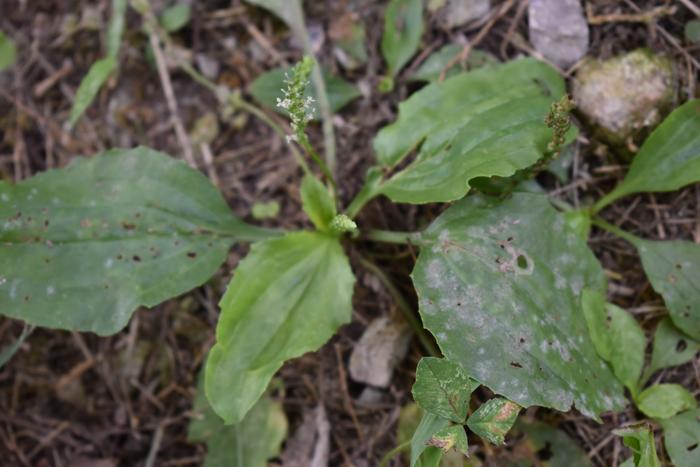
Something about city life seems to suit powdery mildew, a fungal disease that afflicts many plants, including leaves of garden vegetables and roadside weeds.

Credit: Rachel Penczykowski, Washington University in St. Louis
Something about city life seems to suit powdery mildew, a fungal disease that afflicts many plants, including leaves of garden vegetables and roadside weeds.
Rachel Penczykowski, an assistant professor of biology in Arts & Sciences at Washington University in St. Louis, and five WashU graduate and undergraduate students tracked infestations of powdery mildew on common broadleaf weeds. Their study, published in the journal Ecology, covered 22 sites in the St. Louis area ranging from the rural environment of Shaw Nature Reserve near Gray Summit to Forest Park in the heart of the city.
Penczykowski and her team found a strong and surprising pattern: Weeds in the city had significantly more mildew than the weeds in the suburbs or countryside. “Now we need to figure out what’s driving those patterns,” she said.
While the particular fungus the team studied is harmless to other plants or animals, different species of powdery mildew can be a major threat to vegetable gardens, flowers and vineyards, said Quinn Fox, a 2023 PhD graduate and the study’s lead author. “It’s a big concern in different agricultural industries,” Fox said.
At any given location, mildew did best in places where trees or buildings provided a bit of shade. This observation was backed up by experiments that made use of solar array panels at Tyson Research Center, Washington University’s environmental field station. Potted plants placed in the shade of the panels had more mildew than those exposed to full sun.
But that finding raised a bigger question: If mildew does well in shade, why is it so common in the city, which is generally sunnier than the suburbs and countryside? “That’s the paradox,” Penczykowski said.
The heat of city life may be a double-edged sword for the mildew, Penczykowski said. As with other cities, St. Louis tends to be warmer in urban areas because pavement, buildings and other human-made structures absorb heat, creating a phenomenon known as “urban heat islands.” While too much summer heat can be lethal to powdery mildew, the extra warmth could help spores grow faster in spring. It’s also possible that people and vehicles help encourage the spread of spores along busier city roads and between city parks, she said.
In follow-up studies, Penczykowski’s team sowed seeds from city, suburban and countryside locations in a greenhouse before transplanting them into gardens across the St. Louis region to study the factors that encourage or discourage mildew growth. Each garden was split into a full sun and shade treatment, and plants and temperatures were monitored over an entire year. The team’s unpublished preliminary results suggest extra heat is generally bad for mildew growth, but small patches of shade are sufficient to promote infestations of mildew — even in hot city environments and regardless of the plants’ locations of origin. “We’re starting to understand how heat and other aspects of human activity can change the dynamics of disease in plants,” Penczykowski said.
“St. Louis has a thriving urban agriculture scene,” she added. “There are a lot of backyard gardens and community gardens. But very little work has been done on understanding the particular risks of plant diseases to agriculture in cities.”
Penczykowski’s research into plant pathogens is funded by the National Science Foundation (NSF). In 2023, she won a NSF CAREER grant to support her ongoing research and mentoring.
Originally published on The Ampersand website
Journal
Ecology
DOI
Article Title
Effects of microclimate on disease prevalence across an urbanization gradient
Article Publication Date
6-May-2024

