


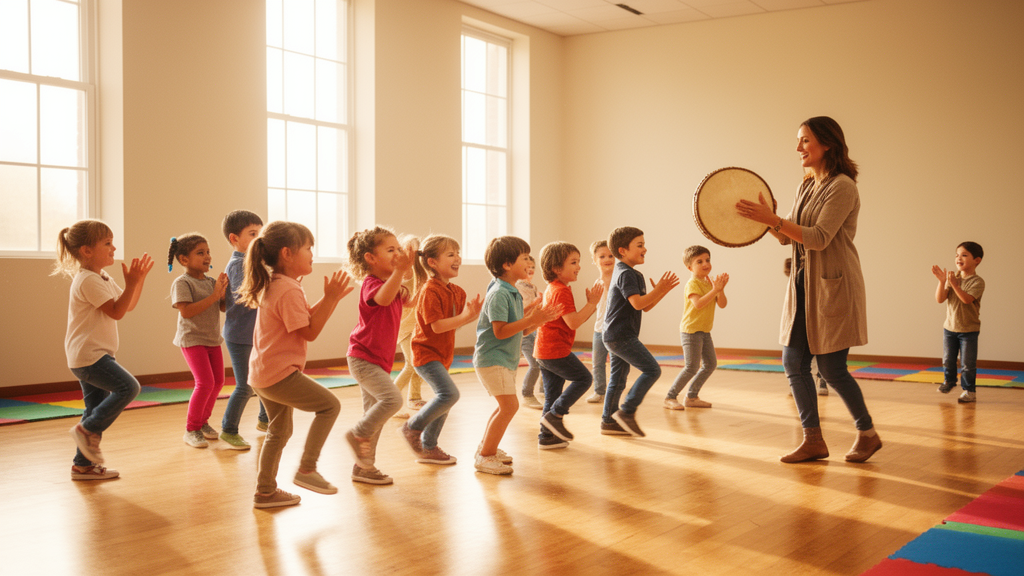
Body percussion — clapping, slapping and stamping the body as a musical instrument — has swept through schools on the promise that it embodies everything modern pedagogy claims to want: learning through movement, cognition rooted in the body, knowledge built by doing. Yet a new conceptual analysis argues that the practice quietly betrays its own philosophy. In a paper published in Frontiers in Sports and Active Living, Francisco Javier Romero-Naranjo of the University of Alicante contends that although body percussion is justified in embodied terms, the standard classroom session is structurally prescriptive: a teacher or a recording sets the pulse, students imitate a demonstrated pattern, deviations are corrected, and success is measured as fidelity of reproduction. The bodies move, but the pedagogy stands still.
The paper’s central move is to identify precisely which property of a rhythmic practice might do the educational work. Embodied learning is an influential orientation in physical education, but it is broad enough to justify almost any activity, and the field has lacked agreement on what the active ingredient actually is. Romero-Naranjo, working within function-based frameworks that locate learning in the epistemic function movement performs, proposes one such function for group rhythm practices: the distribution of influence over a shared timing structure. When the beat comes from a metronome, a recording or a teacher, coupling is unidirectional — performers adapt to a source that cannot be influenced. When the group generates its own pulse, each participant is simultaneously sound source and receiver, and coupling becomes bidirectional. The author calls the first arrangement external entrainment and the second mutual entrainment, borrowing from the physics of coupled oscillators.
The core claim is strikingly counterintuitive: reducing the asymmetry of influence should widen the range of coordinative solutions a group explores, improve transfer to untrained patterns and tempi, and speed recovery after perturbation — all at a cost in fidelity to the trained pattern. In other words, classes in which children negotiate the beat together may produce worse imitators and better adapters. The proposed mechanism hinges on contingency rather than mere variability. Under mutual coupling, a participant’s correction alters the target everyone else is tracking, so the problem itself keeps shifting; an irregular but unresponsive source also presents a moving target, but a learner’s correction leaves it unchanged, leaving one adequate tracking solution available. This distinction supplies the framework’s principal experimental test and separates it from established accounts based on contextual interference or manipulated task constraints, in which variation is arranged in advance and does not depend on what any learner does.
Crucially, the proposal is built to be measured and, if wrong, disconfirmed. The paper introduces the Coupling Asymmetry Index, a continuous quantity that approaches 1 when one source determines everyone’s timing and 0 when influence is fully reciprocal. It is assembled from established tools rather than new statistics: pairwise phase-correction gains are estimated exactly as researchers have done for string quartets, by fitting linear phase-correction models to onset times, and these are aggregated as the complement of weighted network reciprocity. That weighting makes the index invariant to group size — a simple average of pairwise asymmetries would fall from 0.67 in a duet to 0.08 in a twenty-five-person group even when the architecture is unchanged, whereas the weighted index holds steady. Convergent diagnostics include the reciprocal inter-tap adjustment signature documented in joint tapping studies and ensemble tempo drift, which is essentially impossible under a fixed external reference.
The framework also confronts an awkward scaling problem. In large ensembles, participants cannot distinguish individuals by ear; what they hear is the group sound. Mean-field models of coupled oscillators describe this regime, in which each element adapts to the aggregate rather than to identifiable partners. The index remains low under mean-field coupling, which the author argues is the correct verdict for the group, but the aggregate itself becomes unresponsive to any single member as the ensemble grows — so the architecture each person experiences approaches the external case even though no external source exists. Mutual entrainment, the paper concludes, does not scale indefinitely, and the index should always be reported alongside group size.
Body percussion is the exemplary case because it is the one classroom practice in which coupling architecture is a free design variable: the sound source is the body, and there are as many sources as participants. Yet the evidence base, the paper argues, has never treated this as a variable at all. A bibliometric analysis of 245 documents published between 2001 and 2022 found a literature dominated by quasi-experimental pretest-posttest designs that measure product rather than process. Descriptions of interventions specify duration, frequency, population and content, but not who set the tempo, whether participants could alter it, whether alternative solutions were accepted, or how error was defined. Under an ecological account of motor learning, these are precisely the manipulated variables, meaning studies coded as delivering the same intervention may differ on the decisive dimension. Even a five-arm randomized controlled trial with 475 students with ADHD — comparing dual-task rhythmic protocols, traditional physical education, choreographic body percussion, Orff music education and a passive control — leaves the reader unable to determine who produced the beat in the experimental arm.
Rather than asserting this reporting gap as fact, the paper states it as a testable hypothesis about the field itself, complete with a preregisterable survey protocol: peer-reviewed body percussion intervention reports published since 2001 would be coded by two independent raters on five items, with the prediction that pulse source is specified in fewer than 20 percent of them. A worked example applying the coding scheme to a single published trial found one item present, two partial and two absent — suggesting the scheme discriminates, and that the items the field already treats as obligatory are not the ones the theory identifies as decisive. The paper also offers a historical explanation for the prescriptive default, framing it as an institutional frame factor inherited from the material organization of schooling rather than a property of any method. Nineteenth-century classrooms managed dozens of bodies with one adult; desks fixed posture and oriented the gaze forward; movement returned through drill and gymnastics with initiative withheld. Italian primary schools practised gymnastics between the desks for a century largely because the practice required no instruments, no displacement and no extra floor space — the same property that makes body percussion attractive today. A second testable hypothesis follows: if external coupling belongs to the setting rather than the method, the same practice should show systematically higher coupling asymmetry in schools than in drumming circles, samba groups and children’s informal hand-clapping games.
The argument is deliberately bounded. Four boundary conditions limit the claim that lower asymmetry is better: beginners with no temporal scheme likely benefit from a regular external source; mutual coupling requires mutual audibility and fails beyond some group size or once performers disperse through space; repairing a collective pulse presupposes individual timing control; and fixed ensemble performance demands a strong external reference. The framework also distinguishes itself from the autonomy-support literature in motor learning, which concerns the choices a teacher grants; a teacher may offer extensive choice while keeping the pulse at the piano, combining high autonomy support with near-maximal asymmetry, and the two constructs can be dissociated experimentally. Ten falsifiable propositions operationalize the theory, from predictions about exploration, transfer and post-perturbation recovery to a factorial test crossing cognitive load with coupling architecture — the experiment the author identifies as most informative, since every existing comparison varies both at once.
The practical upshot is not the abolition of demonstration but deliberate design: external coupling to establish a temporal scheme, mutual coupling once the scheme is stable, and episodes in which the group repairs its own pulse unaided. For classrooms without sensors, three observational questions approximate the variable — who initiates movement, whether it requires permission, and whether assessment records reproduction or adaptation. A five-item reporting standard, taking fewer than a hundred words in a methods section, would make future studies comparable on the dimension the theory deems decisive. The author is candid about limitations: this is a conceptual contribution reporting no new data, the index has never been computed on real recordings, and the historical material is European and predominantly Spanish. But the question the paper places on the research agenda is hard to unsee. A field that explains learning through emergence, it concludes, should be able to report, for every intervention, whether anything was actually allowed to emerge.
Subject of Research: Coupling architecture and embodied learning in body percussion-based physical education
Article Title: Teaching the moving body with a still pedagogy: body percussion and the coupling architecture of embodied learning in physical education
Article References: Romero-Naranjo, F. J. (2026). Teaching the moving body with a still pedagogy: body percussion and the coupling architecture of embodied learning in physical education. Frontiers in Sports and Active Living, 8, Article 1963569. https://doi.org/10.3389/fspor.2026.1963569
Image Credits: AI Generated
DOI: 10.3389/fspor.2026.1963569
Keywords: body percussion, embodied learning, entrainment, physical education, motor learning, sensorimotor synchronization, coupling asymmetry, rhythm, pedagogy, ecological dynamics, transfer of learning, classroom practice
Cite Scienmag News
Courtney Benton. (October 15, 2026). Who Holds the Beat? Rhythm Science Says the Answer May Shape How Children Learn to Move. Scienmag. https://scienmag.com/who-holds-the-beat-rhythm-science-says-the-answer-may-shape-how-children-learn-to-move/
Courtney Benton. "Who Holds the Beat? Rhythm Science Says the Answer May Shape How Children Learn to Move." Scienmag, 15 October 2026, https://scienmag.com/who-holds-the-beat-rhythm-science-says-the-answer-may-shape-how-children-learn-to-move/. Accessed 15 October 2026.
Courtney Benton. "Who Holds the Beat? Rhythm Science Says the Answer May Shape How Children Learn to Move." Scienmag. October 15, 2026. https://scienmag.com/who-holds-the-beat-rhythm-science-says-the-answer-may-shape-how-children-learn-to-move/


