
Saturday, February 28, 2026
Science
No Result
View All Result
  • Login
  • HOME
  • SCIENCE NEWS
  • CONTACT US
  • HOME
  • SCIENCE NEWS
  • CONTACT US
No Result
View All Result
Scienmag
No Result
View All Result
Home Science News Mathematics

When Waddington meets Helmholtz: EPR-Net for constructing the potential landscapes of complex non-equilibrium systems

April 9, 2024
in Mathematics
Reading Time: 2 mins read
0
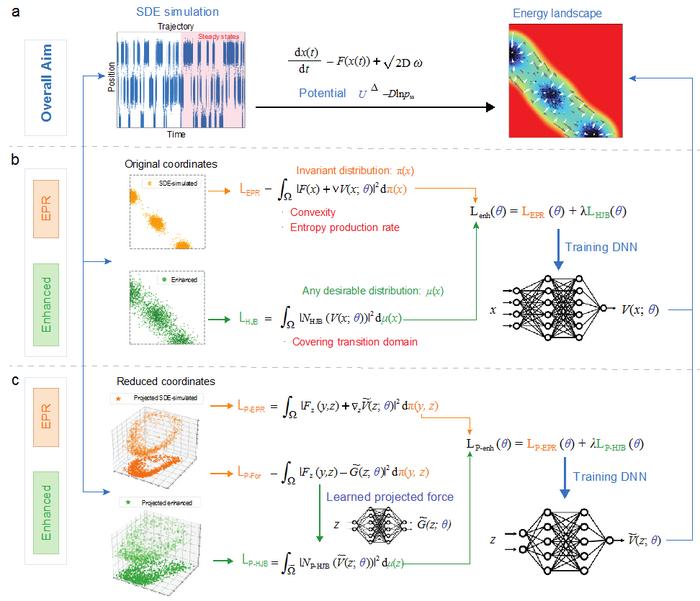
Constructing energy landscapes through enhanced EPR workflow.
66
SHARES
597
VIEWS
Share on FacebookShare on Twitter
ADVERTISEMENT

The concept of Waddington landscape, originally proposed by British developmental biologist Conrad Hal Waddington in 1957, has been influential in describing the dynamical evolution of cellular development. Waddington’s metaphor of a ball rolling down a hill to represent cell differentiation has been widely adopted in epigenetics and developmental biology. However, quantitative characterization of these landscapes, particularly for high-dimensional systems, remains a challenging problem in computational biology.

Constructing energy landscapes through enhanced EPR workflow.

Credit: ©Science China Press

The concept of Waddington landscape, originally proposed by British developmental biologist Conrad Hal Waddington in 1957, has been influential in describing the dynamical evolution of cellular development. Waddington’s metaphor of a ball rolling down a hill to represent cell differentiation has been widely adopted in epigenetics and developmental biology. However, quantitative characterization of these landscapes, particularly for high-dimensional systems, remains a challenging problem in computational biology.

Led by Professor Tiejun Li (from Peking University) and Dr. Wei Zhang (from Freie Universität Berlin and Zuse Institute Berlin), together with Yue Zhao (first author, PhD student from Peking University), the study introduces EPR-Net, a deep learning method that effectively tackles this challenge.                

This method leverages the unique mathematical insight that the negative gradient of Waddington landscape corresponds to an extended Helmholtz decomposition in the context of non-equilibrium systems. This insight, closely related to the entropy production rate (EPR) in statistical physics, is a breakthrough that has not be recognized previously.

The research team demonstrates the power of EPR-Net through its application to various biological models, including those exhibiting multiple stable points, limit cycles, and strange attractors. Enhanced EPR-Net, an extension of the method, is also introduced. The study showcases the effectiveness of enhanced EPR on benchmark problems and its superiority over other methods. It also provides a unified framework to address landscape construction, dimensionality reduction, and problems with variable coefficients.

EPR-Net offers computational efficiency, eliminates the need for boundary conditions, and provides a clear physical interpretation that links directly to the entropy production rate in statistical physics.

To address the challenge of visualizing high-dimensional landscapes, the researchers also developed a dimensionality reduction strategy using EPR-Net. This strategy has been applied to study an 8-dimensional limit cycle system, where it gives accurate projections which not only closely match the system’s equilibrium distribution but also reveal new delicate structures not observed before.

“EPR-Net, with its elegant mathematical foundation and convex structure, promises to be an effective strategy for constructing energy landscape functions of high-dimensional NESS systems.” The researchers conclude. “We are currently exploring further extensions and applications of the method. We feel exciting because this powerful method has the potential to improve our understanding of many complex NESS systems by visualizing their potential landscapes.”

See the article:

EPR-Net: constructing a non-equilibrium potential landscape via a variational force projection formulation


Journal

National Science Review

DOI

10.1093/nsr/nwae052

Share26Tweet17
Previous Post

Avoidance, confusion, solitude: whales react to rising noise pollution

Next Post

Unlocking the secrets of black raspberry resilience: genome-wide discovery and analysis of bZIP transcription factors

Related Posts

blank
Mathematics

Digital Clinical Decision Support Algorithm Significantly Cuts Antibiotic Prescriptions Without Affecting Recovery, Finds Non-Randomized Trial in 32 Rwandan Health Centers

February 26, 2026
blank
Mathematics

Review Indicates Music Might Not Enhance Focus or Mood During Exercise

February 26, 2026
blank
Mathematics

Aspirin Shows Limited Immediate Effect in Bowel Cancer Prevention

February 26, 2026
blank
Mathematics

SQU Research on Functionalized Gold Nanoparticles Featured on American Chemical Society Journal Cover

February 25, 2026
blank
Mathematics

Breakthrough Silicon Qubit Powers Next-Gen Telecom Technologies

February 25, 2026
blank
Mathematics

Breakthrough Achievement: Full Solution to the Polynomial Version of the Brocard–Ramanujan Problem Unveiled

February 25, 2026
Next Post
Figure 1.

Unlocking the secrets of black raspberry resilience: genome-wide discovery and analysis of bZIP transcription factors

  • Mothers who receive childcare support from maternal grandparents show more parental warmth, finds NTU Singapore study

    Mothers who receive childcare support from maternal grandparents show more parental warmth, finds NTU Singapore study

    27618 shares
    Share 11044 Tweet 6902
  • University of Seville Breaks 120-Year-Old Mystery, Revises a Key Einstein Concept

    1022 shares
    Share 409 Tweet 256
  • Bee body mass, pathogens and local climate influence heat tolerance

    665 shares
    Share 266 Tweet 166
  • Researchers record first-ever images and data of a shark experiencing a boat strike

    532 shares
    Share 213 Tweet 133
  • Groundbreaking Clinical Trial Reveals Lubiprostone Enhances Kidney Function

    517 shares
    Share 207 Tweet 129
Science

Embark on a thrilling journey of discovery with Scienmag.com—your ultimate source for cutting-edge breakthroughs. Immerse yourself in a world where curiosity knows no limits and tomorrow’s possibilities become today’s reality!

RECENT NEWS

  • Physical Activity Slows Aging-Related Physical Decline
  • X-ray Activated Platinum Complex Boosts Cancer Immunotherapy
  • New Study Shows Belzutifan and Pembrolizumab Combo Extends Cancer-Free Survival in High-Risk Kidney Cancer Patients After Surgery
  • Botulinum Toxin Causes Masseter Atrophy via Autophagy Impairment

Categories

  • Agriculture
  • Anthropology
  • Archaeology
  • Athmospheric
  • Biology
  • Biotechnology
  • Blog
  • Bussines
  • Cancer
  • Chemistry
  • Climate
  • Earth Science
  • Editorial Policy
  • Marine
  • Mathematics
  • Medicine
  • Pediatry
  • Policy
  • Psychology & Psychiatry
  • Science Education
  • Social Science
  • Space
  • Technology and Engineering

Subscribe to Blog via Email

Success! An email was just sent to confirm your subscription. Please find the email now and click 'Confirm Follow' to start subscribing.

Join 5,190 other subscribers

© 2025 Scienmag - Science Magazine

Welcome Back!

Login to your account below

Forgotten Password?

Retrieve your password

Please enter your username or email address to reset your password.

Log In
No Result
View All Result
  • HOME
  • SCIENCE NEWS
  • CONTACT US

© 2025 Scienmag - Science Magazine