


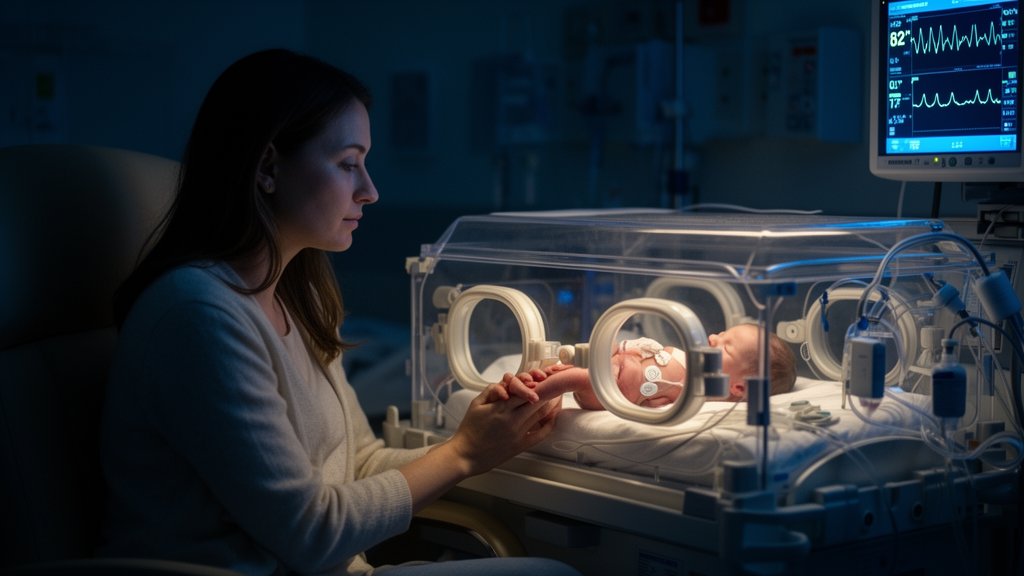
For weeks, the neonatal intensive care unit has watched over a fragile infant with an arsenal of technology: pulse oximeters tracking oxygen saturation, cardiorespiratory monitors tracing every heartbeat, incubators regulating temperature to a tenth of a degree. Then comes the day of discharge, and all of it falls silent. In an instant, the parents of a preterm baby are handed a role that no job description quite captures—they must become the monitor themselves. A new qualitative study published in BMC Nursing offers one of the most detailed portraits yet of what that transformation actually feels like, and its findings are already resonating with clinicians and families who have lived through the disorienting weeks after a NICU stay ends.
The research, led by Kejimu Sunzi and Quanmin Deng of Deyang People’s Hospital in Sichuan, China, together with colleagues at Sichuan Nursing Vocational College and the University of Electronic Science and Technology of China, set out to answer a deceptively simple question: what happens to parents when the infrastructure of intensive care disappears? Discharge education in neonatology has traditionally focused on transmitting information—how to feed, how to bathe, when to call a doctor. What has received far less attention, the researchers argue, is how parents interpret the ambiguous signals of a small infant once they are alone at home, without alarms, without screens, and without a nurse down the hall.
To capture that experience, the team conducted a qualitative descriptive study at a tertiary hospital in China, using individual semi-structured interviews with 24 parents—16 mothers and 8 fathers representing 22 preterm infants. Families were recruited through purposive sampling and interviewed one to twelve weeks after discharge, a window chosen deliberately to span the earliest, most anxious days of home caregiving through the period when routines begin to settle. Verbatim transcripts were analysed inductively using reflexive thematic analysis, a method in which researchers iteratively code the data and construct themes while remaining transparent about how their own perspectives shape the interpretation. Only after initial themes were developed did the team introduce three established interpretive frameworks—Meleis’ Transitions Theory, Mishel’s Uncertainty in Illness Theory, and the Family Management Style Framework—as sensitising lenses to deepen the analysis. A visual transition matrix then synthesised the key transition moments, caregiving tasks, nursing touchpoints and challenges across the families’ journeys.
Four major themes emerged from the interviews, and together they read like a map of the psychological terrain that follows a preterm infant home. The first, and perhaps the most striking, was described as becoming the monitor after leaving monitored safety. Parents who had spent weeks calibrating their attention to the beeps and displays of the NICU suddenly found themselves responsible for detecting the same physiological signals with nothing but their senses and their judgment. Was the baby feeding adequately? Was breathing normal? Was that slight blueness around the lips meaningful or harmless? Was the temperature right, the weight gain sufficient, the fussiness within ordinary limits? These six domains—feeding adequacy, breathing, colour change, temperature, weight gain and thresholds for urgent care—formed the core of parental uncertainty in the study.
The second theme, learning care in fragments and needing embodied rehearsal, points to a structural weakness in how discharge preparation is typically delivered. Parents described acquiring caregiving knowledge in pieces—a demonstration here, a pamphlet there, a hurried explanation at the bedside—rather than through sustained, hands-on practice under supervision. The researchers’ language of embodiment is significant: knowing how to care for a preterm infant is not merely a matter of memorising instructions but of building muscle memory, of rehearsing the physical acts of feeding, positioning and soothing until they feel reliable. Without that rehearsal, parents reported feeling as though they were performing critical tasks for the first time in their own homes, with their own child as the stakes.
The third theme, negotiating family management under fragile normality, shifts the lens from the individual parent to the household. Bringing a preterm infant home does not simply add a baby to a family; it reorganises the family’s entire operating system. Parents described a delicate balancing act in which they tried to construct something resembling an ordinary family life while remaining vigilant for signs of danger. Grandparents, partners and siblings all had to adapt to infection-prevention routines, feeding schedules and the unspoken rule that a slight change in the baby’s behaviour could override any plan. The Family Management Style Framework, one of the study’s three theoretical lenses, proved useful here for describing how families define the situation, manage daily life, and negotiate who carries which burdens.
The fourth theme, rebuilding confidence through accessible nursing connection, carries the study’s most actionable implication. Parents did not describe wanting to be permanently attached to the healthcare system; they described wanting a reliable bridge back to it. Confidence returned, the interviews suggest, when families knew they could reach neonatal nurses promptly after discharge—when a question about a feeding refusal or an episode of vomiting could be answered by someone who knew preterm infants, rather than by a search engine or an emergency department. The absence of that connection, by contrast, left parents to escalate uncertainty into anxiety, or worse, to normalise warning signs they should not have normalised.
What elevates this study beyond a catalogue of parental worries is its theoretical synthesis. By framing discharge as a staged family transition rather than a single handover of information, the authors align themselves with a growing movement in nursing science that treats the hospital-to-home boundary as a process, not an event. Meleis’ Transitions Theory describes how people experience change across time, with identifiable phases of vulnerability and mastery. Mishel’s Uncertainty in Illness Theory explains why ambiguous symptoms are so psychologically corrosive: it is not the severity of a signal that distresses people most, but the inability to interpret it. And the Family Management Style Framework situates the infant’s condition within the family’s collective definition of the situation. Together, these lenses convert scattered parental anecdotes into a coherent model of what support should look like.
The model, in practical terms, is organised around what the researchers call transition touchpoints. First, early co-care in hospital: parents should be involved in hands-on caregiving while the safety net of the NICU is still in place, so that learning happens with expert backup rather than after it is gone. Second, rehearsal before discharge: structured, supervised practice of the specific tasks—feeding, temperature management, recognising respiratory changes—that parents will perform alone. Third, observable thresholds for home decisions: instead of vague advice to watch for problems, parents need concrete, describable criteria—what colour change warrants a phone call, what feeding pattern warrants a clinic visit, what breathing pattern warrants emergency care. Fourth, prompt post-discharge access to neonatal nurses: a responsive channel back to expertise during the first weeks, when uncertainty is at its peak.
The study has limitations inherent to its design. It was conducted at a single tertiary hospital in one region of China, with 24 parents from 22 families, and qualitative findings are not statistically generalisable to all settings. The interviews captured experiences one to twelve weeks after discharge, leaving open the question of how parental confidence evolves over longer horizons. Yet the value of the work lies precisely in its depth: it documents, in parents’ own accounts, the mechanics of a transition that millions of families navigate each year, most of them without a research team paying attention. Preterm birth remains one of the most common complications of pregnancy worldwide, and as neonatal survival rates continue to improve, the population of families making this particular journey keeps growing. The monitors in the intensive care unit will always be essential. This study makes a compelling case that the weeks after they fall silent deserve just as much systematic care—and that the parents who step into the machine’s role should be trained, rehearsed and supported as if the job they are taking on is as critical as it actually is.
Subject of Research: Parental experiences and nursing support during the transition of preterm infants from neonatal intensive care to home caregiving
Article Title: From NICU monitoring to home caregiving: a qualitative study of parents of preterm infants
Article References: Sunzi, K., Deng, Q., Huang, Q., Xu, Y., Gao, Y., Zeng, T., Luo, H., & Lei, C. (2026). From NICU monitoring to home caregiving: a qualitative study of parents of preterm infants. BMC Nursing. https://doi.org/10.1186/s12912-026-05398-x
Image Credits: AI Generated
DOI: 10.1186/s12912-026-05398-x
Keywords: preterm infant, NICU, discharge transition, parental caregiving, nursing research, qualitative study, thematic analysis, uncertainty in illness, family management, neonatology, home care, parental confidence
Cite Scienmag News
Harold Sullivan. (October 14, 2026). When the Monitors Go Silent: How Parents of Preterm Babies Become the Machine. Scienmag. https://scienmag.com/when-the-monitors-go-silent-how-parents-of-preterm-babies-become-the-machine/
Harold Sullivan. "When the Monitors Go Silent: How Parents of Preterm Babies Become the Machine." Scienmag, 14 October 2026, https://scienmag.com/when-the-monitors-go-silent-how-parents-of-preterm-babies-become-the-machine/. Accessed 14 October 2026.
Harold Sullivan. "When the Monitors Go Silent: How Parents of Preterm Babies Become the Machine." Scienmag. October 14, 2026. https://scienmag.com/when-the-monitors-go-silent-how-parents-of-preterm-babies-become-the-machine/


