


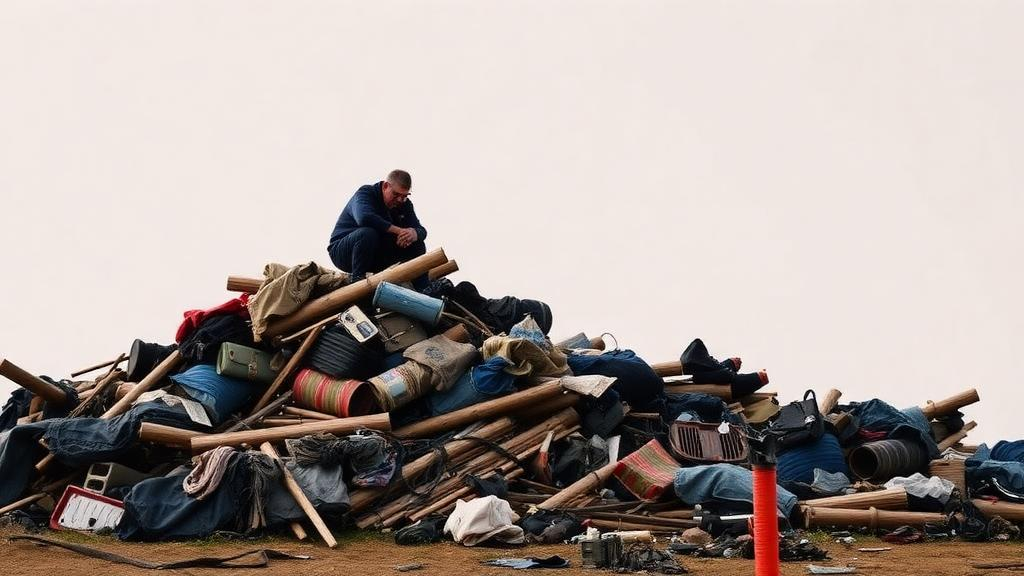
A pastoral theologian is proposing a new concept to describe an experience that many people recognize but few can name: the sensation of carrying a heavy rock in one’s soul when multiple forms of loss converge and compound. Writing in the journal Pastoral Psychology, Rubén Arjona of Union Presbyterian Seminary in Richmond, Virginia, introduces the term “amalgamated grief” to capture the way first-, second-, and third-order suffering can merge into a single, dense weight that resists the ordinary processes of mourning. Drawing on his own recent experiences of bereavement and on the theoretical machinery of pastoral theology, Arjona argues that this amalgamation is not merely a private psychological event but a structural feature of life in a neoliberal age, one that demands both personal and political responses.
The framework builds on a long tradition in grief studies that distinguishes different layers of loss. First-order suffering refers to the direct, immediate pain of losing someone or something loved: the death of a family member, the end of a relationship, the loss of health or livelihood. This is the grief that most people picture when they hear the word, the raw ache that follows bereavement. Classic works in the field, such as Judith Viorst’s “Necessary Losses,” have emphasized that such losses are woven into the very fabric of human development, since growth itself requires surrendering attachments and illusions. Kenneth Doka’s work on disenfranchised grief has further shown that many of these losses go unmourned because society does not recognize them as legitimate grounds for sorrow.
Second-order suffering, in Arjona’s account, emerges from the ways individuals and communities respond to first-order losses. It includes the grief of witnessing others mourn, the secondary losses that cascade after an initial bereavement, and the suffering that arises when care systems fail. Howard Capps and other pastoral theologians have noted that grief is rarely a solitary affair: when one member of a family or congregation suffers, the loss ripples outward, altering relationships, roles, and identities. Second-order suffering also encompasses what Kaethe Weingarten has called “common shock,” the cumulative impact of witnessing violence and suffering in others, whether in person or through relentless media exposure. In this sense, the mourner grieves not only the original loss but the transformations that the loss imposes on everyone connected to it.
Third-order suffering is the most diffuse and, Arjona argues, the most neglected layer. It refers to the suffering generated by large-scale political and economic structures, what pastoral theologian Ryan LaMothe has described as the “political and economic apparatuses of carelessness” at work in the Anthropocene age. Borrowing from philosopher Giorgio Agamben, LaMothe defines an apparatus as anything with the capacity to capture, orient, determine, intercept, model, control, or secure the gestures, behaviors, opinions, or discourses of living beings. Neoliberalism, in this analysis, functions as a master apparatus: it organizes human beings into competitive, self-maximizing units, hollows out communal bonds, and renders care for others, for other species, and for the Earth itself economically invisible. Bruce Rogers-Vaughn’s influential work on caring for souls in a neoliberal age documents how this order produces chronic anxiety, rage, and a pervasive sense of abandonment, even among people who are materially comfortable.
Arjona’s central claim is that these three orders of suffering do not remain neatly separated in lived experience. They amalgamate. A person mourning a death may simultaneously carry the grief of a community in crisis, the dread of ecological collapse, and the grinding devaluation that neoliberal systems impose on anyone who cannot present themselves as productive and self-sufficient. The result is a composite weight, a rock in the soul, that conventional grief models struggle to address because they were designed for discrete, identifiable losses. When the layers are fused, the mourner may not even be able to say what exactly hurts, only that something heavy is present. This amalgamated quality, Arjona suggests, helps explain why so many people report a diffuse, unnameable sorrow that does not map onto any single event.
The article grounds this abstraction in concrete contemporary events. Arjona points to the shutdown of Spirit Airlines in May 2026, reported by The New York Times, as an example of how economic decisions generate layered suffering: workers lost livelihoods, travelers lost affordable connections, and communities lost institutions, all while public debate reduced the event to abstractions about antitrust politics. He cites reporting on a worsening water shortage in a Texas coastal city due to prolonged drought, an instance of ecological third-order suffering that falls hardest on those with the fewest resources. He also references the World Press Photo of the year, whose image of suffering circulates globally, inviting viewers into a kind of vicarious, second-order grief that is witnessed but rarely processed. These examples, he argues, show how personal, communal, and structural losses arrive together, fused into a single experiential weight.
The political dimension of the argument draws heavily on LaMothe’s account of the polis. LaMothe explains that, just as good-enough parents must hold the tension between identification and disidentification with their children, a healthy political community must hold a paradoxical tension between affirming likeness and including difference. When the polis veers toward the pole of identification, those who do not hold dominance are disidentified through physical exclusion, exploitation, marginalization, and oppression. LaMothe extends this “ontological rift” between self and other to the human-nonhuman relationship, and notes that the same logic underwrites racism, sexism, classism, and heterosexism, in which human beings are constructed as absolutely Other and inferior. Arjona’s own earlier work on the criminalization of Mexicans in contemporary American politics exemplifies how such apparatuses of othering generate suffering that is simultaneously personal and structural.
Against this backdrop, Arjona insists that attention to third-order suffering is especially necessary in a neoliberal age, because the apparatus tends to privatize all suffering, recasting structural wounds as personal failures. If grief is understood only as an individual’s problem to be managed, the political forces that amalgamate it escape scrutiny. Dany-Robert Dufour’s analysis of rage in contemporary society, cited by Rogers-Vaughn, illustrates the danger: young people who cannot identify those responsible for their banishment turn their rage inward or against one another through violence. Amalgamated grief that is never named and never located in its structural causes, Arjona implies, risks curdling into exactly this kind of misdirected despair and anger.
Yet the article is not only diagnostic; it proposes ways to break up and ameliorate amalgamated grief. On the personal level, Arjona highlights the significance of vocation, the sense of being called to a purpose that exceeds economic utility. Recovering or deepening a personal vocation, he suggests, can reorient a sufferer away from the neoliberal measure of worth and toward forms of meaning that survive loss. He also emphasizes body-aware practices, echoing Carrie Doehring’s research on spiritual practices that reveal compassion in embodied, relational, and transcendent ways amid traumatic grief. Practices that attend to the body, whether contemplative, liturgical, or simply attentive breathing and movement, help mourners inhabit the weight rather than flee it, gradually loosening the amalgam so that its components can be felt, named, and mourned one by one.
Beyond these individual resources, Arjona argues that a genuinely political pastoral theology requires a commitment to communal practices that center the care of human beings, other species, and the Earth. Here he invokes LaMothe’s reading of Agamben’s concept of “inoperativity,” which entails the deactivation of apparatuses, not by destroying them but by refusing to let them define one’s identity or govern one’s gestures. In LaMothe’s account of the coming Jesus, inoperativity is a form of resistance: stepping outside the logic of productivity and dominance to practice what Arjona, following the keywords of the article, calls radical anarchic care. Such care is anarchic not because it is chaotic but because it refuses the archē, the ruling principle, of the carelessness apparatus. Communities that practice this care, tending to the grieving, the marginalized, the nonhuman, and the damaged Earth, create spaces where amalgamated grief can be disassembled and shared rather than carried alone. The article, published on 7 October 2026, ultimately offers both a vocabulary and a program: name the rock, understand how it was assembled, and then, together, begin to take it apart.
Subject of Research: A pastoral theological concept describing the convergence of first-, second-, and third-order suffering in grief within neoliberal society
Article Title: Amalgamated Grief: The Convergence of First-, Second-, and Third-Order Suffering Within the Human Soul
Article References: Arjona, R. (2026). Amalgamated Grief: The Convergence of First-, Second-, and Third-Order Suffering Within the Human Soul. Pastoral Psychology. https://doi.org/10.1007/s11089-026-01379-8
Image Credits: AI Generated
DOI: 10.1007/s11089-026-01379-8
Keywords: amalgamated grief, pastoral theology, third-order suffering, neoliberalism, grief studies, Ryan LaMothe, Bruce Rogers-Vaughn, Anthropocene, radical anarchic care, Pastoral Psychology, vocation, body-aware practices
Cite Scienmag News
Glenn Wilkins. (October 7, 2026). When Grief Piles Up: The Heavy Weight of Amalgamated Sorrow in a Neoliberal Age. Scienmag. https://scienmag.com/when-grief-piles-up-the-heavy-weight-of-amalgamated-sorrow-in-a-neoliberal-age/
Glenn Wilkins. "When Grief Piles Up: The Heavy Weight of Amalgamated Sorrow in a Neoliberal Age." Scienmag, 7 October 2026, https://scienmag.com/when-grief-piles-up-the-heavy-weight-of-amalgamated-sorrow-in-a-neoliberal-age/. Accessed 7 October 2026.
Glenn Wilkins. "When Grief Piles Up: The Heavy Weight of Amalgamated Sorrow in a Neoliberal Age." Scienmag. October 7, 2026. https://scienmag.com/when-grief-piles-up-the-heavy-weight-of-amalgamated-sorrow-in-a-neoliberal-age/


