


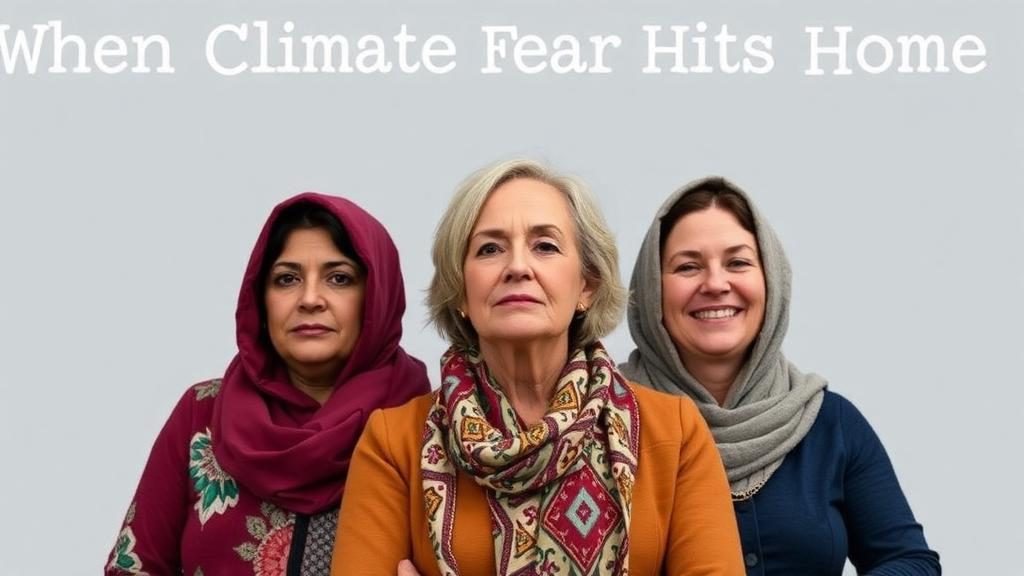
Climate change is usually measured in degrees, sea levels, and parts per million of carbon dioxide. But a new study published in Current Psychology argues that some of its most profound impacts cannot be captured by instruments at all. Instead, they register in sleepless nights, tight chests, and the quiet dread of mothers wondering what kind of world their children will inherit. The research, conducted by Teslime Çakaloğlu and Sinem Utanir Altay, offers one of the most detailed portraits yet of how women experience eco-anxiety, the chronic fear and emotional distress associated with environmental degradation and the climate crisis.
Eco-anxiety has moved rapidly from the margins of environmental psychology to the center of mainstream mental health research. Landmark surveys, including a global study published in The Lancet Planetary Health in 2021, found that climate anxiety was widespread among young people across ten countries and was linked to feelings of betrayal by governments that failed to act. Most of this research, however, has relied on quantitative scales and focused on younger, often urban and educated populations. The new study takes a different route. Rather than asking participants to score their worry on a questionnaire, the researchers sat down with twenty women and asked them to describe, in their own words, what living with climate change actually feels like.
The methodological approach was phenomenology-informed qualitative research, a design that aims to capture lived experience as it is subjectively understood rather than as it can be statistically summarized. Participants were recruited through criterion-based purposive sampling, meaning the researchers deliberately selected women who had direct experience of climate-related change, supplemented by snowball sampling in which early participants referred others. The group included women from both rural and urban settings, an important contrast because climate change intersects differently with rural livelihoods, which often depend directly on land and water, and urban life, where environmental change is mediated through infrastructure, prices, and news coverage. Semi-structured in-depth interviews allowed the women to steer the conversation toward what mattered most to them, while the researchers probed for depth and specificity.
The interview transcripts were analyzed using reflexive thematic analysis, the widely used six-phase approach developed by Virginia Braun and Victoria Clarke, supported by the qualitative data analysis software MAXQDA 2025. Reflexive thematic analysis treats themes not as something waiting to be discovered in the data but as patterns actively constructed by the researcher through engagement with the material. This orientation matters for a topic like eco-anxiety, where the researchers’ own positioning inevitably shapes what is noticed and named. The analysis produced three interrelated themes within the broader domain of women’s lived experiences of eco-anxiety: the psychological effects of climate change, the gendered dimensions of eco-anxiety, and coping strategies that combine everyday action with a sober recognition of its limits.
The first theme, psychological effects of climate change, comprised five constituent codes: worry, uncertainty, emotional exhaustion, somatic burden, and reduced hope. The somatic dimension is particularly striking. For many participants, climate distress was not confined to the mind but manifested in the body, echoing a growing literature linking negative emotions about climate change to insomnia symptoms and broader mental health problems. A cross-sectional study spanning 25 countries, published in Current Psychology in 2023 by Charles Ogunbode and colleagues, found that negative climate emotions were associated with insomnia and poorer mental health across cultures. The new findings suggest that for women juggling multiple responsibilities, this bodily burden may be compounded by the sheer cognitive load of managing households under increasingly unpredictable conditions.
The second theme reveals what makes women’s eco-anxiety distinctive: it is woven into gendered responsibilities and everyday resource management. Participants described how climate-related distress was inseparable from caregiving roles, from securing food and water for their families, and from the invisible labor of anticipating shortages and planning around environmental disruption. This aligns with a substantial body of feminist scholarship on climate change. Researchers such as Margaret Alston, Sherilyn MacGregor, and Annica Kaijser and Anna Kronsell have long argued that climate vulnerability is not gender-neutral, and that intersectional analysis is essential to understanding who bears the costs of environmental change. Ecofeminist scholars, including Greta Gaard, have pushed this further, contending that the domination of nature and the subordination of women share common structural roots. The study’s findings give empirical texture to these theoretical claims, showing how abstract global processes land on specific shoulders.
The third theme, coping strategies, captures the tension at the heart of the study’s title, from anxiety to action. Women described practical responses to climate distress: everyday actions such as conserving resources, adjusting household routines, and making more deliberate consumption choices. Yet these actions coexisted with a clear-eyed recognition of their limits. Participants understood that recycling a bottle or shortening a shower cannot offset systemic forces, and this awareness itself became a source of frustration and, at times, paralysis. This tension mirrors findings across the quantitative literature. A 2023 meta-analytic review by Stanley, Wilson, and Milfont in the Journal of Environmental Psychology confirmed a positive association between eco-anxiety and pro-environmental behavior, while other studies have documented how the same anxiety can produce eco-paralysis when self-efficacy is low. Anxiety, it seems, is a double-edged motivator.
The study’s most consequential argument may be its reframing of what eco-anxiety actually is. Rather than treating it as an individual pathology to be treated in the clinic, the authors contend that eco-anxiety is a socially situated and gendered experience, one that arises from material conditions, caregiving obligations, and perceived constraints on action. This position has real implications for mental health practice. If a woman’s climate distress stems from the impossible position of protecting her family with dwindling resources, individual therapy alone is an incomplete answer. The researchers argue instead that meaningful responses must operate at the community, institutional, and policy levels, addressing the structural conditions that generate and amplify the distress in the first place.
The study also contributes to debates about place-based distress, including the concept of solastalgia, coined by philosopher Glenn Albrecht in 2011 to describe the homesickness felt while still at home when one’s environment changes for the worse. By including both rural and urban women, the research demonstrates that climate-related emotional burden is not confined to those who watch their fields wither or their wells run dry. Urban participants, too, experienced climate change as an ambient threat, filtered through heat waves, water restrictions, and the affective atmospheres of a warming world, a concept developed by geographer Ben Anderson to describe how emotions accumulate in shared spaces.
The research was conducted with careful ethical safeguards. It received approval from the Non-Interventional Research Ethics Committee of Ege University Faculty of Medicine, and all participants provided informed consent before data collection, with permission for their anonymized accounts to be used in publication. The study originated as the first author’s master’s thesis at Ege University, completed in 2025, examining the effects of climate change on women from an ecofeminist perspective. The authors acknowledge the use of AI-based tools solely for translation and language editing, while retaining full responsibility for the scientific content. As climate change accelerates, the study stands as a reminder that the crisis is already inside homes and bodies, and that listening carefully to those who carry its daily weight may be the first step toward turning anxiety into collective action.
Subject of Research: Women's lived experiences of eco-anxiety and gendered climate distress
Article Title: From anxiety to action: women’s lived experiences of eco-anxiety in the context of climate change
Article References: Çakaloğlu, T., & Altay, S. U. (2026). From anxiety to action: women’s lived experiences of eco-anxiety in the context of climate change. Current Psychology, 45(18), Article 1497. https://doi.org/10.1007/s12144-026-10059-y
Image Credits: AI Generated
DOI: 10.1007/s12144-026-10059-y
Keywords: eco-anxiety, climate change, women, gendered vulnerability, mental health, qualitative research, thematic analysis, solastalgia, climate psychology, caregiving, environmental psychology, climate adaptation
Cite Scienmag News
Glenn Wilkins. (October 11, 2026). When Climate Fear Hits Home: Women Carry the Emotional Weight of a Warming World. Scienmag. https://scienmag.com/when-climate-fear-hits-home-women-carry-the-emotional-weight-of-a-warming-world/
Glenn Wilkins. "When Climate Fear Hits Home: Women Carry the Emotional Weight of a Warming World." Scienmag, 11 October 2026, https://scienmag.com/when-climate-fear-hits-home-women-carry-the-emotional-weight-of-a-warming-world/. Accessed 11 October 2026.
Glenn Wilkins. "When Climate Fear Hits Home: Women Carry the Emotional Weight of a Warming World." Scienmag. October 11, 2026. https://scienmag.com/when-climate-fear-hits-home-women-carry-the-emotional-weight-of-a-warming-world/


