

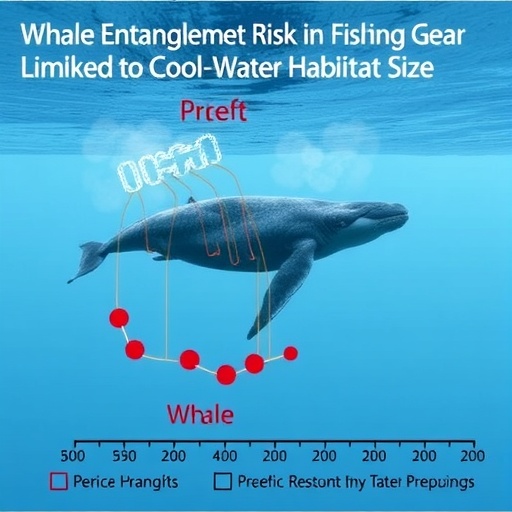
Off the U.S. West Coast, humpback whales are increasingly entangling in fishing gear, posing a dire threat to their survival. New research from Jarrod Santora and colleagues at the National Oceanic and Atmospheric Administration, published in the renowned journal PLOS Climate, unpacks the complex ecological dynamics driving this rising risk. The study reveals a direct connection between shrinking cool-water habitats—critical feeding grounds for these majestic marine mammals—and the frequency of entanglements, underscoring the profound impact of ocean warming and habitat compression on marine ecosystems.
Humpback whale entanglements in fishing equipment such as gillnets and traps have surged sharply in recent years. While annual reported cases had consistently remained below 10 prior to 2014, by 2024 that number ballooned to 31—an alarming increase. This trend coincides with documented episodes of marine heatwaves, including the infamous “blob” events of 2015 and 2016, which drastically reduced the extent of the cool, productive waters where humpbacks hunt. Understanding the drivers behind this escalation in entanglement is essential for developing effective mitigation strategies.
The research team employed an innovative metric known as the Habitat Compression Index (HCI), which quantifies how the spatial extent of suitable cool-water habitat fluctuates in response to changes in sea surface temperature. Developed under Santora’s leadership, this index captures the “compression” effect whereby rising ocean temperatures push cool-water zones shoreward and into smaller areas. Consequently, the whales’ foraging territory becomes restricted and overlaps more extensively with fishing zones, amplifying the likelihood of harmful interactions.
To unravel the interplay of factors contributing to entanglement risk, the scientists analyzed data spanning over 25 years, integrating reported entanglement incidents, estimated population trends, and habitat availability metrics. Their comprehensive analysis demonstrated that years characterized by diminished cool-water habitat correspond to elevated numbers of whale entanglements. Notably, whale population growth alone could not statistically account for the dramatic surges seen during heatwave years, emphasizing the overriding influence of environmental stressors rather than mere population density.
This evidence supports the hypothesis of “habitat compression” as a primary driver pushing humpbacks closer to shore-based fishing activities, intensifying their risk of becoming entangled. The team’s findings also suggest the presence of a “compression-assisted resolution” phenomenon, wherein extreme habitat compression artificially inflates the observed rates of whale recaptures and entanglements, potentially skewing population assessments during marine heatwave events. Such insights highlight the intricate and dynamic nature of marine ecosystems in a warming world.
Importantly, the Habitat Compression Index functions not only as a retrospective analytical tool but also as a potent forecasting system. The study found that predictions based on the HCI could anticipate oceanic thermal conditions six to twelve months in advance, offering a valuable early warning mechanism. For example, the study notes that January 2024 forecasts accurately projected lowered cool-water habitat extent, which correlated strongly with the subsequent spike to 31 entanglement reports that year. This predictive capacity is a breakthrough for proactive management.
The researchers advocate for integrating the HCI into fishery management frameworks as a “rate tracker” to monitor thermal habitat accumulation throughout winter and spring. Such integration would empower regulators to implement dynamic strategies—such as adjusting fishing seasons, scaling trap limits, or enacting spatial closures—in response to anticipated habitat compression events. This adaptive approach could substantially reduce entanglement incidents and balance conservation goals with fishing industry needs.
Moreover, this study shines a light on the multifaceted challenges faced by marine conservationists. It underscores how climate-induced environmental shifts—rather than solely increases in whale numbers—drive risk patterns. This nuanced understanding urges a paradigm shift from focusing only on population management toward encompassing ecosystem-based approaches that factor in habitat dynamics and climate variability.
Humpback whales play vital roles in marine ecosystems as apex consumers and cultural icons, yet their survival is increasingly precarious. Entanglement injuries can lead to prolonged suffering, reduced reproductive success, and mortality. The research conducted by Santora and colleagues equips scientists, policymakers, and stakeholders with actionable knowledge to enhance whale protection amid accelerating climate change pressures.
In summary, the intersection of rising ocean temperatures, habitat compression, and fishing activity emerges as a critical nexus influencing humpback whale entanglement risk along the U.S. West Coast. The Habitat Compression Index represents a pioneering tool in disentangling these complex relationships, with significant implications for ecosystem-based fishery management. This transformative research calls for integrating thermal habitat metrics into predictive models and crafting responsive mitigation strategies that safeguard not only humpbacks but the resilience of marine ecosystems in a warming world.
Subject of Research: Animals
Article Title: Whale entanglements disentangled through the lens of cumulative habitat compression
News Publication Date: February 25, 2025
Web References: http://dx.doi.org/10.1371/journal.pclm.0000723
References: Santora JA, Schroeder ID, Hazen EL, Field JC, Forney KA, Saez L, et al. (2026) Whale entanglements disentangled through the lens of cumulative habitat compression. PLOS Clim 5(2): e0000723.
Image Credits: Santora JA, et al., 2025, PLOS Climate, CC-BY 4.0
Keywords: humpback whales, habitat compression, entanglement risk, marine heatwave, cool-water habitat, fishing gear, ecosystem-based management, climate change, Habitat Compression Index, U.S. West Coast


