


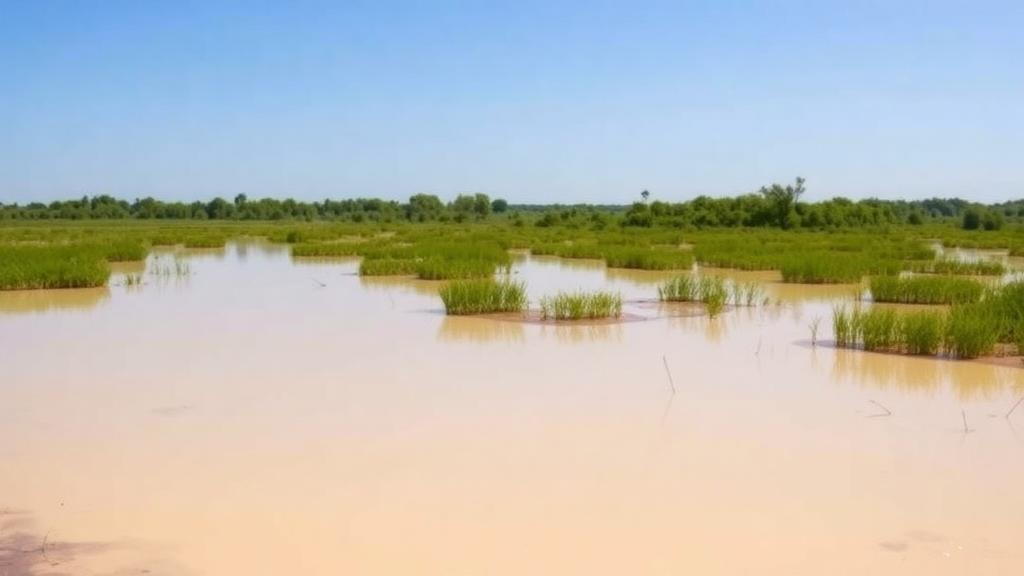
Two small wastewater treatment plants in the Spanish province of Valencia have become the proving ground for an idea that could reshape how Europe pays for clean water. At Carrícola and Los Monasterios, researchers working within the EU-funded LIFE Renaturwat project have upgraded conventional treatment trains with constructed wetlands whose filter media is not sand or gravel but aluminium-rich sludge recovered from drinking water treatment plants. The result is a system that polishes secondary effluent, strips phosphorus with remarkable efficiency, and simultaneously turns an industrial waste product into a functional resource. What makes the new study, published in Environmental Science and Pollution Research, stand out is not the engineering alone but the economics: the team has built a rigorous framework for attaching credible monetary values to benefits that have traditionally been treated as invisible.
The regulatory backdrop gives the work its urgency. The revised Urban Wastewater Treatment Directive, (EU) 2024/3019, extends binding treatment obligations to all urban agglomerations of at least 1000 population equivalents. That threshold matters because small communities, often dismissed as marginal polluters, collectively exert significant pressure on roughly 11 percent of the European Union’s surface water bodies. Previous directives largely left these agglomerations outside the strictest requirements, and the resulting nutrient loads, particularly phosphorus, continue to drive eutrophication in rivers, lakes and coastal waters. Member states now face the task of upgrading hundreds of small plants, and the central question is which technology can deliver compliance without imposing costs that small municipalities cannot bear.
Nature-based solutions offer an appealing answer. Constructed wetlands use planted beds and microbial communities to remove organic matter, nitrogen and pathogens, operating with minimal energy input and low maintenance demands compared with conventional activated sludge systems. The Renaturwat innovation lies in the substrate. Drinking water treatment generates large volumes of aluminium-based sludge, a residue that is typically landfilled. Because aluminium hydroxides bind phosphate strongly, the sludge acts as an efficient adsorbent when used as wetland fill material, capturing phosphorus that would otherwise flow into receiving waters. This closes a loop within the urban water cycle: a by-product of one treatment process becomes the active ingredient of another, embodying circular economy principles in a way that regulators and funders increasingly demand.
Quantifying the full value of such systems, however, has long been the weak link in the argument. Conventional cost-benefit analysis captures capital expenditure, operating costs and, at best, the market value of reclaimed water. It says nothing about biodiversity gains, carbon sequestration, landscape amenity, habitat for fauna and flora, or the recreational and educational value of a green infrastructure that doubles as a small wetland ecosystem. These non-market benefits are real, and environmental economists have spent decades developing methods to estimate them, but applying them consistently to a specific treatment upgrade at a specific site has remained challenging. The Valencia team, led by Vicent Hernández-Chover of the University of Valencia’s Water Economics Group together with Carmen Hernández-Crespo of the Universitat Politècnica de València, addressed the gap by combining two established techniques into a single framework.
The first component is the AMUVAM method, an analytic multicriteria valuation approach originally developed for valuing environmental assets such as the Pego-Oliva wetland, and paired here with the Analytic Network Process, or ANP. Where simpler methods treat ecosystem services as independent line items, ANP acknowledges that they interact: water availability supports fauna and flora, which in turn underpin cultural and recreational values, while regulating services feed back into all of the others. To capture this web of interdependencies, the researchers convened a panel of twelve multidisciplinary experts who performed pairwise comparisons, judging the relative influence of each service on the others. The mathematical machinery of ANP then converts those judgments into weighted priorities that reflect the network structure rather than a flat checklist.
The second component is monetisation. Once each ecosystem service carries a weight reflecting its relative importance, the framework needs a pivot value to translate those weights into euros. The team used the market price of drinking water supply in Spain, €1.09 per cubic metre, as that anchor. The logic is pragmatic: water is the service that society already pays for through tariffs, so its price provides a defensible, policy-relevant benchmark against which the other, unpriced services can be scaled. This choice avoids the volatility and controversy of hypothetical willingness-to-pay surveys while keeping the valuation grounded in an observable market signal that water utilities and regulators already use.
The results are striking in their internal consistency. Water availability emerged as the dominant ecosystem service, accounting for 33.27 percent of total relevance, which is unsurprising in a Mediterranean region where drought and water stress are recurring realities. Aggregated by category, provisioning services took 42.23 percent of overall relevance, followed by fauna and flora at 25.84 percent, cultural services at 22.54 percent, and regulating services at 9.40 percent. The prominence of biodiversity-related values in a small treatment wetland underscores how much ecological value these systems generate beyond their nominal job of cleaning effluent. It also suggests that decision frameworks which ignore fauna, flora and cultural dimensions systematically understate the case for nature-based treatment.
Translated into money over a 25-year horizon, the benefits are substantial. The Carrícola system generates approximately €242,200 in economic value, while the larger Los Monasterios installation produces around €880,726. Set against the costs of implementing and maintaining the wetlands, these figures yield benefit-cost ratios of 6.6 to 7.5, meaning that every euro invested returns roughly seven euros in combined market and non-market value. Crucially, the team tested the robustness of these estimates under conservative scenarios, and the ratios remained above unity even when assumptions were pushed toward pessimism. For municipal decision-makers accustomed to treatment upgrades that are pure cost centres, a sevenfold return is a persuasive number.
The methodological significance extends beyond the two Spanish case studies. By making the valuation chain explicit, from expert judgments about ecosystem service interdependencies, through network-based weighting, to monetisation against a real market price, the AMUVAM-ANP framework produces numbers that can be audited, replicated and adapted to other sites. Sensitivity analysis, a standard tool for testing how model outputs respond to changes in inputs, supports the credibility of the results. The approach also aligns with a broader movement in environmental accounting, traceable to landmark work on the value of global ecosystem services and to the Common International Classification of Ecosystem Services, which seeks to embed natural capital into routine decision-making rather than leaving it as an afterthought in environmental impact statements.
For the thousands of small European agglomerations now facing compliance deadlines under the new directive, the implications are concrete. Constructed wetlands enhanced with recovered treatment sludge offer a pathway that satisfies phosphorus removal targets, reuses a waste stream, operates cheaply, and generates a bundle of ecosystem services whose economic weight can now be demonstrated rather than asserted. The LIFE Renaturwat results provide the transparent, replicable economic basis that funding applications, tariff negotiations and procurement decisions have often lacked. As water stress intensifies across the Mediterranean and beyond, the ability to show that a wetland beside a small treatment plant is not merely compliant infrastructure but a productive natural asset may prove to be the argument that finally tips investment toward nature-based solutions at scale.
Subject of Research: Economic valuation of nature-based constructed wetland systems for water reuse in small wastewater treatment plants
Article Title: Integrating multicriteria analysis and economic valuation to assess nature-based water reuse systems (LIFE Renaturwat)
Article References: Hernández-Chover, V., Castellet-Viciano, L., Bellver-Domingo, Á., Hernández-Sancho, F., & Hernández-Crespo, C. (2026). Integrating multicriteria analysis and economic valuation to assess nature-based water reuse systems (LIFE Renaturwat). Environmental Science and Pollution Research. https://doi.org/10.1007/s11356-026-38244-3
Image Credits: AI Generated
DOI: 10.1007/s11356-026-38244-3
Keywords: constructed wetlands, water reuse, ecosystem services valuation, nature-based solutions, circular economy, phosphorus removal, wastewater treatment, multicriteria decision analysis, AMUVAM, analytic network process, EU Urban Wastewater Treatment Directive, LIFE Renaturwat
Cite Scienmag News
Sloane Callahan. (October 3, 2026). Wetlands That Pay for Themselves: Spanish Study Puts a Price Tag on Nature-Based Water Reuse. Scienmag. https://scienmag.com/wetlands-that-pay-for-themselves-spanish-study-puts-a-price-tag-on-nature-based-water-reuse/
Sloane Callahan. "Wetlands That Pay for Themselves: Spanish Study Puts a Price Tag on Nature-Based Water Reuse." Scienmag, 3 October 2026, https://scienmag.com/wetlands-that-pay-for-themselves-spanish-study-puts-a-price-tag-on-nature-based-water-reuse/. Accessed 4 October 2026.
Sloane Callahan. "Wetlands That Pay for Themselves: Spanish Study Puts a Price Tag on Nature-Based Water Reuse." Scienmag. October 3, 2026. https://scienmag.com/wetlands-that-pay-for-themselves-spanish-study-puts-a-price-tag-on-nature-based-water-reuse/


