


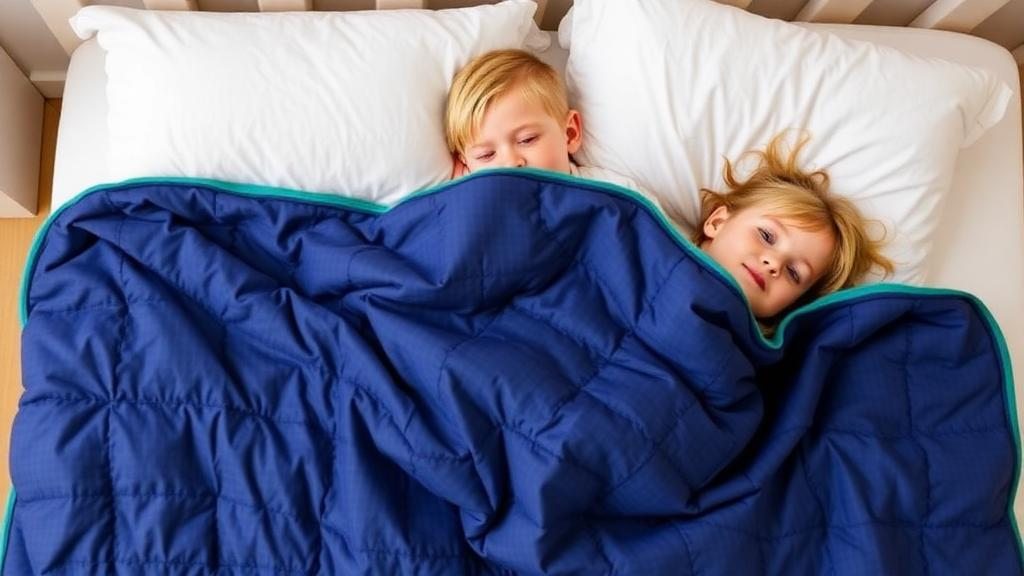
For many families raising a child with attention deficit hyperactivity disorder, the hardest part of the day begins when the lights go out. Bedtime resistance, struggles to fall asleep, night wakings and groggy mornings can turn the household into what researchers describe as a constant battleground, leaving parents sleep deprived and the whole family strained. A new study from Sweden, published in the Scandinavian Journal of Occupational Therapy, now offers a detailed picture of how one increasingly popular tool, the weighted blanket, changes the way parents perceive their children’s sleep problems across multiple distinct sleep domains.
The study, led by Maria Lönn of Halmstad University together with colleagues from Halmstad University, Lund University and Swedish child and adolescent psychiatry services, is part of a larger research programme known as the SLEEP project. Rather than treating sleep as a single, unitary measure, the researchers asked a deceptively simple question: which specific sleep problems do parents of children with ADHD actually perceive as problematic before and after their children start using a weighted blanket? The answer matters because what clinicians classify as a sleep disorder does not always match what families experience as a problem in everyday life, and a client-centred approach, central to occupational therapy, depends on capturing that lived perspective.
The evidence base for weighted blankets rests on a sensory rationale. The deep pressure provided by the blanket’s weight is intended to help the child adapt to the environment, regulate physiological arousal and improve emotional regulation. Previous research from the same team had shown that children with ADHD who adhered to weighted blanket use had fewer parent-reported sleep problems than children who discontinued use, and that parents themselves slept better. But sleep is multidimensional, and sleep problems among children with ADHD are diverse and multifaceted, spanning difficulties at bedtime, during the night and across the following day. The new study set out to move beyond total scores and examine how each domain evolves.
The participants were drawn from an ADHD unit within a child and adolescent mental health service in southern Sweden. In the parent intervention trial, ninety-four children aged six to fourteen were randomised to begin a sixteen-week sleep intervention with either a weighted blanket or a lighter fibre blanket, using each for four weeks in a crossover phase before choosing their preference. Seventy-one children chose the weighted blanket. The present analysis focused on the forty-eight children who used the weighted blanket all nights or most nights, defined as four to seven nights per week, during the open-label phase, and for whom complete questionnaire data at both baseline and the sixteen-week follow-up were available, giving a final sample of forty-five children.
The weighted blankets themselves were fibre-weighted products weighing between four and ten kilograms, in a standard Swedish size of 150 by 210 centimetres. The appropriate weight for each child was decided independently by two occupational therapists based on background characteristics including age, gender, ADHD subtype, severity of sleep problems, and the child’s weight and height. Most of the children in the analysed sample used six-kilogram blankets. The children had uncomplicated DSM-5 ADHD diagnoses without significant comorbidities, and sleep problems were verified at the mental health service using parent-rated screening questions covering sleep initiation, sleep maintenance and sleep duration.
To capture parents’ perceptions, the researchers used the Children’s Sleep Habits Questionnaire, a thirty-three-item screening instrument divided into eight subscales: sleep onset, night wakings, sleep duration, daytime sleepiness, bedtime resistance, sleep anxiety, parasomnias and sleep-disordered breathing. Crucially, parents did not merely rate how often each behaviour occurred; they also rated whether they perceived it as a problem. If a parent marked at least one item within a subscale as problematic, the entire subscale was scored as problematic. Sleep-disordered breathing was excluded from the analysis because it was not a problem in this sample and was not expected to change. Changes between baseline and follow-up were tested with McNemar’s test, a statistical method suited to paired nominal data, with a p-value below 0.05 considered significant.
The baseline picture was dominated by two concerns. Before the weighted blankets were introduced, parents most frequently rated bedtime resistance, reported by 73.3 percent of parents, and daytime sleepiness, reported by 71.1 percent, as problems. Sleep onset difficulties and short sleep duration followed at 62.2 percent and 57.8 percent respectively, while night wakings, sleep anxiety and parasomnias were less commonly perceived as problems, each affecting roughly 38 to 40 percent of the sample. After sixteen weeks of weighted blanket use, the overall burden had clearly shifted: daytime sleepiness remained a problem for 37.8 percent of parents, bedtime resistance for 31.1 percent, sleep onset and sleep duration for 28.9 percent each, and sleep anxiety for 20 percent. Night wakings and parasomnias had become the least common concerns, reported by only 8.9 to 11.1 percent of parents.
The change analysis showed that parents’ perceptions improved across every subscale, with statistically significant shifts for all seven domains examined. The proportion of parents moving from ‘problem’ to ‘no problem’ ranged from about 27 percent to 42 percent depending on the domain. Bedtime resistance showed the largest shift, with 42.2 percent of parents, nineteen of forty-five, no longer perceiving it as a problem after the intervention, a change with a p-value of 0.000. Sleep onset delay followed at 37.8 percent, daytime sleepiness at 35.6 percent, sleep duration at 33.3 percent, night wakings at 31.1 percent, and sleep anxiety and parasomnias at 26.7 percent each. Among the parents who had specifically flagged each problem at baseline, a majority reported a shift from problem to no problem at follow-up, and persistent problems were especially rare for night wakings, sleep anxiety and parasomnias. Notably, three parents did report that sleep anxiety emerged as a new problem during blanket use, a reminder that individual responses can vary in both directions.
One intriguing discrepancy emerged when the authors compared these perception-based findings with their earlier trial data. In the previous study, which used actigraphy, an objective wrist-worn measure of sleep, no statistically significant change in sleep onset latency was found among children adhering to weighted blankets. Yet in the present study, 38 percent of parents reported that sleep onset delay had shifted from problem to no problem. The researchers suggest that parents may have experienced bedtime as smoother and less conflict-laden with the blanket, a change in the quality of the routine that does not necessarily translate into a shorter time to fall asleep as measured by a device. A weighted blanket may improve a child’s ability to handle emotional and behavioural difficulties at bedtime, enhancing the child’s own agency and reducing the parental support needed, even when the underlying sleep physiology is unchanged.
The authors are careful about the limits of their design. The study lacked a control group, the sample was small, and the results should be regarded as exploratory; causation cannot be firmly established. Subscales also contain different numbers of items, from a single item for sleep onset delay to eight items for daytime sleepiness, which means positive change can appear more readily in subscales with fewer items. The recruitment of children with uncomplicated ADHD, which excluded roughly half of patients referred to the service, including those with significant comorbidities such as anxiety, depression, autism or intellectual impairment, further limits generalisability. Nevertheless, the clinical relevance of the findings is high, particularly because parent-reported sleep problems tend to persist in children with ADHD and can worsen core symptoms, parental stress and maternal mental health. The team argues that asking parents about specific problematic sleep domains, using an instrument such as the Children’s Sleep Habits Questionnaire in a client-centred way, could serve as an appropriate starting point for evaluating weighted blanket interventions in paediatric occupational therapy practice, replacing a one-size-fits-all approach with one targeted to each family’s actual concerns, while future evaluations should assess multiple dimensions of sleep both before and after use.
Subject of Research: Parents' perceptions of sleep problems in children with ADHD before and after a weighted blanket sleep intervention
Article Title: Parents’ perceptions of sleep problems in children with ADHD when using weighted blankets
Article References: Lönn, M., Erlandsson, L.-K., Aili, K., Svedberg, P., Jarbin, H., & Larsson, I. (2025). Parents’ perceptions of sleep problems in children with ADHD when using weighted blankets. Scandinavian Journal of Occupational Therapy, 32(1), Article 2538474. https://doi.org/10.1080/11038128.2025.2538474
Image Credits: AI Generated
DOI: 10.1080/11038128.2025.2538474
Keywords: ADHD, weighted blankets, children's sleep, sleep problems, occupational therapy, parent perceptions, Children's Sleep Habits Questionnaire, bedtime resistance, sleep intervention, client-centred practice, pediatric sleep, Sweden
Cite Scienmag News
Ophelia Keating. (October 2, 2026). Weighted Blankets Ease Bedtime Battles for Children With ADHD, Parents Report. Scienmag. https://scienmag.com/weighted-blankets-ease-bedtime-battles-for-children-with-adhd-parents-report/
Ophelia Keating. "Weighted Blankets Ease Bedtime Battles for Children With ADHD, Parents Report." Scienmag, 2 October 2026, https://scienmag.com/weighted-blankets-ease-bedtime-battles-for-children-with-adhd-parents-report/. Accessed 4 October 2026.
Ophelia Keating. "Weighted Blankets Ease Bedtime Battles for Children With ADHD, Parents Report." Scienmag. October 2, 2026. https://scienmag.com/weighted-blankets-ease-bedtime-battles-for-children-with-adhd-parents-report/


