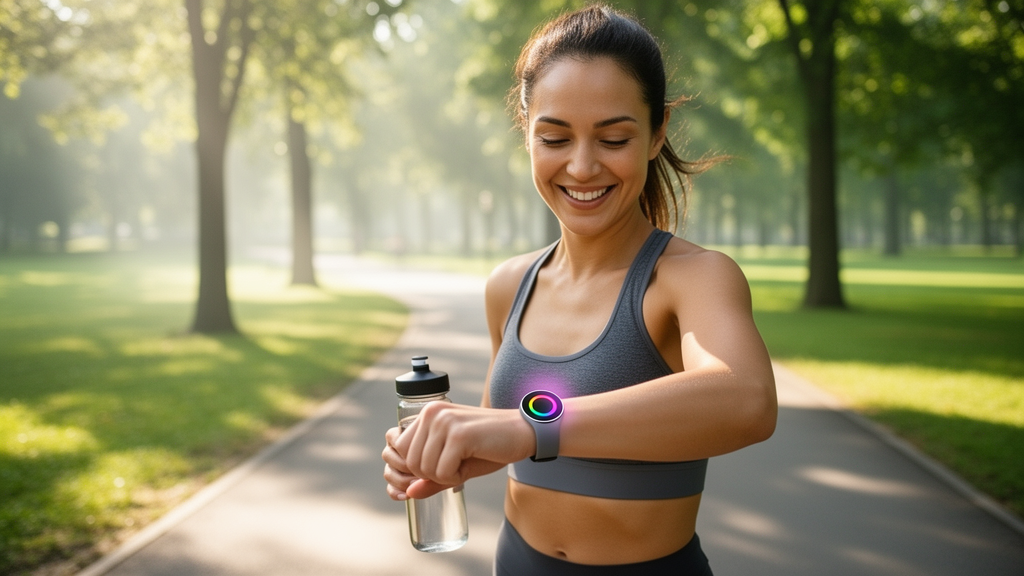
People who use smartwatches, fitness trackers, and fitness applications tend to report sticking with their exercise routines more consistently, and much of that link appears to run through two psychological factors: confidence in one’s ability to exercise and the enjoyment felt while doing it. That is the central finding of a new questionnaire study published in Frontiers in Psychology, which surveyed 367 users of digital fitness technologies in China and modeled the statistical pathways connecting device use to exercise adherence.
The research team, led by Zitong Qin of Universiti Malaya with colleagues at the Capital Institute of Physical Education and Sports and Tianjin University, set out to test what they call a chain mediation model. Rather than asking simply whether wearable device use correlates with exercise adherence, they examined whether exercise self-efficacy — a person’s belief in their capacity to complete planned exercise — and positive exercise experiences, such as pleasure, vitality, satisfaction, and flow, jointly explain that association in a specific sequence: device use first, then self-efficacy, then positive experiences, then adherence.
The participants were recruited between March and May 2026 through fitness clubs, sports application communities, and college athlete groups across several Chinese provinces. To qualify, respondents had to have used a smartwatch, fitness tracker, or sports application with data-tracking functions for at least three of the previous six months, exercise at least twice per week, and be between 18 and 60 years old. Of 412 questionnaires collected, 45 were discarded for repeated responses, failed attention checks, or suspiciously short completion times, leaving 367 valid responses. The sample skewed young and highly educated, with an average age of about 28 years, and just over half used smartwatches while roughly a third used fitness trackers.
The headline numbers are striking. Wearable device use showed a total statistical association with exercise adherence of β = 0.430, which is a moderately strong standardized relationship for behavioral research. When the two psychological mediators were folded into the structural equation model, the direct association shrank to β = 0.197, though it remained statistically significant. The indirect pathways running through self-efficacy and positive experiences together accounted for 54.0 percent of the total association — meaning that, statistically, more than half of the link between device use and adherence traveled through these cognitive and emotional factors.
The mediation analysis, validated with bootstrap resampling of 5,000 iterations, revealed three distinct indirect pathways, all statistically significant. The strongest ran from device use through exercise self-efficacy to adherence (β = 0.119, 95% CI [0.068, 0.176]). A second ran through positive experiences alone (β = 0.053, 95% CI [0.024, 0.091]). The third — the chain pathway the study was designed to test, in which device use boosts self-efficacy, which in turn fosters more positive exercise experiences, which then support adherence — was also significant (β = 0.059, 95% CI [0.035, 0.086]). The full model explained 22.7 percent of the variance in self-efficacy, 36.0 percent in positive experiences, and 34.0 percent in exercise adherence.
The authors interpret these patterns through well-established theoretical frameworks. Self-efficacy theory holds that beliefs about one’s capabilities shape persistence when facing obstacles, and wearable devices may nurture those beliefs through real-time data feedback, goal-achievement prompts, and visible records of progress. On the emotional side, gamified features such as badges, challenges, and leaderboards, along with social sharing functions, may make workouts more enjoyable and socially connected, generating the positive affective experiences that previous research has linked to a greater willingness to keep exercising. The chain model suggests these two mechanisms may not operate in parallel but in sequence, with cognitive appraisals of competence coloring the emotional texture of exercise itself.
Several robustness checks strengthened the picture. When the 56 participants who used fitness applications only — not actual wearable devices — were excluded, all indirect pathways remained significant, though the direct association weakened. An alternative model reversing the order of the two mediators produced a smaller chained indirect effect (β = 0.049 versus 0.059), offering tentative statistical support for the hypothesized ordering. Notably, when the four functional dimensions of device use — data tracking, goal setting and feedback, social sharing, and personalization — were tested simultaneously, none was uniquely associated with adherence, suggesting the functions work jointly rather than through any single feature.
The measurement work was unusually thorough for a survey study. The team used or adapted four validated scales covering device usage, self-efficacy, positive exercise experience, and adherence, all showing high internal consistency (Cronbach’s alpha between 0.887 and 0.913). A four-factor confirmatory factor analysis on all 56 items fit the data well (CFI = 0.922, RMSEA = 0.034) and substantially outperformed a one-factor model, and convergent and discriminant validity checks, including HTMT ratios, all passed conventional thresholds. A Harman’s single-factor test suggested common method bias was not dominant, though the authors candidly note this diagnostic is relatively insensitive.
That candor matters, because the study’s limitations are substantial and the authors are unusually explicit about them. The design is cross-sectional: every variable was measured at a single time point, so the
Subject of Research: A cross-sectional questionnaire study of the statistical pathways linking wearable device use to exercise adherence through exercise self-efficacy and positive exercise experiences.
Article Title: The association between wearable device use and exercise adherence: a chain mediation model of exercise self-efficacy and positive experiences
Article References: Qin, Z., Guo, Y., & Liu, X. (2026). The association between wearable device use and exercise adherence: a chain mediation model of exercise self-efficacy and positive experiences. Frontiers in Psychology, 17, Article 1943574. https://doi.org/10.3389/fpsyg.2026.1943574
Image Credits: AI Generated
DOI: 10.3389/fpsyg.2026.1943574
Keywords: wearable devices, exercise adherence, exercise self-efficacy, positive exercise experiences, chain mediation model, structural equation modeling, fitness trackers, sport psychology, cross-sectional survey, physical activity, bootstrap mediation, digital health technology
Cite Scienmag News
Glenn Wilkins. (October 30, 2026). Wearable Devices and Exercise Persistence Linked Through Confidence and Enjoyment. Scienmag. https://scienmag.com/wearable-devices-and-exercise-persistence-linked-through-confidence-and-enjoyment/
Glenn Wilkins. "Wearable Devices and Exercise Persistence Linked Through Confidence and Enjoyment." Scienmag, 30 October 2026, https://scienmag.com/wearable-devices-and-exercise-persistence-linked-through-confidence-and-enjoyment/. Accessed 30 October 2026.
Glenn Wilkins. "Wearable Devices and Exercise Persistence Linked Through Confidence and Enjoyment." Scienmag. October 30, 2026. https://scienmag.com/wearable-devices-and-exercise-persistence-linked-through-confidence-and-enjoyment/