


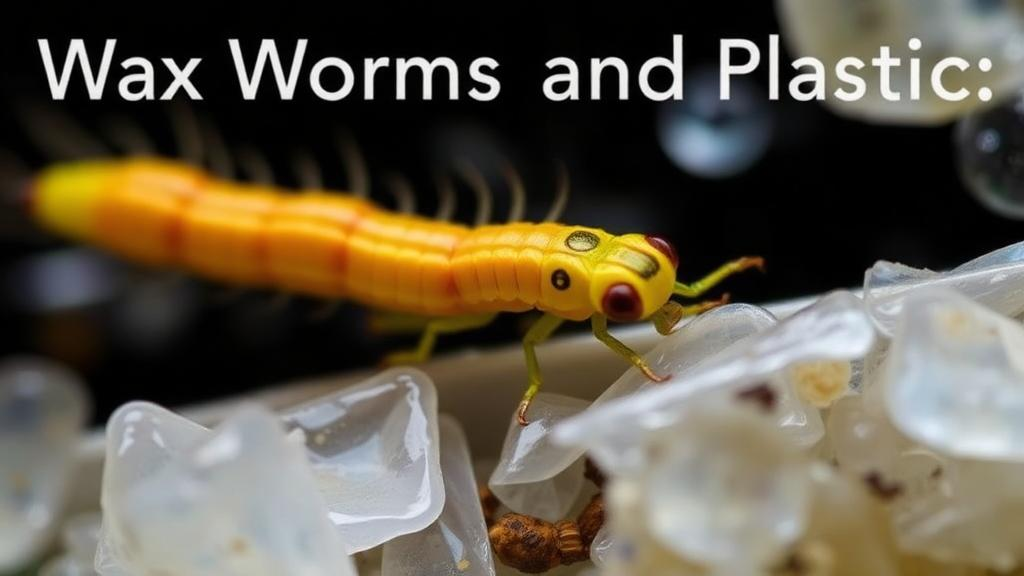
In a world drowning in plastic, one of the most unlikely candidates for a cleanup crew has been quietly munching away in laboratories around the globe: the larva of the greater wax moth, Galleria mellonella. This unassuming caterpillar, better known to beekeepers as a hive pest that raids honeycomb, has become the star of a rapidly growing body of research suggesting that insects and their gut microbes may be able to break down some of the most persistent synthetic polymers humans have ever produced. A new review published in Environmental Science and Pollution Research by Iswahyudi Iswahyudi and Marchel Putra Garfansa of Universitas Islam Madura in Indonesia now takes stock of that evidence, and its conclusions are both encouraging and sobering in equal measure.
The review synthesizes studies in which wax moth larvae were exposed to an impressive range of plastics: polyethylene, the world’s most produced polymer and the backbone of shopping bags and packaging film; polystyrene, familiar from foam cups and insulation; polypropylene, polyvinyl chloride, various bioplastics, and even complex mixed waste from discarded electrical and electronic equipment. Across these studies, larvae have been reported to consume, fragment, and in some cases chemically transform plastic substrates, prompting headlines that celebrate the emergence of so-called plastivores. Yet the authors caution that the field’s enthusiasm has sometimes outrun its data, and that a closer look at experimental design reveals significant gaps between what has been demonstrated and what has been assumed.
One of the review’s central contributions is a careful distinction between macroplastics and microplastics, two categories that the authors argue cannot be treated interchangeably. Macroplastic experiments typically involve films, sheets, foams, and fragments large enough for larvae to chew and ingest directly. Microplastic studies, by contrast, use powders and particles whose tiny dimensions radically change the physics of the interaction. Particle size and geometry influence the surface-area-to-volume ratio of the material, how easily larvae can masticate and swallow it, how readily microbes can colonize its surface, and even how reliably analysts can recover particles from complex samples for measurement. Because of these differences, the authors warn, results obtained from macroplastic substrates cannot be directly extrapolated to microplastic degradation, a point with major implications for how the field interprets its own literature.
The reported efficiencies of consumption and transformation varied widely across studies, and the review identifies a long list of variables that make direct comparisons treacherous. Polymer type obviously matters, but so do the form and dimensions of the substrate, the duration of exposure, the feeding regime, the density of larvae in each experiment, any pretreatment applied to the plastic, and the analytical method used to assess degradation. A study measuring mass loss of a polyethylene film after several weeks of larval feeding is, in a strict sense, measuring something quite different from a study tracking the fate of micron-scale polystyrene particles. Without standardized substrates and protocols, the review suggests, apparent degradation rates may reflect experimental artifacts as much as genuine biological capability.
At the heart of the wax worm story lies its gut microbiome. Recurrently reported taxa associated with plastic exposure include Bacillus, Pseudomonas, Enterococcus, and Enterobacter, bacterial genera with well-documented metabolic versatility. Several studies have isolated strains from larval guts and shown activity against plastics in vitro, including a Bacillus cereus isolate reported to degrade polypropylene and an Enterobacter strain linked to polyethylene breakdown. Fungi have entered the picture as well, with Aspergillus flavus recovered from wax moth guts and shown to degrade polyethylene microplastic particles. But the review draws an important line here: detecting or enriching these taxa in plastic-fed larvae indicates an association with plastic exposure, not definitive proof that the microbes directly degrade the polymer. Correlation, in other words, is not depolymerization.
The mechanistic picture that emerges from chemical, metabolomic, microbiome, and proteomic analyses is one of oxidative attack followed by downstream metabolism. Proposed pathways typically begin with oxidation of the polymer backbone, introducing oxygen-containing functional groups into hydrophobic chains that are otherwise extraordinarily resistant to biological attack. From there, smaller fragments could theoretically feed into familiar metabolic routes, including pathways for aromatic compound catabolism in the case of polystyrene. Supporting this model, studies have documented changes in larval lipid homeostasis when larvae are fed polyethylene, suggesting that plastic-derived carbon may be incorporated into host metabolism, and spectral analyses have detected oxidized regions on exposed plastic surfaces. Salivary enzymes from the larvae have also been implicated, with research published in Nature Communications identifying enzymes in wax worm saliva capable of oxidizing polyethylene within hours.
Yet even the most compelling mechanistic evidence falls short of the full biodegradation story. The review emphasizes that complete depolymerization, bioassimilation of plastic carbon into biomass, and mineralization to carbon dioxide remain insufficiently demonstrated across most polymer types and size classes. Many studies report mass loss or surface changes without confirming where the missing material went. A larva that chews plastic into smaller fragments produces apparent mass loss while potentially generating microplastics rather than eliminating them. Distinguishing true chemical transformation from mere fragmentation, and both from genuine assimilation, requires analytical tools that many early studies lacked. The authors point to work using isotope labeling and infrared microspectroscopy as a model for how future experiments should be designed, tracing labeled carbon from plastic into larval tissue to prove bioassimilation directly.
The review also highlights the role of diet in shaping the wax worm’s plastic-processing capacity. Co-diet supplementation experiments, in which larvae received honeybee wax or other nutrients alongside plastic, have produced mixed results: some found that co-diets altered the core gut microbiome and enhanced degradation, while others concluded that adding wax or honeycomb did not influence the core gut bacteria or their associated enzymes at all. These inconsistencies matter because they bear directly on the central question of whether plastic degradation is primarily a microbial achievement, a host enzymatic process, or a collaboration between the two. The answer may differ by polymer, by substrate form, and by the composition of the larval gut community, which itself varies with diet and environment.
What, then, is the realistic outlook for wax moth biotechnology? The authors are clear that G. mellonella is not about to be deployed in landfills or ocean gyres. Larvae require controlled conditions, and the scale of global plastic waste dwarfs anything insect husbandry could consume. The true value of the wax worm, they argue, lies in discovery: identifying candidate enzymes, microorganisms, and host-microbiome interactions that could eventually be engineered or industrialized. A recently improved reference-quality genome of the plastic-degrading wax moth strengthens that prospect, giving researchers a genetic toolkit for exploring how the insect tolerates plastic diets and which proteins it deploys against them. Comparable work in other plastivores, notably mealworms, has already demonstrated respirometric approaches that measure plastic-to-carbon-dioxide conversion in real time, offering a template for rigorous verification that the wax worm field would do well to adopt.
The review closes with a roadmap that reads as both a critique and an invitation. Future studies, the authors urge, should use chemically characterized substrates with defined size classes, include appropriate controls, perform molecular-weight analysis to track chain scission, and apply isotope tracing to distinguish fragmentation from chemical transformation, bioassimilation, and mineralization. Only with such rigor can the field move from tantalizing observations to verified biodegradation, and from there to applications that might one day contribute to managing plastic waste. For now, the greater wax moth remains what it has been since the first viral reports of plastic-eating caterpillars captured the public imagination: a fascinating biological model whose secrets are still being carefully, and skeptically, unwrapped. The plastic problem will not be solved by hungry larvae alone, but the enzymes and microbes they harbor may yet teach us how to take apart the polymers we have made so well.
Subject of Research: Biodegradation of macroplastics and microplastics by greater wax moth larvae and their gut microbiome
Article Title: Biological degradation of macroplastics and microplastics by greater wax moth larvae (Galleria mellonella): evidence, gut microbiome, and proposed mechanisms
Article References: Iswahyudi, I., & Garfansa, M. P. (2026). Biological degradation of macroplastics and microplastics by greater wax moth larvae (Galleria mellonella): evidence, gut microbiome, and proposed mechanisms. Environmental Science and Pollution Research. https://doi.org/10.1007/s11356-026-38252-3
Image Credits: AI Generated
DOI: 10.1007/s11356-026-38252-3
Keywords: Galleria mellonella, plastic biodegradation, microplastics, polyethylene, polystyrene, gut microbiome, plastivores, bioremediation, polypropylene, polyvinyl chloride, oxidative degradation, isotope tracing
Cite Scienmag News
Gavin Prescott. (October 4, 2026). Wax Worms and Plastic: What the Evidence Really Says About Moth Larvae That Eat Our Waste. Scienmag. https://scienmag.com/wax-worms-and-plastic-what-the-evidence-really-says-about-moth-larvae-that-eat-our-waste/
Gavin Prescott. "Wax Worms and Plastic: What the Evidence Really Says About Moth Larvae That Eat Our Waste." Scienmag, 4 October 2026, https://scienmag.com/wax-worms-and-plastic-what-the-evidence-really-says-about-moth-larvae-that-eat-our-waste/. Accessed 4 October 2026.
Gavin Prescott. "Wax Worms and Plastic: What the Evidence Really Says About Moth Larvae That Eat Our Waste." Scienmag. October 4, 2026. https://scienmag.com/wax-worms-and-plastic-what-the-evidence-really-says-about-moth-larvae-that-eat-our-waste/


