


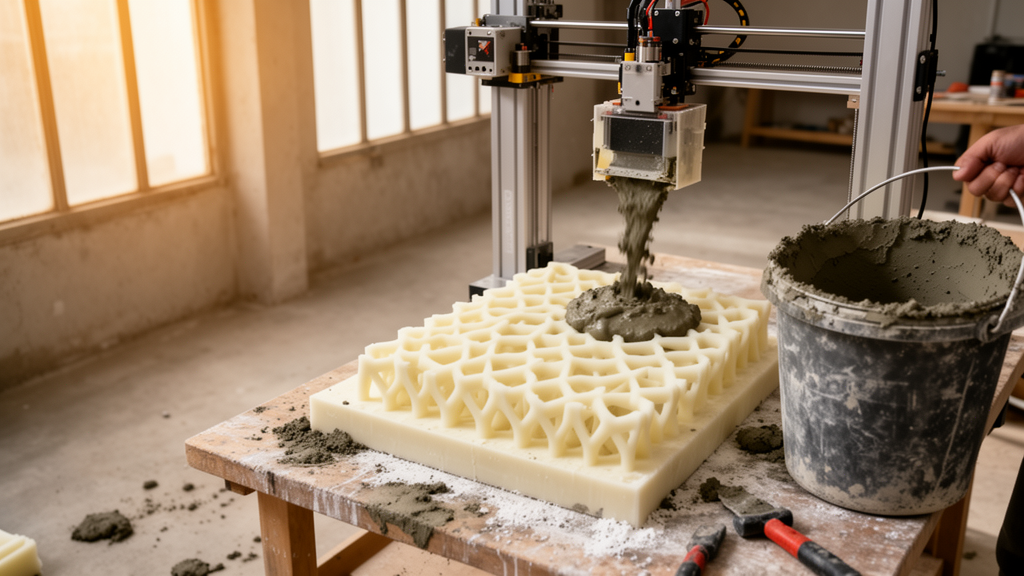
Concrete has a formwork problem. Every curved wall, sculptural staircase, and bespoke facade panel needs a mould, and the moulds for such individualized elements are typically milled from polystyrene, plywood, or timber, used once or a handful of times, and then discarded. Contaminated with concrete residue and release agents, they are rarely recycled in practice. Now a team at Technische Universität Braunschweig, working with the German machinery firm Herrhammer GmbH, has demonstrated a radically different route: formwork 3D printed from a porous wax foam, finished by CNC milling, and then melted down and printed again. In a full-scale case study published in Frontiers in Built Environment, the process produced a geometrically complex precast concrete staircase element while consuming roughly 80 percent less wax than the conventional solid-block route.
The technology, called Wax Foam 3D Printing (WF3DP), deliberately fuses additive and subtractive manufacturing rather than choosing between them. A robotic extrusion system deposits wax foam close to the final geometry, exploiting the material efficiency of 3D printing, while a five-axis CNC milling machine then cuts the printed preform to the precise contour and surface quality that concrete casting demands. The key innovation lies in the material itself: a wax-air composite in which roughly 20 percent of the volume is air, foamed mechanically without any chemical change. Because the wax can be remelted, filtered, and re-foamed indefinitely, the approach supports a closed-loop material cycle at the process level, not merely as an aspiration.
The hardware is substantial. The custom WF3DP unit integrates a heated reservoir holding molten wax at about 90 degrees Celsius, a mechanical foaming unit that whips filtered wax together with air and pre-cools the mixture into a homogeneous semi-solid foam, and a temperature-controlled delivery hose feeding a 12-millimetre extrusion nozzle. The print head is carried by an industrial six-axis KUKA robot with a working volume of 1.6 by 1.2 by 2 metres. Immediately before extrusion, the foam passes through a localized cooling stage regulated to within one degree Celsius, bringing it slightly below its freezing point so that a partially crystallized microstructure gives the extrudate dimensional stability and clean layer formation.
Throughput is impressive for a feasibility study. Stable deposition was achieved at rates of up to 28.5 kilograms per hour, and in the case study roughly 250 kilograms of wax foam were deposited in a continuous print lasting 8 hours and 45 minutes. The printed block measured about 1050 by 1550 by 500 millimetres, including a 20-millimetre offset for milling. Cooling from 65 to 25 degrees Celsius took 3 days and 21 hours, a dramatic improvement over the more than two weeks expected for a comparable solid wax block, whose enormous thermal mass must dissipate its heat slowly.
The material choice proved decisive. The team characterized a new formulation, Tudastar wax, against the ConFormWax (CFW) used in a decade of earlier wax formwork research at Braunschweig. CFW wax has a freezing range of only 62 to 66 degrees Celsius and begins softening well below it; in earlier trials with massive elements up to 1.5 tonnes, hydration heat from curing concrete had softened and partially melted the formwork surface, preventing reuse. Tudastar wax freezes at approximately 81 degrees Celsius, providing a much larger thermal margin. In compressive tests, solid Tudastar wax reached 4.69 newtons per square millimetre, and foaming with 20 percent air reduced its strength by only 6 percent, to 4.40, whereas foamed CFW wax lost 48 percent of its strength. Foamed Tudastar wax therefore carried 2.7 times the load of foamed CFW wax.
Temperature-dependent testing revealed how much of that strength evaporates as the wax warms. Printed Tudastar foam specimens softened from 3.59 newtons per square millimetre at room temperature to 3.03 at 35 degrees and 1.72 at 45 degrees, less than half the room-temperature value, with the failure mode shifting from partly brittle cracking to ductile deformation. Yet even at 45 degrees, the printed foam retained the room-temperature strength of foamed CFW wax, and the measured formwork temperatures during the case study, peaking at 40 to 47 degrees near the wax-concrete interface, stayed well within Tudastar’s thermal margin. Surface-energy measurements using the Owens-Wendt-Rabel-Kaelble method showed Tudastar wax to be almost entirely nonpolar, with a polar component of just 0.25 millinewtons per metre, suggesting favourable demoulding behaviour without release agents.
The full-scale case study put these properties to the test. A cooperating precast manufacturer commissioned a customized radial seating step, a two-step double-curved element with an inner radius of 115 centimetres and an outer radius of 155 centimetres, specified in fair-faced concrete class SB3, a demanding architectural surface standard. The conventional reference formwork had been built manually by a single carpenter in about 1.5 days from plywood and modelling foam, designed for up to 15 casting cycles but reused for only seven before being discarded as non-recyclable waste. The wax route instead printed a near-net-shape preform, scanned it in 3D, and finish-milled it in about 1.5 hours on a five-axis machine.
The print was not flawless. Edges warped upward by as much as 50 millimetres, producing a bowl-shaped deformation, and cracks developed between deposited strands where interlayer bonding proved insufficient. During machining, delamination occurred along layer interfaces, requiring local repair with molten wax, infrared reheating to densify the surface, and remachining. These defects matter because fine gaps between printed layers allowed cement paste and mixing water to penetrate by capillary action during casting, causing localized discoloration and an alternating rough and smooth texture on the demoulded concrete. The element reproduced its complex radial geometry accurately with sharply defined edges and no adhesion damage, but it met the SB3 surface requirements only in part and would need remedial treatment to comply fully.
Demoulding after roughly 23 hours of curing confirmed the expected release behaviour: no release agent was applied to the wax, and no concrete residue or adhesion was detected, though wooden wedges and mechanical force were needed to initiate separation, causing localized surface damage that prevented direct reuse of the formwork for a second casting. The team instead closed the material loop at process level: the used formwork was completely remelted in an 8-kilowatt tank, pumped through fine filtration units to remove concrete particles, re-foamed, and printed into new formwork elements for ongoing research. Earlier investigations had already shown CFW wax withstanding more than 200 remelting cycles without noticeable property changes, and comparable behaviour is expected for Tudastar wax provided oxidation is avoided.
The resource accounting is striking. Producing a formwork element of comparable size by the solid wax block route would have required roughly 1.13 tonnes of wax, most of it machined away without ever contributing to the casting surface. The near-net-shape printed route consumed about 250 kilograms, an approximately 80 percent reduction. The authors estimate that with structural infill patterns and dedicated slicing software, printing time could fall to about 2.5 hours and cooling to roughly one day, cutting the waiting time until the formwork is available to about one-tenth of the solid-block route. Labour input, currently high at around 17 hours including path planning and repair, is expected to become comparable to conventional routes once automation matures. The study identifies interlayer bonding, warpage control, geometric accuracy, surface quality, and damage-free demoulding as the principal hurdles between this prototype and an industrial-ready technology, but it establishes something concrete: a formwork that is printed, milled, cast, and melted down again, within a largely digital process chain powered by on-site solar energy.
Subject of Research: Materials science
Article Title: A novel formwork technology based on wax foam 3D printing and CNC milling
Article References: Jonischkies, S., Mainka, J., Kloft, H., Diesslin, R., & Hack, N. (2026). A novel formwork technology based on wax foam 3D printing and CNC milling. Frontiers in Built Environment, 12, Article 1934051. https://doi.org/10.3389/fbuil.2026.1934051
Image Credits: AI Generated
DOI: 10.3389/fbuil.2026.1934051
Keywords: 3D printing, concrete, formwork, recycling, CNC milling, circular economy, novel, technology, based, foam, printing, milling
Cite Scienmag News
Denise Maddox. (October 16, 2026). Wax foam 3D printing slashes formwork waste in concrete casting breakthrough. Scienmag. https://scienmag.com/wax-foam-3d-printing-slashes-formwork-waste-in-concrete-casting-breakthrough/
Denise Maddox. "Wax foam 3D printing slashes formwork waste in concrete casting breakthrough." Scienmag, 16 October 2026, https://scienmag.com/wax-foam-3d-printing-slashes-formwork-waste-in-concrete-casting-breakthrough/. Accessed 16 October 2026.
Denise Maddox. "Wax foam 3D printing slashes formwork waste in concrete casting breakthrough." Scienmag. October 16, 2026. https://scienmag.com/wax-foam-3d-printing-slashes-formwork-waste-in-concrete-casting-breakthrough/


