

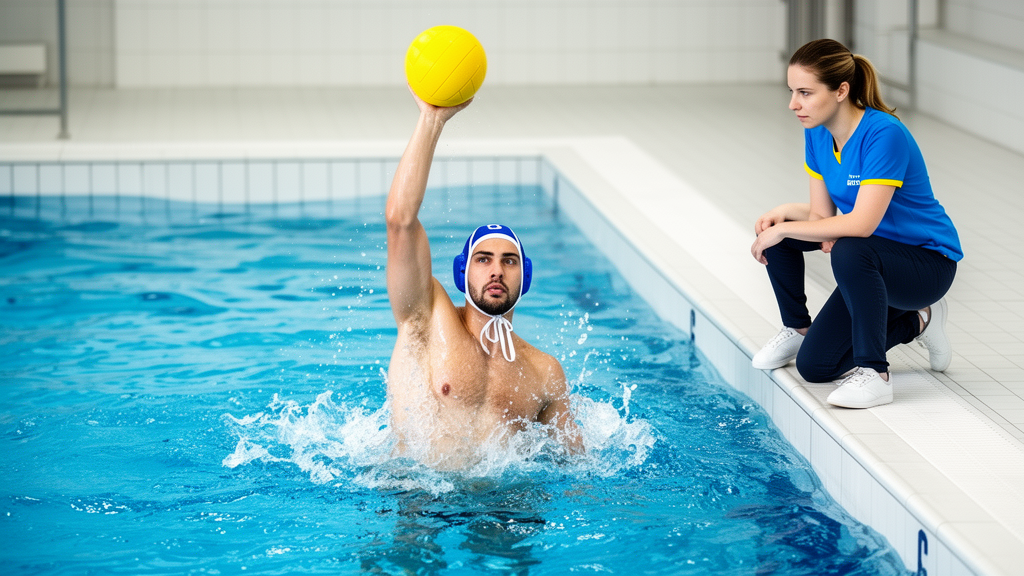
Water polo asks more of the shoulder than almost any other team sport. Players sprint head-up freestyle, tread water vertically for entire quarters, absorb physical contact, and then unleash repeated overhead shots on goal — all while their bodies are partially unsupported in the pool. A new cross-sectional study from Universidad Europea de Madrid, published in Frontiers in Sports and Active Living, has now dissected how male and female competitive water polo players differ in the strength, mechanics, and structure of this overworked joint, and the results upend some common assumptions about sex differences in overhead athletes.
The research team recruited 52 competitive players — 26 men and 26 women aged roughly 18 to 30 — from two federated Spanish clubs. All were field players, not goalkeepers, with at least three years of continuous water polo experience, training four to five days per week and competing at regional or national level. Crucially, every athlete was free of shoulder injury and pain for the six months before testing, ensuring that the measurements captured healthy, adapted shoulders rather than compromised ones. Data were collected across roughly nine months of the competitive season, following STROBE reporting guidelines and ethical approval from the European University of Madrid.
The investigators took a three-pronged approach. Functional capacity was quantified with a handheld dynamometer, measuring maximal isometric strength of the shoulder’s internal and external rotators with the arm at 90 degrees of abduction, from which they calculated the internal-to-external rotation strength ratio (IR/ER ratio) — a key index of muscle balance around the joint. Biomechanics were assessed with the PALM palpation meter, a caliper-based device that tracks the position of the scapula’s inferior angle relative to the spine both at rest and during maximal arm elevation, yielding a measure of scapular displacement. Structure was probed with ultrasound: supraspinatus tendon thickness, the rotator cuff muscle most implicated in overhead pathology, was imaged in the modified Crass position with a high-frequency linear transducer.
On the surface, the raw numbers told a familiar story. Men produced significantly greater internal rotation strength (15.94 versus 13.32 kilograms, p = 0.011) and a higher IR/ER ratio (1.27 versus 1.11, p = 0.004), the latter showing a large effect size of 0.87. Women, by contrast, exhibited markedly greater scapular displacement during arm elevation — 7.08 centimeters versus 5.85, p = 0.004, also a large effect. External rotation strength showed only a non-significant trend favoring men (p = 0.052), and supraspinatus tendon thickness was statistically indistinguishable between sexes, averaging around 0.62 centimeters in both groups. Arm dominance, whether right- or left-handed, made no difference to any measured variable.
Then came the twist. Because the male players were, on average, taller (1.77 versus 1.69 meters) and heavier (72.73 versus 67.53 kilograms) than their female counterparts, the researchers ran multiple linear regression models with sex, height, and body mass as predictors. Once body size was accounted for, sex lost its association with internal rotation strength (p = 0.331) and the IR/ER ratio (p = 0.177). In other words, the apparent strength advantage of male water polo players was largely a reflection of bigger bodies, not of maleness itself — a finding consistent with decades of evidence that absolute muscle force scales strongly with anthropometry.
Scapular displacement, however, refused to disappear. Even after adjustment for height and body mass, sex remained a significant predictor of scapular displacement (β = −0.850, p = 0.005), and the result survived Holm-Bonferroni correction for multiple comparisons (adjusted p = 0.020). This means the greater movement of the shoulder blade during arm elevation in female players is not explained by their smaller frames — it appears to be a genuine, sex-specific biomechanical characteristic of the water polo shoulder.
What might drive this difference? The authors point to a constellation of factors documented in the broader literature: women generally exhibit greater joint laxity, lower passive tissue stiffness, and distinct neuromuscular control strategies, all of which could alter how the scapula moves as the arm rises overhead. There is also a sport-specific consideration. Men and women compete under essentially identical conditions — same pool dimensions, same match duration, and balls of the same weight despite slight differences in size — meaning female players may shoulder a relatively greater mechanical load during each throw. The researchers are careful to note this hypothesis was not directly tested, but it offers a plausible framework for why scapular behavior might diverge between sexes under equal external demands.
Importantly, greater scapular displacement should not automatically be read as pathology. Scapular dyskinesis — altered movement patterns of the shoulder blade — is common in overhead athletes and has been linked to shoulder disorders, but the authors emphasize that increased displacement may equally represent a functional adaptation to the sport’s demands. Disentangling adaptation from risk factor requires longitudinal work that this cross-sectional design cannot provide. The same caution applies to the strength findings: an elevated IR/ER ratio has been associated with shoulder dysfunction in overhead athletes, but since sex was not an independent determinant of this ratio in water polo players, the authors argue that rotator cuff conditioning should be tailored to each athlete’s functional profile rather than to sex alone.
The clinical implications are tangible. Shoulder injuries account for 25 percent of all self-reported injuries and 16 percent of physiotherapist-reported injuries in water polo, making it the most frequently injured anatomical site and the source of a quarter of all lost training days. Previous research has reported shoulder injury rates nearly 2.4 times higher in female players than in males (8.09 versus 3.40 injuries per 100 participant-years), while other work found that 80 percent of the most severe injuries — those causing three or more weeks of absence — occurred in male athletes. Against this backdrop, the new findings suggest that prevention programs built around sex alone may miss the mark: strength deficits track body size, but scapular control may deserve particular attention in female players’ neuromuscular training.
The study is not without limitations, which the authors acknowledge candidly. The convenience sample of 52 athletes from two clubs limits generalizability, and the exploratory design was powered to detect only large effects. Playing position — center forward, driver, winger, or defender — was not systematically recorded, despite the very different throwing volumes these roles entail. The PALM device captures static and functional scapular position reliably, but it cannot capture the full three-dimensional kinematics of the scapula during an actual throw. And because all measurements were taken by a single unblinded examiner, some measurement bias cannot be excluded. Still, as a first sport-specific integration of strength, scapular mechanics, and tendon morphology in male and female water polo players, the study carves out a clear message: when it comes to the water polo shoulder, what separates the sexes is not raw force but the way the shoulder blade moves — a distinction that could reshape how the sport screens, trains, and protects its athletes.
Subject of Research: Sex differences in shoulder strength, scapular displacement, and supraspinatus tendon morphology in competitive water polo players
Article Title: Shoulder strength, scapular displacement, and supraspinatus morphology in male and female competitive water polo players: a cross-sectional study
Article References: Shoulder strength, scapular displacement, and supraspinatus morphology in male and female competitive water polo players: a cross-sectional study. (n.d.). https://doi.org/10.3389/fspor.2026.1933053
Image Credits: AI Generated
DOI: 10.3389/fspor.2026.1933053
Keywords: water polo, shoulder biomechanics, scapular displacement, rotator cuff strength, sex differences, supraspinatus tendon, injury prevention, overhead athletes, handheld dynamometry, ultrasound, sports science, neuromuscular control
Cite Scienmag News
Scienmag. (October 16, 2026). Water Polo’s Hidden Shoulder Divide: Strength Differences Vanish, Scapular Motion Does Not. https://scienmag.com/water-polos-hidden-shoulder-divide-strength-differences-vanish-scapular-motion-does-not/
Scienmag. "Water Polo’s Hidden Shoulder Divide: Strength Differences Vanish, Scapular Motion Does Not." Scienmag, 16 October 2026, https://scienmag.com/water-polos-hidden-shoulder-divide-strength-differences-vanish-scapular-motion-does-not/. Accessed 16 October 2026.
Scienmag. "Water Polo’s Hidden Shoulder Divide: Strength Differences Vanish, Scapular Motion Does Not." Scienmag. October 16, 2026. https://scienmag.com/water-polos-hidden-shoulder-divide-strength-differences-vanish-scapular-motion-does-not/


