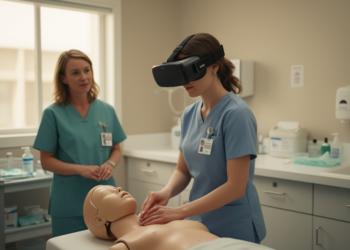
When novice healthcare assistants in Switzerland put on a head-mounted display and watched a 360-degree virtual reality recording of a botched blood draw, the most striking differences depended on whose hands were on the screen. Apprentices who reviewed footage of their own venipuncture procedure reported a markedly stronger sense of being present in the scene and rated the technology as more useful than classmates who watched an unfamiliar peer perform the same task. But the self-observers also felt significantly more anxiety, and when researchers scored how many errors each group actually caught, the two conditions were indistinguishable — and both were strikingly weak.
Those findings come from an exploratory pilot study published in Empirical Research in Vocational Education and Training, in which researchers compared two ways of using immersive 360-degree video for reflective error analysis in Swiss vocational healthcare training.
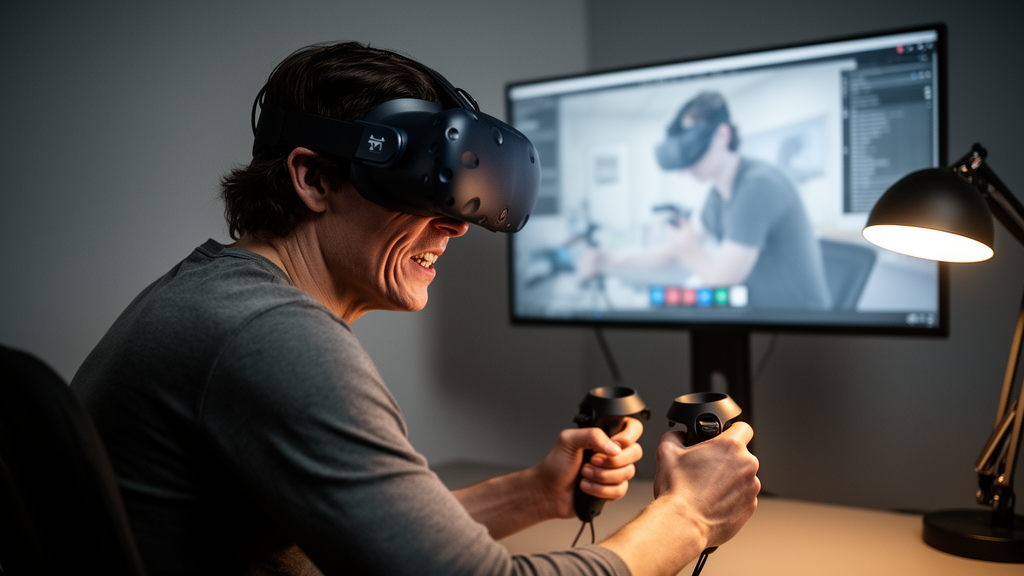
The technology behind the exercise is worth understanding on its own terms. Unlike a conventional two-dimensional camera locked into one framing, a 360-degree camera records the entire room simultaneously. Viewed through a head-mounted display — in this study, a Meta Quest 2 — the recording lets learners turn their heads and explore the scene from any angle, reducing what researchers call the keyhole effect of fixed-perspective video.
Instructors judged the overall difficulty of error identification comparable across conditions, since both depicted the kinds of mistakes novices typically make during first attempts at venipuncture.
The performance results were sobering. Participants in both groups identified roughly 2.3 errors out of the twelve embedded in their videos, a level the authors describe as generally low. Statistical tests found no detectable difference between the self- and peer-observation conditions on any of the three performance components, with effect sizes ranging from negligible to small. A sensitivity power analysis revealed why the study could not have detected subtle differences: with groups of sixteen and seventeen, the design was sensitive only to effects of around r = .46 or larger — approaching the conventional threshold for a large effect. Smaller differences may simply have gone unseen.
Where the conditions diverged was in experience, not output. Self-observers reported a significantly stronger sense of presence, with a large effect, and higher perceived usefulness of the technology, though that difference did not survive correction for multiple comparisons and should be read as exploratory. Anxiety, by contrast, was significantly higher among self-observers even after correction, with a large effect: it sat near the floor of the scale in the peer group but approached the midpoint among those watching themselves. Frustration also trended higher in the self-condition with a medium effect that fell short of the adjusted threshold. These patterns align with earlier video-based learning research suggesting that watching one’s own performance evokes negative emotions stemming from the gap between desired and observed performance, particularly for novices.
One result carried a cautionary lesson about human judgment. Self-observers rated the error-analysis task as significantly easier than peer-observers did — by more than one point on a seven-point scale — yet they performed no better. The authors suggest this may reflect an illusion of fluency: because apprentices were viewing a situation they had personally enacted, they mistook familiarity for mastery and underestimated the task’s actual demands. Their difficulty judgments may have tracked how well they knew the scene rather than how hard analyzing it truly was.
The study’s limitations frame how far its conclusions can travel. Assignment to conditions was by intact class rather than randomization, so pre-existing differences between the two classes cannot be excluded. The sample was small, the self-report instruments were translated into Italian without separate validation, and all measures of presence, emotion, and cognitive demand were retrospective self-reports rather than process measures captured during the activity. The generally low error-identification scores suggest a possible floor effect that may have blunted sensitivity to group differences. And because both conditions used 360-degree recordings, the study cannot determine whether the difficulties were specific to the immersive format or would have appeared with ordinary two-dimensional video as well.
Practically, the pilot left its mark on the training program. The task has remained part of the same branch course since the 2022 data collection, deemed feasible to implement provided an alternative — such as a desktop version of the video — exists for apprentices who experience motion sickness, which led to two exclusions in the study. But the design has been revised. Because low identification rates showed the task was too hard as administered, later cohorts now receive a list of candidate errors from which they can select. And because the substantial resources required to produce individualized self-recordings were not matched by any detectable performance gain, subsequent editions have used only the standardized peer video. The authors suggest future work compare self- and peer-observation across expertise levels, add guidance such as visual cues, vary how salient errors are, and use eye tracking to measure where learners actually direct their attention — questions that remain open as immersive technology spreads through vocational classrooms.
Subject of Research: Self- versus peer-observation of procedural errors in immersive 360-degree video virtual reality among Swiss healthcare assistant apprentices
Article Title: Analyzing one’s own and others’ errors in 360° video-based virtual reality: an exploratory pilot study in swiss vocational healthcare training
Article References: Amenduni, F., Candido, V., Cosoli, R., & Cattaneo, A. (2026). Analyzing one’s own and others’ errors in 360° video-based virtual reality: an exploratory pilot study in swiss vocational healthcare training. Empirical Research in Vocational Education and Training, 18(1), Article 14. https://doi.org/10.1186/s40461-026-00217-8
Image Credits: AI Generated
DOI: 10.1186/s40461-026-00217-8
Keywords: virtual reality, 360-degree video, vocational education, healthcare training, error analysis, venipuncture, simulation-based training, sense of presence, epistemic emotions, pilot study, Switzerland, apprentices
Cite Scienmag News
Glenn Wilkins. (October 27, 2026). Watching Yourself Fail in VR: Self-Review Raises Anxiety but Not Error-Spotting Skills. Scienmag. https://scienmag.com/watching-yourself-fail-in-vr-self-review-raises-anxiety-but-not-error-spotting-skills/
Glenn Wilkins. "Watching Yourself Fail in VR: Self-Review Raises Anxiety but Not Error-Spotting Skills." Scienmag, 27 October 2026, https://scienmag.com/watching-yourself-fail-in-vr-self-review-raises-anxiety-but-not-error-spotting-skills/. Accessed 29 October 2026.
Glenn Wilkins. "Watching Yourself Fail in VR: Self-Review Raises Anxiety but Not Error-Spotting Skills." Scienmag. October 27, 2026. https://scienmag.com/watching-yourself-fail-in-vr-self-review-raises-anxiety-but-not-error-spotting-skills/