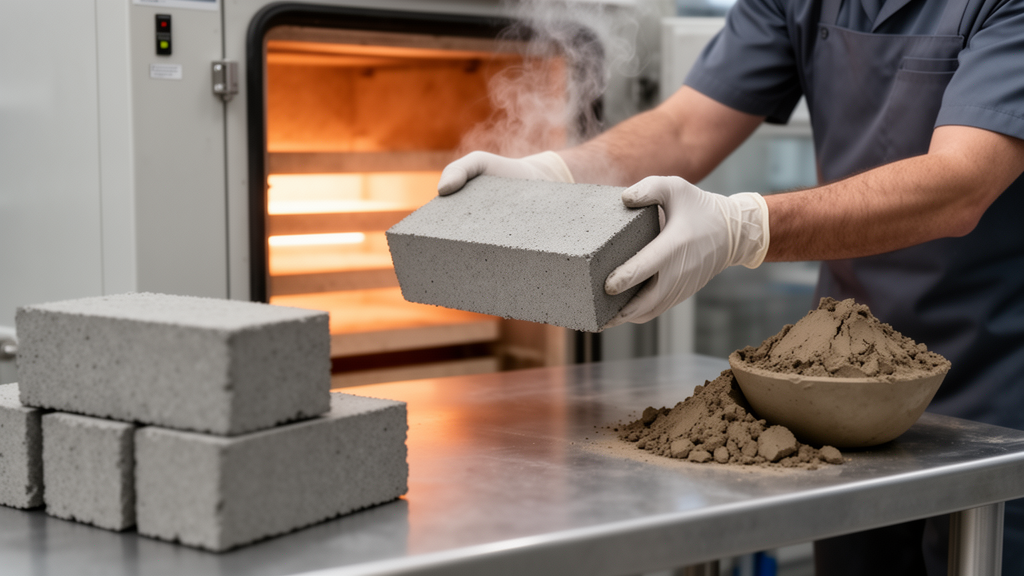
A composite soil binder made entirely from two industrial waste products—carbide slag and silica fume—can harden clay into a load-bearing material whose strength depends dramatically on the temperature at which it cures, according to a laboratory study published in Case Studies in Construction Materials. Researchers led by Yangyang Zhang of the study team found that specimens cured at 25 degrees Celsius reached an unconfined compressive strength of 6.36 megapascals after 28 days, while identical mixtures held at 5 degrees Celsius managed only 2.39 megapascals over the same period. The finding matters because real construction projects rarely enjoy the controlled, standard-temperature curing assumed in most laboratory evaluations, and the new results quantify exactly how much strength is at stake when cold weather sets in.
The team, which also included Wei Huang and Xinchi Xu, set out to address two problems at once. Conventional cement solidification of soil is a mature and widely used geotechnical technique, but cement production is energy-intensive and carbon-heavy, and cement-treated soil itself suffers from low early strength and a tendency to crack. Meanwhile, industry generates large quantities of carbide slag, a calcium-rich residue from acetylene manufacturing, and silica fume, a fine, highly reactive silica byproduct of electric arc furnace smelting. Both wastes are typically landfilled or stockpiled, occupying land and posing risks to soil, groundwater, and air. Combining them into a single curing agent offered a route to recycle both streams while replacing part of the cement demand in ground improvement.
The experimental soil was collected from roughly three meters below the ground surface at a foundation pit in Huainan City, in China’s Anhui Province. After drying, crushing, and sieving through a two-millimeter mesh, the material was classified under the unified soil classification system as a low-plasticity clay, with a natural water content of 26.2 percent, a liquid limit of 42.5 percent, and a plastic limit of 19.3 percent. X-ray fluorescence analysis showed the carbide slag was dominated by calcium oxide at 67.95 percent of its mass, while the silica fume contained 95.6 percent silicon dioxide. X-ray diffraction identified the carbide slag as mainly calcium hydroxide and calcite, and the silica fume as chiefly cristobalite.
Specimens were compacted into cylinders 39.1 millimeters in diameter and 80 millimeters tall, with the curing agent fixed at 15 percent of the dry soil mass, sodium hydroxide added at 3 percent of the agent mass as an alkaline activator, and a water-binder ratio of 0.45. Five carbide slag-to-silica fume ratios, from 1:9 to 5:5, were tested for seven-day strength at 25 degrees Celsius. Strength followed a clear parabolic pattern: 1.51, 2.11, 2.93, 3.63, and 2.74 megapascals for the five ratios in ascending carbide slag order. The 4:6 blend won decisively, and all subsequent temperature and age experiments used it. The authors attribute the optimum to a balance of chemistry: carbide slag supplies calcium that reacts with dissolved silicate from the silica fume to form calcium silicate hydrate gel, but beyond the optimum, excess unreacted calcium hydroxide accumulates and can drive localized drying shrinkage and cracking.
Temperature proved to be the dominant lever on strength. At every curing age tested—3, 7, and 28 days—strength rose steadily as curing temperature climbed from 5 to 15 to 25 degrees Celsius. After three days, the 25-degree specimens were 285.44 percent stronger than their 5-degree counterparts and 85.47 percent stronger than those held at 15 degrees. The same pattern held at the later ages, with 25-degree curing delivering gains of 164.77 and 68.37 percent over 5 and 15 degrees at seven days, and 166.33 and 66.22 percent at 28 days. The mechanism, the researchers argue, is that warmth accelerates dissolution of the binder materials and speeds the alkali-activation and pozzolanic reactions that generate the gel products responsible for binding soil particles together.
Time worked in the opposite direction of temperature in one revealing way. Strength increased continuously with curing age at all three temperatures, but the shape of the growth curve depended on the thermal environment. At 5 degrees Celsius, early strength gain was slow while later growth was substantial: 28-day strength exceeded 3-day strength by 117.37 percent and 7-day strength by 22.42 percent. At 25 degrees, early strength climbed rapidly but later gains flattened, with 28-day increases of 50.2 percent over 3 days and 23.14 percent over 7 days. The explanation offered is that cold initially suppresses hydration, leaving reactive material available to dissolve and react slowly over weeks, whereas warm conditions burn through the reactive inventory early and then slow down. For engineers scheduling work in cold seasons, this suggests low temperatures delay rather than permanently forfeit strength.
Failure behavior also shifted with temperature. Specimens cured at lower temperatures developed localized shear and tensile cracks under vertical compression, while those cured at 25 degrees displayed classic shear failure with a slightly bulging surface, dispersed cracking, and obvious plastic deformation—signs of a more ductile skeleton in which cementitious products had bonded particles into a stabler structure. The stiffness parameter E50, the tangent modulus at half the peak stress, grew with both temperature and age, rising from 46.51 to 102.17 megapascals between 3 and 28 days at 5 degrees, an increase of 119.67 percent, with corresponding gains of 96.06 and 104.50 percent at 15 and 25 degrees. Across conditions, E50 scaled roughly linearly with strength, at ratios between about 17 and 35 times the unconfined compressive strength depending on temperature.
Microstructural analysis tied these macroscopic trends to pore evolution and reaction products. Nuclear magnetic resonance measurements showed that raising temperature or extending age reduced both the number and size of pores. At seven days, total porosity fell from 21.61 percent at 5 degrees to 16.31 percent at 25 degrees, while the share of micro-fine pores below 0.1 micrometers grew from 91.91 to 96.28 percent. At 15 degrees, extending curing from 3 to 28 days cut total porosity from 31.59 to 20.18 percent, a 36.12 percent reduction, as medium and large pores progressively converted into fine ones. X-ray diffraction found the mineral assemblage—dominated by quartz and the hydrated aluminosilicate gismondine—did not change in type with temperature or age, only in intensity, with gismondine peaks strengthening as curing progressed. Scanning electron microscopy confirmed the visual contrast: loose, crack-riddled skeletons at 5 degrees versus tightly interlocked, densely cemented particle fabrics at 25 degrees, with energy-dispersive spectroscopy identifying calcium silicate hydrate gel and calcium hydroxide among the reaction products.
To condense the combined influence of temperature and age into a usable tool, the team fit a binary nonlinear regression model expressing strength as a function of both variables, achieving a coefficient of determination of 0.99, with temperature showing a strong positive correlation of 0.89 with strength and age a weaker 0.43. On the sustainability side, the accounting favored the waste binder decisively. Using standard Chinese carbon emission factors of 35, 140, and 735 kilograms of carbon dioxide per tonne for carbide slag, silica fume, and cement respectively, the carbon intensity per unit strength of the 4:6 blend came to 4.05 kilograms per megapascal, compared with 75.53 for a 15 percent cement-treated soil whose strength was only 1.52 megapascals—a 94.6 percent reduction. The authors note that their next phase will add control groups of carbide slag alone, silica fume alone, and cement under identical curing conditions, and will examine drying shrinkage, cracking behavior, and long-term volume stability, since the present work did not include those comparisons.
Subject of Research: Laboratory study of how curing temperature and age affect the strength, pore structure, and solidification mechanism of clay treated with a carbide slag and silica fume composite binder.
Article Title: Effect of curing temperature on mechanical properties and solidification mechanism of carbide slag-silica fume composite solidified clay
Article References: Zhang, Y., Huang, W., & Xu, X. (2026). Effect of curing temperature on mechanical properties and solidification mechanism of carbide slag-silica fume composite solidified clay. Case Studies in Construction Materials, 25, Article e06648. https://doi.org/10.1016/j.cscm.2026.e06648
Image Credits: AI Generated
DOI: 10.1016/j.cscm.2026.e06648
Keywords: carbide slag, silica fume, soil solidification, curing temperature, unconfined compressive strength, industrial waste recycling, low-carbon binder, clay stabilization, pozzolanic reaction, porosity, carbon emissions, geotechnical engineering
Cite Scienmag News
Denise Maddox. (October 29, 2026). Warm Curing Supercharges Waste-Based Binder That Turns Clay Into Construction Material. Scienmag. https://scienmag.com/warm-curing-supercharges-waste-based-binder-that-turns-clay-into-construction-material/
Denise Maddox. "Warm Curing Supercharges Waste-Based Binder That Turns Clay Into Construction Material." Scienmag, 29 October 2026, https://scienmag.com/warm-curing-supercharges-waste-based-binder-that-turns-clay-into-construction-material/. Accessed 29 October 2026.
Denise Maddox. "Warm Curing Supercharges Waste-Based Binder That Turns Clay Into Construction Material." Scienmag. October 29, 2026. https://scienmag.com/warm-curing-supercharges-waste-based-binder-that-turns-clay-into-construction-material/