

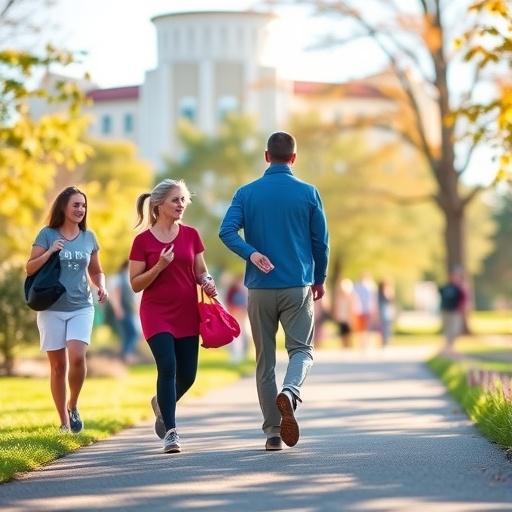
In a comprehensive exploration of physical activity patterns across metropolitan divides, a new study sheds light on the nuanced preferences of U.S. adults during their leisure time and how these habits align with nationally recommended physical activity guidelines. Conducted by Christiaan Abildso and colleagues at West Virginia University, this research meticulously analyzes data collected from nearly 400,000 adults in 2019, revealing significant disparities between rural and urban populations. The study, freshly published in the open-access journal PLOS One, not only highlights walking as the predominant activity across all settings but also underscores important differences that may inform targeted public health strategies.
The prominence of walking as the leading form of physical activity echoes findings from previous national surveys, confirming its status as a cornerstone of leisure-time exercise. However, the investigators reveal a striking paradox: although walking is the most frequently practiced activity, only about one-quarter of those who consider it their primary exercise meet the comprehensive physical activity guidelines set by the U.S. Department of Health and Human Services. These standards emphasize a dual approach, recommending at least 150 minutes of moderate-intensity aerobic exercise weekly alongside two or more days dedicated to muscle-strengthening activities. Alarmingly, a significant segment of walkers reported engaging in activities far below these thresholds, suggesting a gap between engagement and efficacy.
Delving further into the metropolitan distinctions, the research highlights divergent leisure pursuits that reflect cultural, environmental, and possibly socioeconomic factors inherent to urban and rural lifestyles. Rural adults tend to gravitate towards activities intimately tied to their environments—gardening, hunting, fishing, and farm work prevail among this cohort. These activities, while physically engaging, may not consistently satisfy the rigorous intensity or muscle-strengthening components prescribed by federal guidelines. In contrast, urban residents exhibit preferences for running, weightlifting, cycling, and dance, activities more commonly associated with deliberate fitness regimens.
The disparity in physical activity levels extends beyond mere preferences. Quantitative analyses indicate that urban residents surpass their rural counterparts in meeting aerobic and muscle-strengthening recommendations. This divergence is particularly consequential given the mounting evidence linking physical inactivity with higher risks of chronic diseases, including cardiovascular conditions, diabetes, and certain cancers. The findings intimate that rural populations are disproportionately burdened, potentially due to limited access to exercise facilities, less infrastructural support, or cultural norms less conducive to regular, structured physical activity.
Critically, these insights carry profound implications for public health policy and intervention design. By elucidating the specific activities favored within distinct communities, health practitioners and policymakers can tailor initiatives that resonate culturally and practically. For instance, enhancing rural infrastructure to facilitate safer and more accessible walking, running, or cycling routes may bridge existing gaps. Equally, supporting programs that integrate traditional rural activities with strength-building elements could optimize engagement and health outcomes without disregarding cultural authenticity.
The research methodology itself embodies rigorous analytical standards, utilizing a nationally representative telephone survey conducted in 2019 that captures a broad spectrum of 75 leisure-time physical activity options. This expansive approach enables a granular understanding of behaviors rather than relying on generalized activity metrics. It also allows parsing out complex patterns within subpopulations defined by geographic locality—urban versus rural—that are often obscured in aggregate data.
This cross-sectional observational study outlines limitations inherent to its design, notably reliance on self-reported data which may introduce recall bias or social desirability effects. However, given the unprecedented sample size and the breadth of activity types assessed, the study’s findings offer a robust foundation for subsequent longitudinal and intervention studies. The authors advocate for contemporary analyses incorporating data collected post-COVID-19, anticipating shifts in exercise habits induced by pandemic-related lifestyle changes.
An intriguing facet of the research is the consideration of environmental and social determinants that may shape physical activity patterns. Abildso emphasizes the importance of creating enabling environments through infrastructural modifications—ranging from the addition of wide shoulders on rural roads for safe running and cycling, to enhancing senior centers’ capacity for chair exercise programs. Such multi-sectoral efforts extend beyond healthcare into urban planning, transportation, and community development.
The study’s revelations also highlight a critical health equity concern: structural and systemic barriers that may impede rural residents’ ability to achieve recommended activity levels. The authors call for sustained investment and partnership with small towns and rural regions to foster supportive social and cultural milieus. Initiatives like repurposing abandoned spaces (Brownfields) into vibrant physical activity hubs, maintaining open access to school sporting facilities, and expanding recreational trail networks signify practical pathways toward this goal.
Christiaan Abildso’s reflections poignantly underscore an emerging paradox—widespread participation in walking does not necessarily translate into health-beneficial activity sufficient to meet established guidelines. This discrepancy mandates a reevaluation of public health messaging and program design to not only promote activity engagement but also encourage the intensity and diversity of exercise essential for optimal health.
The implications of this research traverse individual behavior and community infrastructure, reinforcing that physical activity promotion must transcend mere exhortations. Integrating culturally sensitive, contextually relevant strategies that account for geographic disparities holds promise for mitigating the well-documented rural-urban health divide. As physical inactivity remains a formidable public health challenge, such data-driven, tailored approaches could catalyze meaningful improvements in population health outcomes.
In conclusion, the 2026 study published in PLOS One offers a pivotal contribution to understanding leisure-time physical activity across the United States. Its compelling findings articulate how commonplace activities like walking, while ubiquitous, may fall short of recommended thresholds, particularly in rural settings. By illuminating the spectrum of leisure preferences and their associations with physical activity guidelines, this research sets the stage for innovative, location-specific interventions that could recalibrate the nation’s approach to physical health promotion in the coming years.
Subject of Research: People
Article Title: Adults’ leisure-time physical activity preferences and association with physical activity guidelines by metropolitan status, United States, 2019
News Publication Date: 1-Apr-2026
Web References:
http://dx.doi.org/10.1371/journal.pone.0345026
References:
Abildso CG, Fitzhugh EC, Beck AM, Johnson A, Maruca DL, Meyer SM, et al. (2026) Adults’ leisure-time physical activity preferences and association with physical activity guidelines by metropolitan status, United States, 2019. PLoS One 21(4): e0345026.
Image Credits:
Credit: Christiaan Abildso, CC-BY 4.0
Keywords:
Physical activity, leisure-time exercise, urban-rural disparities, walking, aerobic guidelines, muscle-strengthening exercises, public health, physical inactivity, health equity, rural health, urban health, infrastructure


