


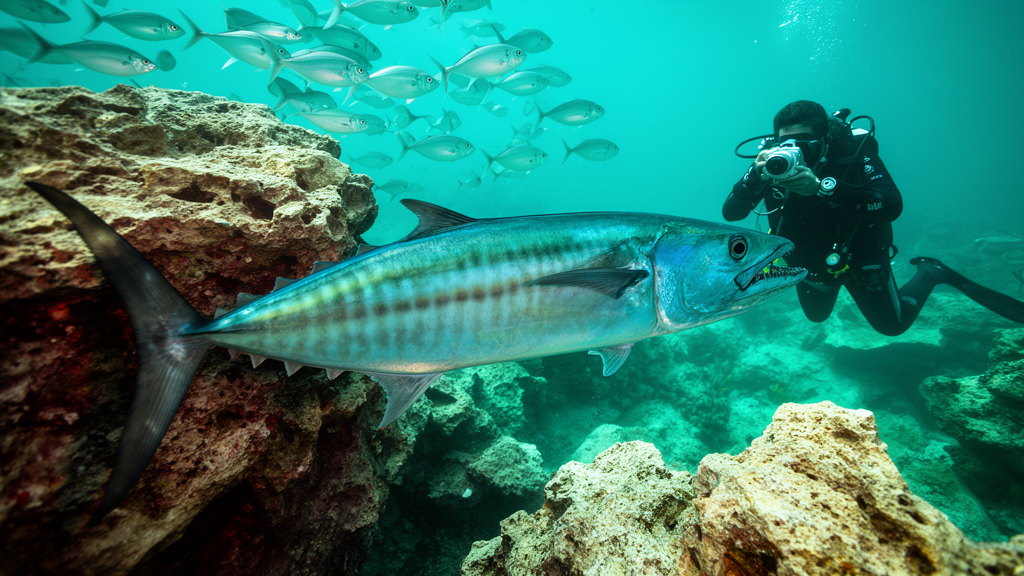
Two immature male wahoo, Acanthocybium solandri, were documented in Maltese waters in October and November 2024, establishing the first confirmed record of the species around Malta. The captures are notable because wahoo is a circumglobally distributed tropical and subtropical scombrid that occurs only occasionally in the Mediterranean. Researchers examined the two fish through external measurements, meristic characters and dissection, and investigated their stomach contents and parasites to clarify identification and assess whether the parasite assemblage could provide clues about the fish’s origin. The records add wahoo to the known marine-fish diversity of the Maltese archipelago and extend the mapped distribution of the species in the central Mediterranean.
Specimen A was caught on 16 October 2024 by a professional fisherman off Malta at 35.2503° N, 13.5846° E, at a reported depth of 518 metres. The fish was associated with a fishing aggregation device, or FAD, deployed for catching Coryphaena hippurus, known in Malta as lampuki or lampuka, and was then encircled at the surface with a boat seine net. Specimen B was caught on 15 November 2024 at an approximate location 42 nautical miles southwest of Malta and an estimated depth of 350 metres. It was taken by trolling with an artificial lure attached to a feather, close to lampuki FADs. A few weeks before the second capture, fishermen reported seeing five or six similar fish swimming near the surface, although the study did not verify those sightings as wahoo.
Both fish were brought to the laboratory, photographed, measured and weighed. Identification and measurement followed established methods and reference descriptions for the species. Sex and gonadal maturity were assessed during dissection by macroscopic observation. Specimen A had a total length of 57.8 centimetres and weighed 1,227 grams, whereas specimen B measured 61.2 centimetres and weighed 1,043 grams. Both were classified as immature males. Fork lengths were 56.5 and 59.4 centimetres, and head lengths were 12.1 and 12.5 centimetres. In proportional terms, the two fish were similar across most measured characters, despite the second individual being longer and the first weighing more.
The specimens had the diagnostic body form and fin structure of A. solandri. Their bodies were elongate, fusiform and only slightly compressed. Each had a large mouth with strong triangular teeth set in a single series, a pointed snout approximately as long as the remainder of the head, and no gillrakers. The posterior part of the maxilla was concealed beneath the preorbital bone, the body was covered with small scales, and a single lateral line curved downward beneath the first dorsal fin. The caudal peduncle was slender and carried a well-defined lateral keel between two smaller keels on each side. A swim bladder was present, and the fishes lacked an anterior corselet. After death, their backs were bluish dark, their snouts silvery dark and their sides silvery with more than 20 dark-grey vertical bars, some doubled or Y-shaped. Their fins were dark, while the tips of the caudal lobes were whitish.
Meristic counts were consistent between the two fish in most major structures. Specimen A had 26 rays in the first dorsal fin and specimen B had 25; both had 11 rays in the second dorsal fin followed by nine finlets. Their anal fins had 12 and 11 rays, respectively, followed by nine finlets. Both had five ventral-fin rays in addition to the first ray and a bifid inter-pelvic process. Pectoral-fin counts were 21 in specimen A and 23 in specimen B, and the caudal fins were each estimated to contain approximately 50 rays. Selected measurements expressed as percentages of total length also showed broad agreement, including head length at 20.9% and 20.4%, mouth length at 11.3% and 11.1%, and body depth at 14.5% and 11.9%.
Careful identification is important because the wahoo resembles the narrow-barred Spanish mackerel, Scomberomorus commerson, a Lessepsian migrant that entered the Mediterranean through the Suez Canal and is frequently caught in Levantine waters. The two species can be separated by several anatomical characters. Wahoo lack gillrakers, conceal the posterior end of the maxilla, possess a snout about as long as the rest of the head, and have a lateral line that curves downward under the first dorsal fin. In S. commerson, the gillrakers are present, the posterior maxilla is exposed, the snout is shorter than the remainder of the head, and the lateral line bends below the end of the second dorsal fin. The morphology and proportional measurements of the Maltese specimens matched those reported for earlier Mediterranean wahoo records.
The Maltese fish are the smallest wahoos yet reported from the Mediterranean. Previously captured Mediterranean specimens had total lengths of 90 to 144 centimetres and weights of 4 to 26 kilograms, compared with total lengths of 57.8 and 61.2 centimetres and weights just above one kilogram for the new records. The earlier specimens came from varied fishing methods, including a tuna trap near Palermo, harpoons in the Strait of Messina, tuna and mackerel nets in Lebanon, a rod and reel in Antalya, and an underwater spear gun in İskenderun Bay. Most of the Mediterranean captures were from Sicily and Turkey during summer; the Lebanese fish was caught in January 2024. The two Maltese specimens were captured in autumn near FADs used in a traditional Maltese method of fishing for pelagic fish.
Wahoo is an epipelagic oceanic predator distributed in tropical and subtropical waters of the Atlantic, Indian and Pacific oceans, as well as the Caribbean and Mediterranean. It generally occurs at depths below 200 metres and feeds near the surface on pelagic fishes, cephalopods and crustaceans. The species can reach a maximum fork length of 210 centimetres and a weight of 96 kilograms. It is an important commercial and recreational fishery species in many tropical oceans and is also encountered as longline bycatch. Within the Mediterranean, however, wahoo remains uncommon, and most historical records are isolated occurrences rather than evidence of a persistent local population. The Maltese captures therefore document presence at a new location but do not establish a resident Mediterranean population.
How the Maltese fish entered the Mediterranean remains uncertain. A specimen collected near Palermo in 1872 was initially described as Cybium verany and was later identified as A. solandri. Subsequent records included the Strait of Messina in 1990 and 2004, Libyan waters, Lebanese waters in 2024, and locations off Antalya and İskenderun in Turkey. An Atlantic origin through the Strait of Gibraltar was considered likely for the early individual, but wahoo has since been confirmed in the Red Sea, including the Gulf of Aqaba and Saudi Arabian waters. A more recent introduction through the Suez Canal therefore cannot be excluded for at least some Mediterranean records, particularly those in the Levantine Sea. The study also considered increased fishing effort, fair weather, exceptionally high Mediterranean seawater temperatures during 2023 and 2024, and the rapid circulation of social-media reports as possible contributors to the greater number of observed records in 2024; these factors were proposed as explanations rather than demonstrated causes.
Parasite examination provided a limited biological marker for the newly documented fish. The stomach of specimen A contained two nematode larvae from the family Anisakidae together with remains of digested fishes. Specimen B contained eight specimens of the pteropod Cavolinia tridentata, a widely distributed species found in the Atlantic, Pacific and Mediterranean. Tentative morphological examination was combined with mitochondrial cytochrome c oxidase subunit II analysis. Both larvae showed more than 99.5% sequence identity and more than 99% query coverage with reference sequences of Anisakis pegreffii in GenBank. The resulting 608-base-pair consensus sequence was deposited under accession number PQ686358. The identification also constituted a new host record for A. pegreffii, adding a species to the limited parasite catalogue associated with wahoo in the Mediterranean.
The parasite evidence was interpreted cautiously because only two worms were recovered from one of the two fish. Anisakis pegreffii is the most common species of its genus in the Mediterranean and matures in the gastric chambers of toothed whales, with crustaceans and small fishes serving as intermediate hosts and many fishes and cephalopods acting as paratenic hosts. The study noted that newly introduced hosts may carry fewer parasites than established populations because their usual intermediate hosts can be absent and local hosts may not yet have become infected. In wahoo, anisakid species are usually located in or on viscera of the body cavity. The two larvae were free within the gastric lumen rather than embedded in visceral tissues, which the authors regarded as consistent with recent acquisition. This interpretation does not by itself determine where the Maltese fish originated, but it supports the broader use of parasite composition and infection location as a possible biological tag for investigating movements of a newly arrived marine predator.
Subject of Research: First documented wahoo occurrence in Maltese waters, based on two immature male specimens and parasite analysis.
Article Title: Acanthocybium solandri ( Actinopterygii , Scombriformes , Scombridae ) first record from Malta with notes on using its parasites as biological tags
Article References: Deidun, A., Corsini-Foka, M., Marrone, A., Insacco, G., Schembri, J. P., Sciberras, A., Santoro, M., Occhibove, F., Di Natale, A., & Zava, B. (2025). Acanthocybium solandri (Actinopterygii, Scombriformes, Scombridae) first record from Malta with notes on using its parasites as biological tags. Acta Ichthyologica et Piscatoria, 55, 11-17. https://doi.org/10.3897/aiep.55.143882
Image Credits: AI Generated
Keywords: wahoo, Acanthocybium solandri, Maltese waters, Mediterranean Sea, Anisakis pegreffii, parasite biological tags, fish morphology, scombrid fishes, marine-fish diversity, Fishing Aggregated Devices, Acanthocybium, solandri
Cite Scienmag News
Margaret Porter. (October 20, 2026). Wahoo Recorded in Malta for the First Time. Scienmag. https://scienmag.com/wahoo-recorded-in-malta-for-the-first-time/
Margaret Porter. "Wahoo Recorded in Malta for the First Time." Scienmag, 20 October 2026, https://scienmag.com/wahoo-recorded-in-malta-for-the-first-time/. Accessed 20 October 2026.
Margaret Porter. "Wahoo Recorded in Malta for the First Time." Scienmag. October 20, 2026. https://scienmag.com/wahoo-recorded-in-malta-for-the-first-time/


