


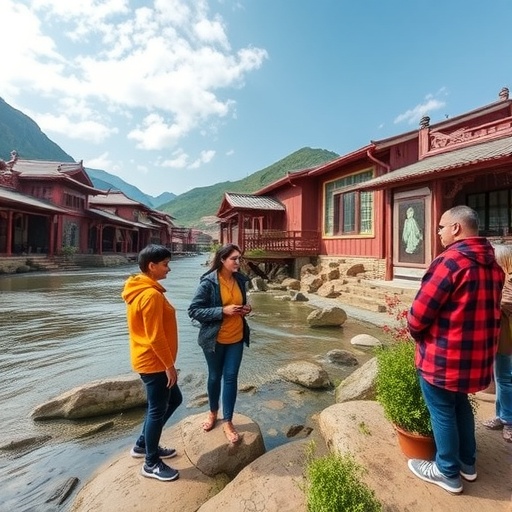
In an innovative study that bridges the gap between technology and cultural education, researchers have explored a groundbreaking model of Yellow River cultural education utilizing virtual reality (VR) photography exhibitions. This contemporary approach is poised to transform the way that educational institutions present and disseminate cultural heritage, drawing attentiveness to one of China’s most famed geographical landmarks. The Yellow River, often referred to as the cradle of Chinese civilization, holds immense historical and cultural significance, and the integration of VR technology strives to enhance engagement and interaction among audiences.
VR technology has moved to the center stage of educational methodologies, providing immersive experiences that traditional formats cannot match. By employing VR photography, the study delves into the vibrant narrative of the Yellow River, offering users a digital window into its landscapes, historical milestones, and cultural richness. This format invites participants to explore a digitally reconstructed environment that showcases the Yellow River’s diverse heritage while simultaneously enriching their understanding of its importance in shaping Chinese identity and history.
The research underscores the pressing need to modernize educational paradigms, especially those dealing with complex cultures and histories. By utilizing VR as an instructional tool, educators can present the multifaceted stories surrounding the Yellow River. This is particularly crucial in a time when attention spans are dwindling and interest in traditional educational formats is waning. The VR model acts as a compelling alternative that is interactive, engaging, and far more likely to resonate with younger generations accustomed to digital interactivity.
In this exploratory study, Yang and Jamaludin discuss the structural design and operational framework of a VR education model focused on the Yellow River. This model does not merely replicate existing educational resources; it aims to create a fully immersive educational experience. Students are expected to navigate through scenes captured via high-resolution photography, while guided narratives unfold, providing invaluable context and insights into the importance of each landmark or event portrayed.
Educational efficacy is a critical focus in this research, and the authors evaluate how VR content can enhance cognitive engagement and retention. By comparing traditional educational methodologies with the proposed VR approach, they illustrate significant improvements in students’ abilities to recall and relate to cultural touchstones. The interactivity offered by VR experiences encourages learners to engage actively with the material, fostering a deeper connection to the subject matter.
Critically, this research opens up discussions surrounding accessibility in education. The integration of VR in cultural education can serve diverse demographics, including those who may not have the opportunity to physically visit cultural sites. By making the Yellow River’s rich history accessible through VR, the researchers lay the groundwork for a more inclusive educational environment that transcends geographical boundaries.
The model reflects a shift toward student-centered learning, where students are not passive recipients of information but active participants in their educational journey. Empowering learners to explore, interact, and create personal narratives around cultural experiences enhances their critical thinking and analytical skills. This, in turn, reflects modern educational ideals that advocate for a stronger focus on experiential learning and real-world applications of knowledge.
Implementation of this educational model, however, is not without its challenges. The study highlights the necessity of investing in technological infrastructure and training educators to effectively deliver VR content. As educational institutions strive to integrate cutting-edge technology into their curricula, the researchers stress that careful planning and resource allocation are crucial to the success of this transformative initiative.
The broader implications of using VR in cultural education reach far beyond the Yellow River. While this study specifically targets one of China’s most significant waterways, the adaptability of the VR model allows for application to various cultural contexts around the world. Such a framework can enhance cultural dissemination globally, preserving the rich tapestry of human history and facilitating greater intercultural understanding.
Furthermore, as technology continues to evolve, the fusion of VR with artificial intelligence presents exciting possibilities for the future of cultural education. With AI-driven algorithms refining user experiences and personalizing content delivery based on user interactions, the educational potential is limitless. The prospect of blending VR with adaptive learning systems propels cultural education into a future where learning is not just informative but transformative.
Ultimately, the exploration of a new model of Yellow River cultural education through VR photography exhibitions signifies a critical evolution in how cultural heritage can be shared and taught. It aligns with contemporary educational demands for innovation and relevance while honoring the historical significance of one of China’s most vital symbols. This research is a clarion call for educators, policymakers, and cultural institutions alike to embrace technological advancements that foster engagement and appreciation for the rich narratives of cultural history.
As we move forward into an increasingly digital age, the findings of this research hold essential lessons, not only for educational practices but also for how societies value and preserve their cultural legacies. In a world where digital experiences are becoming central to our lives, the potential for VR-based education to enrich our understanding of our past, our cultures, and ultimately ourselves cannot be overstated. Through such innovations, we take a significant step toward nurturing a society that values education, technology, and cultural heritage in equal measure.
The study conducted by Yang and Jamaludin is a pioneering effort that signifies the intersection of culture, technology, and education. It highlights a future where learners can engage dynamically with their heritage, offering them a richer understanding of their identity and the histories that shape the landscapes of their world.
Through immersive experiences that VR technology provides, we not only revisit the past but also prepare for a future where respect for cultural narratives is deeply ingrained in education. This transformative vision of cultural education is not just about making learning more entertaining; it’s about embedding cultural consciousness within educational standards, ensuring that future generations inherit a profound appreciation for their heritage and the legacies of those who came before them.
Yang, H., Jamaludin, K.A. Exploration of a new model of Yellow River cultural education based on VR photography exhibitions.
Discov Educ 4, 420 (2025). https://doi.org/10.1007/s44217-025-00875-y
Cite Scienmag News
Courtney Benton. (October 15, 2025). VR Photography Enhances Yellow River Cultural Education. Scienmag. https://scienmag.com/vr-photography-enhances-yellow-river-cultural-education/
Courtney Benton. "VR Photography Enhances Yellow River Cultural Education." Scienmag, 15 October 2025, https://scienmag.com/vr-photography-enhances-yellow-river-cultural-education/. Accessed 4 September 2026.
Courtney Benton. "VR Photography Enhances Yellow River Cultural Education." Scienmag. October 15, 2025. https://scienmag.com/vr-photography-enhances-yellow-river-cultural-education/


