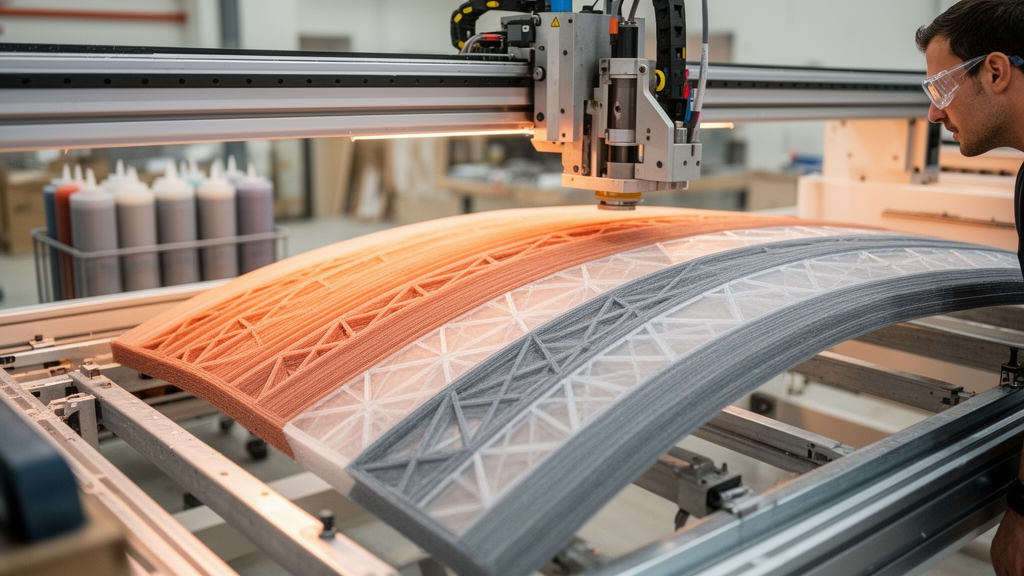
The process, called simulation-to-design-to-voxel-3D-printing (S-D-VP), was developed by Samuel Esses and Kostas Grigoriadis and published in the journal Architectural Intelligence. It culminated in a voxel-printed architectural model measuring 242 × 136 × 194 mm, in which structural reinforcement, ventilation channels and graded transparency are fused into one continuous volume of photopolymer resin.
The core idea is deceptively simple but technically demanding: instead of designing a facade as a set of discrete components that are later assembled, the team treats the entire envelope as a single, materially continuous object in which every point can carry its own material properties. ‘Multi-material’ here means two or more materials fused into a continuously graded arrangement, made possible by Stratasys’ PolyJet liquid photopolymer technology, which defines material properties at each individual voxel — the three-dimensional equivalent of a pixel — throughout the volume of a part.
The facade geometry itself was not drawn from scratch. It builds on a previous optimisation study by Abdelaziz and colleagues, which used a Non-dominated Sorting Genetic Algorithm II to search roughly 8.5 quadrillion possible solutions balancing three objectives: reducing summer solar radiation, maximising winter solar gain and minimising structural displacement. That process produced 16 optimal facade solutions, and the south-oriented option — 8 m tall, 10.5 m wide and 6 m deep — showed a 25.94% improvement in Useful Daylight Illuminance compared with a typical uniform curtain wall, achieved through a graded transmittance distribution in a multi-property PETG material. That optimised form, together with its whole-year solar radiation heatmap, became the starting point for the new workflow.
With the base geometry fixed, the team turned to topology optimisation (TO) to work out where reinforcement should go. Using the SIMP method in the generative design software nTopology, they thickened the base surface into a finite element mesh, assigned PETG as the material, applied a global gravity load and defined six support regions. Thirty-two load regions of 1 kN each were placed according to the stress distribution from an earlier Karamba3D analysis, with denser point placement in areas of higher stress. The optimisation was constrained to a volume fraction of 0.1, meaning the reinforcing structure was targeted at just 10% of the design space — chosen because it minimised the optical disruption the reinforcement would cause when seen through the transparent facade, while test studies showed that lower values did not produce a viable, structurally continuous geometry.
The results were evaluated qualitatively rather than through load testing, since the study is explicitly workflow-oriented design research rather than a structural engineering study. Static analyses in nTop showed an overall reduction in Von Mises stress when the TO form was merged with the base surface, with higher stress concentrations at the support regions of the original geometry reduced in the modified version. A displacement analysis showed that the TO form significantly reduced movement compared with the unreinforced facade, and a second optimisation on the interior side produced an even stiffer combined result. The displacement values, ranging from 0.0 to 0.243 m across 10,474 mesh vertices, were then fed into a lattice generator, so that regions undergoing greater displacement received thicker lattice members — a structural ‘tattoo’ whose thickness map is itself a legible record of structural behaviour.
Ventilation was handled with the same optimisation logic. Because sharp angles disrupt continuous airflow, the team used topology optimisation to generate the air circulation network itself, producing three design options of increasing geometric complexity. Each was evaluated with computational fluid dynamics simulations against qualitative criteria: constant air flow velocity, continuous linear streamlines, and the maximum amount of ductwork containing streamlines. Notably, all geometry had to be scaled down to 1% of its original size because full-scale simulations exceeded the available computing hardware, so the CFD values should not be read as 1:1 figures. The winning configuration, CFD_03_01, placed air inlets at the top and produced the highest airflow velocities of all options, with effective circulation throughout the network except for one central zone at the top, which was judged redundant and removed from the geometry.
Integrating the two systems revealed a familiar architectural tension: cutting ventilation voids into the envelope weakened it, but embedding the TO reinforcement brought the stresses back down. A final static analysis compared three states — the base surface alone, the base surface with ventilation voids, and the base surface with voids plus the embedded TO geometry — and showed that the stress distribution became visibly more extensive when voids were introduced, then visibly reduced again once the reinforcement was embedded. The fully reinforced option was selected for fabrication.
Translating this design into a printable object required solving a genuine software gap. Commercial CAD tools remain largely built on boundary representations that assign one homogeneous material per closed volume, which is inadequate for graded, heterogeneous material distributions, and standalone slicer tools that convert CAD data into the bitmap stacks required for voxel printing are scarce. The team therefore built a custom bitmap-generation slicer in Python. The design was modelled in the VFX software Houdini, whose native OpenVDB library enables volumetric modelling, and converted into a point cloud with 0.15 mm spacing containing 71,205,790 points. Each point stored position, colour and alpha values, with solar radiation data mapped to variable transmittance and structural displacement data mapped to colour across the lattice. Because fully transparent zones could be defined by the mesh boundary alone, points with an alpha value of zero were removed, cutting the dataset by 87.66% to 8,786,055 points.
The slicer converted this data into a stack of 7,202 PNG slices at a 0.027 mm layer height, combining voxel-derived colour and transparency data with a high-resolution mesh contour of each cross-section to preserve surface detail. The images were then dithered with the Floyd–Steinberg algorithm down to six discrete RGB values corresponding to the six materials loaded in the Stratasys J750 printer — VeroClear, VeroPureWhite, VeroBlack, VeroYellowVivid, VeroMagentaVivid and VeroCyanVivid — and processed through GrabCAD’s Voxel Print Utility into printer instructions. Before committing to the full facade, the team validated the pipeline with a small functionally graded gyroid print, 80 × 30 × 11 mm, blending transparent VeroClear with the rubber-like Agilus30, demonstrating continuous variation of optical and mechanical properties through the part’s volume — a level of material control the authors note would be difficult to replicate by splitting a model into discrete parts.
The printed facade model confirmed the feasibility of the approach while exposing its limits. Banding artefacts appeared where gradients transitioned from fully opaque to fully transparent — artefacts absent from the initial design renders but visible in the pre-print volumetric renderings, and therefore anticipated in the final print. Follow-up studies on a small segment showed that removing VeroPureWhite from the dithering step eliminated the banding, at the cost of a more translucent print and the loss of fully opaque zones, though the authors stress this is not a comprehensive solution. The team also printed representative pathways for electrical services within the volume, purely illustrative at this stage, and has begun initial full-scale extrusion tests of facade segments in PETG. The authors are careful about scope: PolyJet build volumes remain far too small for full-scale construction, the simulations served as exploratory design inputs rather than validation tools, and a fully functional prototype with integrated material, airflow and structural testing remains future work. What the study demonstrates now is that structural, ventilation and daylight requirements can be integrated within a single continuous multi-material envelope, and that simulation-derived data can be translated directly into voxel-level material instructions through an accessible, custom-built pipeline.
Subject of Research: A simulation-to-design-to-voxel-3D-printing workflow for a multi-material building facade with integrated shading, reinforcement and ventilation
Article Title: A simulation to design and voxel 3D printing (S-D-VP) workflow: multi-material integrated facade 2
Article References: Esses, S., & Grigoriadis, K. (2026). A simulation to design and voxel 3D printing (S-D-VP) workflow: multi-material integrated facade 2. Architectural Intelligence, 5(1), Article 28. https://doi.org/10.1007/s44223-026-00135-5
Image Credits: AI Generated
DOI: 10.1007/s44223-026-00135-5
Keywords: 3D printing, voxel printing, multi-material additive manufacturing, building facade, topology optimisation, CFD, PolyJet, architecture, solar shading, ventilation, digital fabrication, slicer software
Cite Scienmag News
Denise Maddox. (October 28, 2026). Voxel 3D printing turns simulation data into a multi-material building facade. Scienmag. https://scienmag.com/voxel-3d-printing-turns-simulation-data-into-a-multi-material-building-facade/
Denise Maddox. "Voxel 3D printing turns simulation data into a multi-material building facade." Scienmag, 28 October 2026, https://scienmag.com/voxel-3d-printing-turns-simulation-data-into-a-multi-material-building-facade/. Accessed 5 November 2026.
Denise Maddox. "Voxel 3D printing turns simulation data into a multi-material building facade." Scienmag. October 28, 2026. https://scienmag.com/voxel-3d-printing-turns-simulation-data-into-a-multi-material-building-facade/